Natural Selection and Evolution
Variation
Individuals within a species are not identical — they show variation. Some variation is genetic (caused by different alleles, e.g. blood type), some is environmental (caused by living conditions, e.g. a scar), and much is a combination of both (e.g. height is influenced by genes but also by diet). Genetic variation arises through mutations (random changes in DNA), meiosis (shuffling of chromosomes during gamete formation) and sexual reproduction (combining alleles from two parents) (B5.2a).
Variation within a population is essential for natural selection because it provides a range of characteristics on which selection can act. Without variation, all individuals would be equally suited (or unsuited) to their environment.
Variation can be genetic, environmental or both. Genetic variation comes from mutations, meiosis and sexual reproduction. Variation is essential for natural selection to occur.
Darwin’s Theory of Natural Selection
Charles Darwin proposed that species evolve through natural selection (B5.2c). The theory works in four steps:
1. Within a population, individuals show variation in their characteristics.
2. Individuals compete for limited resources such as food, water and mates.
3. Those with characteristics best suited to the environment are more likely to survive and reproduce — this is ‘survival of the fittest’.
4. The advantageous alleles are passed to offspring, so over many generations the proportion of individuals with the beneficial trait increases.
Speciation occurs when populations of the same species become geographically or reproductively isolated. Over time, different environmental pressures and random mutations cause the two groups to evolve differently. Eventually, they become so genetically different that they can no longer interbreed to produce fertile offspring — they are now separate species (B5.2d).
Extinction occurs when a species cannot adapt quickly enough to environmental changes. Causes include climate change, new predators or competitors, new diseases, habitat destruction and catastrophic events (e.g. volcanic eruptions, asteroid impacts). The fossil record provides evidence of past extinctions and shows that the vast majority of species that have ever lived are now extinct.
Natural selection: variation → competition → survival of the fittest → advantageous alleles passed on. Over many generations, this changes species — this is evolution.
Evidence for Evolution
Key evidence for evolution includes the fossil record (showing gradual changes in organisms over millions of years), comparative anatomy (similar bone structures in different species, suggesting common ancestry) and DNA analysis (closely related species share more DNA sequences). Darwin’s observations of finch beak shapes on the Galápagos Islands remain a classic example of natural selection in action (B5.2e).
Another well-known example is the peppered moth during the Industrial Revolution. Before industrialisation, light-coloured moths were well camouflaged on pale, lichen-covered trees. Dark (melanic) moths were rare because they were easily spotted by predators. As pollution killed lichens and darkened tree bark with soot, dark moths gained the advantage — they were better camouflaged and survived in greater numbers. When the Clean Air Acts reduced pollution, the light form became dominant again. This demonstrates natural selection responding to environmental change within observable timescales.
The theory of evolution by natural selection was independently proposed by both Charles Darwin and Alfred Russel Wallace in the mid-19th century. While Darwin is more famous, Wallace reached similar conclusions from his own fieldwork in Southeast Asia. Their joint paper was presented to the Linnean Society in 1858.
Darwin’s theory was controversial at the time because it contradicted the prevailing religious belief in creation. Today, the evidence from fossils, DNA, comparative anatomy and observed examples (such as antibiotic resistance) makes evolution one of the most strongly supported theories in biology.
It is important to note that individual organisms do not evolve — populations evolve over many generations as the frequency of advantageous alleles increases. Evolution has no direction or goal; it simply reflects which traits happen to be best suited to the current environment. A trait that is advantageous in one environment may become disadvantageous if conditions change.
Antibiotic resistance is a modern example of natural selection. When a population of bacteria is exposed to an antibiotic, most die. However, random mutations may have given some bacteria resistance. These resistant individuals survive, reproduce rapidly and pass on the resistance allele. Over time, the resistant strain becomes dominant (B5.2e).
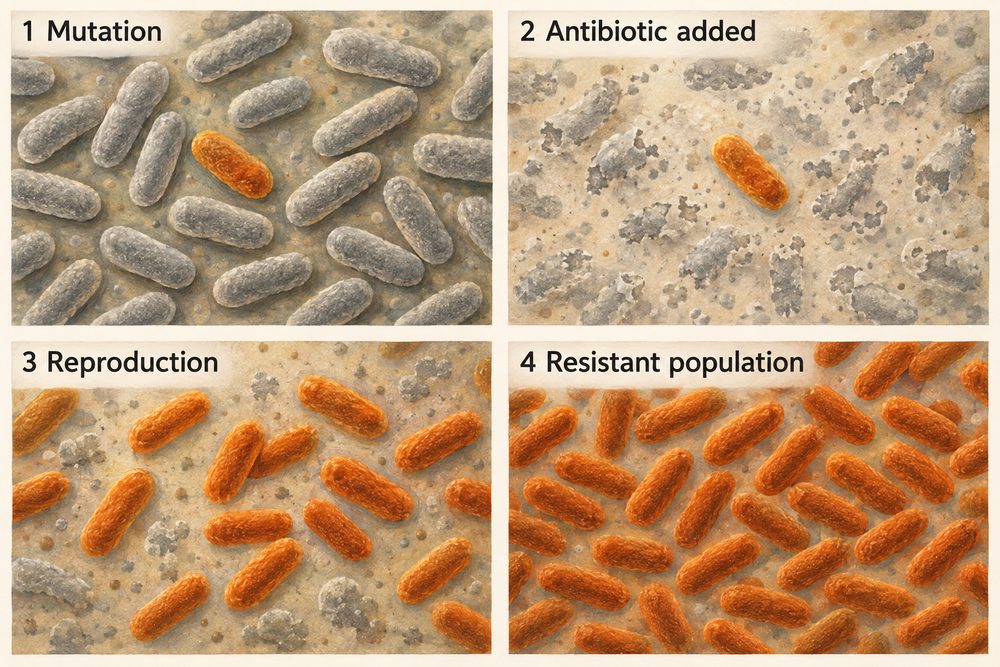
MRSA (methicillin-resistant Staphylococcus aureus) is a well-known resistant strain. To slow resistance, doctors should only prescribe antibiotics when necessary, and patients must complete the full course. Overuse in farming also contributes to the problem.
Antibiotic resistance is natural selection in bacteria: random mutation gives resistance, the antibiotic kills non-resistant bacteria, resistant ones survive and reproduce. Overuse of antibiotics speeds up this process.
Selective Breeding
Selective breeding (artificial selection) is when humans choose organisms with desirable traits and breed them together over many generations. Examples include breeding cows that produce more milk, wheat varieties resistant to disease, and dogs with specific temperaments. While selective breeding achieves rapid change, it reduces genetic variation within a population, which can make the population vulnerable to disease (B6.2a).