Feeding the Human Race
The Challenge of Food Security
The global human population is growing rapidly, creating increasing demand for food. Food security means having reliable access to sufficient, affordable, nutritious food. Achieving food security is one of the biggest global challenges biologists are helping to address (B6.2).
Threats to food security include: population growth (more people need more food), climate change (droughts and floods damage crops), rising costs (fuel and fertiliser prices increase food prices), conflict (war disrupts farming and food distribution) and water scarcity (irrigation becomes unreliable).
Food security is threatened by population growth, climate change, rising costs, conflict and water scarcity. Biologists develop solutions to increase food production sustainably.
Farming Techniques to Increase Yield
Farmers use various methods to increase the amount of food produced per area of land (yield):
• Fertilisers — provide essential minerals (nitrates for protein synthesis, phosphates for DNA and energy transfer, potassium for enzyme function). They can be organic (manure, compost) or inorganic (manufactured chemical fertilisers). Overuse of inorganic fertilisers can cause eutrophication in nearby waterways.
• Pesticides — kill organisms that damage crops: herbicides (kill weeds that compete with crops), insecticides (kill insect pests) and fungicides (kill fungal diseases). Pesticides increase yield but can harm non-target organisms and accumulate in food chains through bioaccumulation.
Biological control uses living organisms instead of chemicals to manage pests. Examples include introducing ladybirds to eat aphids, or using parasitic wasps that lay eggs inside caterpillars. Biological control avoids chemical pollution but can be unpredictable — the introduced organism may become an invasive species or fail to control the pest effectively.
Integrated pest management (IPM) combines chemical and biological methods, using pesticides only when necessary and relying on natural predators where possible. This reduces environmental damage while maintaining crop yields.
Biological control uses natural predators to manage pests, avoiding chemical pollution. However, introduced organisms can be unpredictable. IPM combines both approaches for best results.
Genetic Modification and Selective Breeding
Genetic modification (GM) involves inserting a gene from one organism into another to give it a new characteristic. GM crops can be engineered to be pest-resistant (reducing pesticide use), drought-tolerant (growing in dry conditions), or produce higher yields. For example, golden rice has been modified to produce beta-carotene, which the body converts to vitamin A, helping prevent blindness in developing countries (B6.2d).
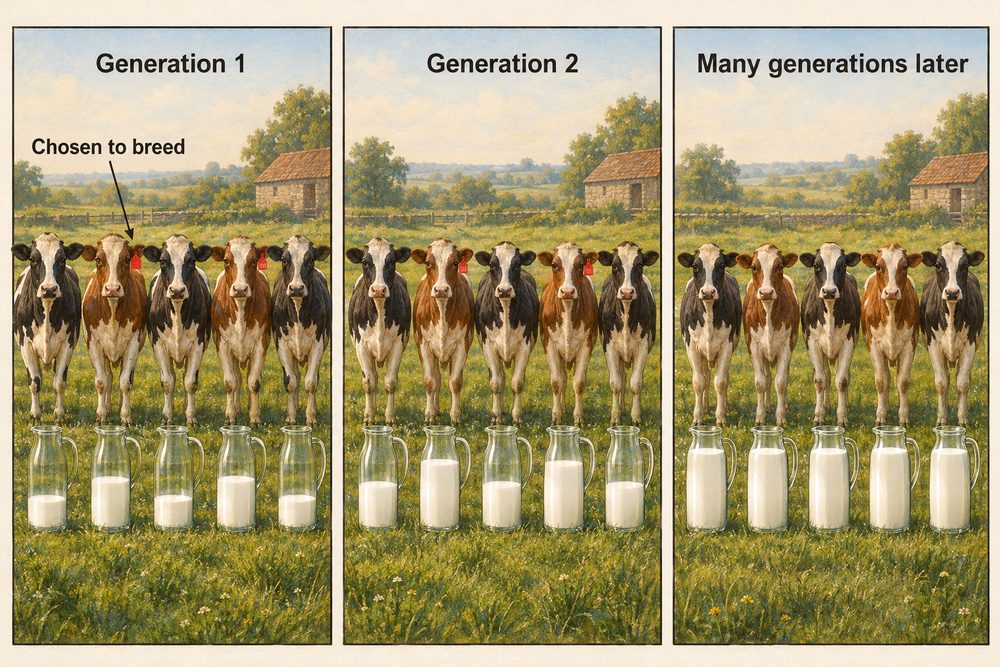
Concerns about GM crops include: potential effects on wild populations if GM genes spread through cross-pollination, unknown long-term health effects, and ethical issues about ‘playing God’ with nature. Selective breeding (choosing organisms with desired traits and breeding them over many generations) is the traditional alternative but takes much longer and cannot introduce entirely new characteristics.
Sustainable farming aims to produce food without depleting resources or damaging the environment. Key practices include crop rotation (growing different crops each season to prevent soil mineral depletion and reduce pest build-up), organic farming (using natural fertilisers and biological control instead of chemicals), and reducing food miles (sourcing food locally to cut transport emissions).
Hydroponics — growing plants in nutrient solutions without soil — allows year-round production in controlled environments, using less water and land than traditional farming. This is particularly useful in urban areas or regions with poor soil quality.
Another approach to food security is reducing food waste. Globally, roughly one-third of all food produced is wasted — either during production, distribution or by consumers. Improved storage, better supply chain management and public awareness campaigns can all help reduce waste and make existing food production go further.
Insect farming is also being explored as a sustainable protein source. Insects like crickets and mealworms require far less land, water and feed than traditional livestock. They produce fewer greenhouse gases and can be fed on organic waste. While not yet mainstream in Western diets, insects are already consumed by over 2 billion people worldwide.
Food miles are the distance food travels from producer to consumer. Shorter food miles mean less transport emissions. However, the picture is complex: food grown locally in heated greenhouses may have a larger carbon footprint than food imported from a country where it grows naturally outdoors. A full carbon footprint analysis considers energy use at every stage, not just transport.
The balance between increasing food production and protecting the environment is central to this topic. Intensive farming maximises yield but often damages ecosystems through pollution, habitat loss and soil degradation. Agroforestry (integrating trees with crops) and permaculture (designing farming systems that mimic natural ecosystems) offer alternative approaches that aim to produce food while supporting biodiversity and maintaining soil health for future generations.
GM crops can be pest-resistant, drought-tolerant or more nutritious, but concerns exist about gene transfer to wild plants and unknown long-term effects. Sustainable practices include crop rotation, organic farming and hydroponics.