Health, Disease and the Immune System
Health and Disease
Health is a state of physical and mental well-being, not just the absence of disease (B6.3a). Communicable diseases are caused by pathogens — microorganisms that infect and cause illness. Pathogens include bacteria, viruses, fungi and protists. Communicable diseases can be spread by direct contact, airborne droplets, contaminated water or food, and animal vectors such as mosquitoes.
Non-communicable diseases cannot be spread between people. Examples include cancer, cardiovascular disease, type 2 diabetes and asthma. Risk factors for non-communicable diseases include smoking, poor diet, lack of exercise, obesity and excessive alcohol consumption. Some non-communicable diseases have genetic components too.
Communicable diseases are caused by pathogens (bacteria, viruses, fungi, protists) and can spread between organisms. Non-communicable diseases (cancer, CVD, diabetes) cannot be passed on and are linked to lifestyle risk factors.
The Body’s Defence Systems
The body has several lines of defence against pathogens (B6.3h):
Non-specific defences (first line) prevent pathogens from entering the body. These include: skin (a physical barrier), mucus in the nose and airways (traps pathogens), cilia (tiny hairs that sweep mucus out of the airways), stomach acid (pH 1-2, kills most pathogens in food), and tears and saliva (contain the enzyme lysozyme, which breaks down bacterial cell walls).
If pathogens breach the first line, the body’s second line of defence — the inflammatory response — is activated. Damaged cells release chemicals that cause blood vessels to dilate and become more permeable. This increases blood flow to the area (causing redness and swelling) and allows white blood cells to reach the site of infection more quickly.
The different types of pathogen cause illness in different ways. Bacteria reproduce rapidly in the body and produce toxins that damage cells and tissues. Viruses are much smaller — they invade host cells, take over the cell’s machinery to replicate themselves, and burst out of the cell (lysis), destroying it in the process. Fungi can cause surface infections (e.g. athlete’s foot) or systemic infections in immunocompromised patients. Protists include the Plasmodium parasite that causes malaria, transmitted by mosquito vectors.
The interplay between communicable and non-communicable diseases is significant. For example, a weakened immune system (from HIV, a communicable disease) increases susceptibility to infections and certain cancers (non-communicable). Poor nutrition (a risk factor for non-communicable diseases) also weakens the immune system, making individuals more vulnerable to infections.
OCR Gateway also requires knowledge of specific diseases and how they spread. Salmonella is a bacterial disease spread through contaminated food. HIV is a virus spread through body fluids (blood, semen). Cholera is a bacterial disease spread through contaminated water. Understanding transmission routes helps develop prevention strategies such as vaccination, hygiene practices and vector control programmes.
Drug development follows a rigorous process. New medicines are first tested on cells and tissues in the lab (preclinical testing), then on animals to check for toxicity, before clinical trials on human volunteers. Phase 1 tests safety on healthy volunteers, Phase 2 tests effectiveness on patients, and Phase 3 involves larger groups with double-blind placebo controls. Only after passing all phases and regulatory review can a drug be approved for widespread use.
If pathogens get past the non-specific defences, lymphocytes mount a specific immune response. Each pathogen has unique proteins on its surface called antigens. Lymphocytes recognise these foreign antigens and produce antibodies — Y-shaped proteins that bind to the specific antigen, marking the pathogen for destruction.
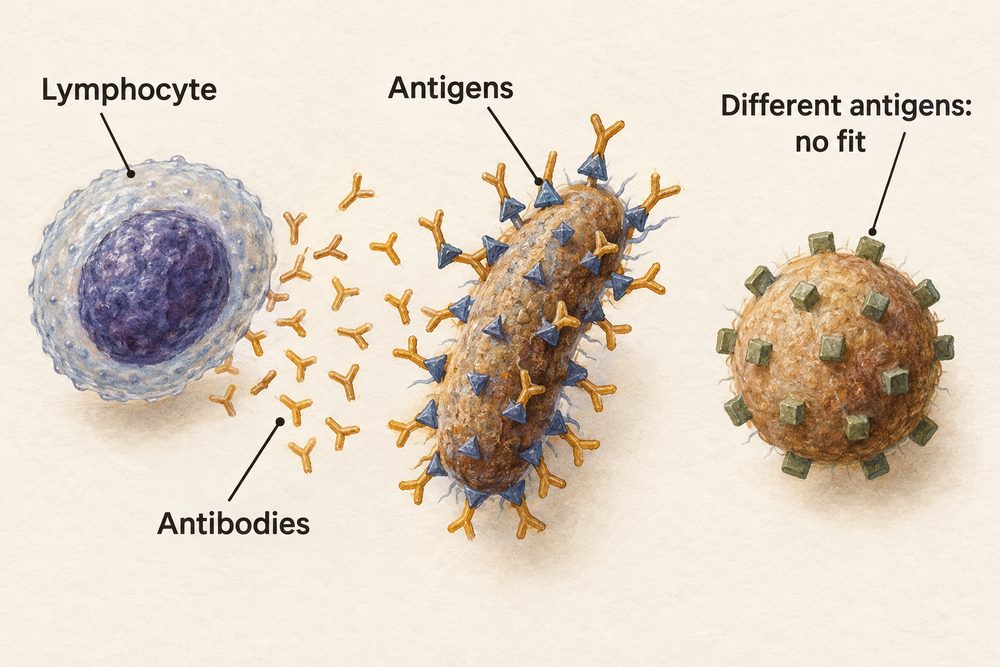
Antibodies work by: clumping pathogens together (agglutination) so phagocytes can engulf them more easily, neutralising toxins produced by pathogens, and marking pathogens for destruction by other immune cells. After infection, some lymphocytes become memory cells that remain in the body for years. If the same pathogen enters again, memory cells produce antibodies much faster, often preventing illness entirely.
Phagocytes are white blood cells that carry out phagocytosis — they engulf and digest pathogens. This is a non-specific response (phagocytes attack any foreign cell).
Lymphocytes produce antibodies specific to antigens on pathogens. After infection, memory cells allow a faster response to reinfection. Phagocytes provide non-specific defence by engulfing pathogens.
Vaccination introduces a dead or weakened form of a pathogen (or its antigens) into the body. The immune system responds by producing antibodies and memory cells, without causing the disease. If the real pathogen enters later, memory cells trigger a rapid immune response. Vaccination programmes have eradicated smallpox and greatly reduced diseases like measles, polio and tetanus (B6.3j).
Antibiotics are medicines that kill bacteria or stop them reproducing. They work by targeting bacterial structures (e.g. cell walls) that human cells lack. Antibiotics do not work against viruses because viruses reproduce inside human cells and lack the structures antibiotics target. Overuse and misuse of antibiotics drives antibiotic resistance, creating ‘superbugs’ like MRSA (B6.3j).
Painkillers (e.g. paracetamol, ibuprofen) treat symptoms but do not kill pathogens. They relieve pain and reduce fever while the immune system fights the infection.
Vaccines introduce weakened pathogens to produce memory cells without causing disease. Antibiotics kill bacteria but not viruses. Overuse drives antibiotic resistance.