Non-Communicable Disease and Lifestyle
Non-Communicable Diseases
Non-communicable diseases (NCDs) cannot be passed from one person to another (B6.3b). Unlike communicable diseases caused by pathogens, NCDs are caused by the interaction of multiple factors including genetics, lifestyle and environment (B6.3l). Major NCDs include cardiovascular diseases (heart disease and stroke), many forms of cancer, lung diseases (such as bronchitis), liver diseases (such as cirrhosis), and type 2 diabetes.
Non-communicable diseases are the leading cause of death worldwide. Understanding the risk factors that contribute to these diseases is essential for prevention and public health.
Lifestyle Risk Factors
The OCR Gateway specification requires you to analyse the effect of lifestyle factors on the incidence of NCDs at local, national and global levels (B6.3n). The key lifestyle factors are:
Smoking — damages the lining of arteries, leading to atherosclerosis (fatty deposits). Increases risk of cardiovascular disease, lung cancer, chronic obstructive pulmonary disease (COPD) and bronchitis. Tar in cigarette smoke is a carcinogen — a cancer-causing substance.
Diet — a high-fat, high-salt, high-sugar diet increases the risk of cardiovascular disease, type 2 diabetes and obesity. Too much saturated fat raises cholesterol levels, which contributes to atherosclerosis.
Alcohol — excessive alcohol consumption damages the liver, leading to cirrhosis (scarring of liver tissue). It also increases the risk of liver cancer and cardiovascular disease.
Lack of exercise — physical inactivity increases the risk of obesity, cardiovascular disease and type 2 diabetes. Regular exercise helps maintain a healthy weight and strengthens the heart.
Key lifestyle risk factors for NCDs include smoking (cardiovascular disease, lung cancer), poor diet (CVD, type 2 diabetes), excessive alcohol (liver disease), and lack of exercise (obesity, CVD) (B6.3n).
Cardiovascular Disease
Cardiovascular disease (CVD) is a major cause of death globally. It occurs when fatty deposits (atherosclerosis) build up inside coronary arteries, narrowing them and reducing blood flow to the heart muscle. This can cause angina (chest pain) or, if the artery becomes completely blocked, a heart attack. A stroke occurs when blood supply to the brain is interrupted.
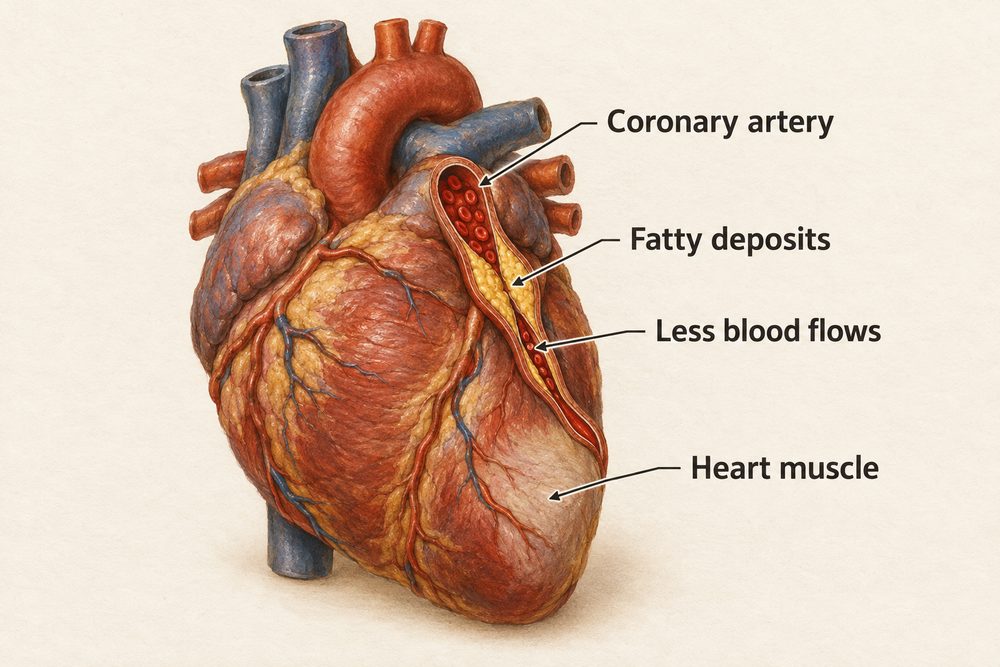
The spec requires you to evaluate different treatments for CVD (B6.3m). These include:
Lifestyle changes — improving diet, exercising more, stopping smoking, reducing alcohol. Low risk, but requires long-term commitment from the patient.
Medical treatments — statins lower blood cholesterol levels, reducing atherosclerosis. Blood thinners (anticoagulants/antiplatelets) reduce the risk of blood clots. Medication is effective but may have side effects.
Surgical treatments — stents are small tubes inserted into narrowed arteries to hold them open, restoring blood flow. Bypass surgery uses a blood vessel from another part of the body to create a new route for blood around the blocked artery. Surgery is effective but carries risks of infection and complications.
CVD treatments range from lifestyle changes (low risk, requires commitment) to medication (statins, blood thinners) to surgery (stents, bypass). Each has benefits and risks that must be evaluated (B6.3m).
Cancer
Cancer is the result of changes in cells that lead to uncontrolled growth and division (B6.3o). Mutations in the DNA that controls the cell cycle cause cells to divide rapidly, forming a tumour. Benign tumours do not spread to other parts of the body. Malignant tumours invade surrounding tissues and can spread to other organs through the blood — this is called metastasis.
Risk factors for cancer include smoking (lung cancer), UV radiation (skin cancer), certain viruses (e.g. HPV and cervical cancer), and genetic predisposition. Not all cancers have known causes.
When analysing data on lifestyle and disease, it is crucial to distinguish between correlation and causation. A correlation means two factors are linked (e.g. countries with higher smoking rates also have higher lung cancer rates). Causation means one factor directly causes the other. Correlation does not always mean causation — other variables (confounding factors) may be involved. Causation is only established through controlled experiments.
Stem cells have potential benefits in medicine (B6.3p). They can divide and differentiate into specialised cell types, so they could be used to replace damaged tissues. However, there are risks (e.g. tissue rejection after transplantation) and ethical concerns about using embryonic stem cells. The spec also asks about gene technology in medicine (B6.3q) and the importance of understanding the human genome for predicting disease likelihood and targeting treatments (B6.3r).
Correlation means two variables are linked; causation means one directly causes the other. Proving causation requires controlled experiments. Many NCD studies show correlations, not proof of causation.