Enzymes, Transport and Food Tests
Enzymes and the Active Site
Enzymes are proteins that act as biological catalysts — they speed up chemical reactions inside living organisms without being used up. Each enzyme has a specific three-dimensional shape with an indentation called the active site. The active site’s shape is precisely complementary to one particular substrate molecule.
The lock and key model describes how the substrate (key) fits into the active site (lock) of the enzyme. Once bound, the enzyme catalyses the reaction, and the products are released. The enzyme is then free to catalyse another reaction. Because each enzyme’s active site has a unique shape, enzymes are said to be substrate-specific.
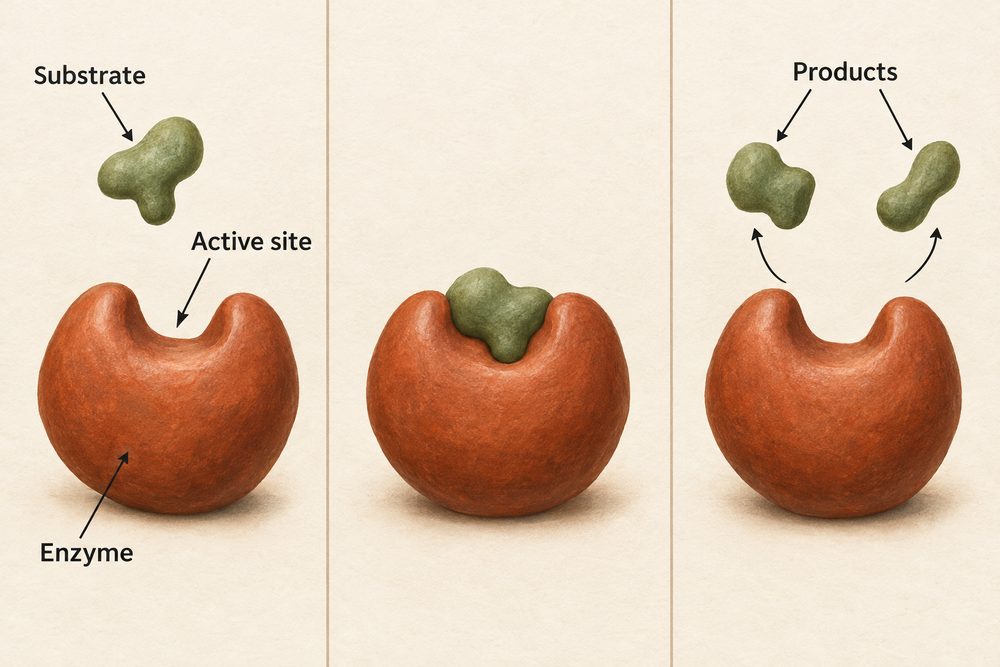
Enzymes are proteins with a specific active site that is complementary to one substrate. The lock and key model explains substrate specificity. At the optimum temperature and pH, the reaction rate is highest. Outside this range, enzyme activity decreases.
Temperature and pH Effects
Temperature affects enzyme activity in two ways. As temperature rises towards the optimum, molecules have more kinetic energy, collide more frequently and form enzyme–substrate complexes faster — so the rate of reaction increases. Above the optimum, the enzyme’s structure is disrupted: bonds maintaining the active site break, and the shape changes permanently. This is called denaturation. Unlike inhibition, denaturation is irreversible.
pH also affects enzyme activity. Each enzyme has an optimum pH at which the active site shape is maintained. Extreme pH (too acidic or too alkaline) denatures the enzyme by altering the bonds that hold its three-dimensional shape. For example, pepsin (a stomach enzyme) works best at pH 2, while amylase in the mouth works best at pH 7.
In a typical enzyme investigation, amylase is mixed with starch solution at a range of pH values (using buffer solutions to maintain each pH). Iodine solution is used to test for starch: it turns blue-black in the presence of starch and remains orange-brown when starch has been fully broken down.
You measure how long it takes for the iodine to stop turning blue-black (i.e. the starch has all been digested). A shorter time means a faster rate of reaction. The independent variable is pH; the dependent variable is the time taken for the colour change. Control variables include temperature (maintained by a water bath), concentration of enzyme and starch, and volume of solutions. Note: a thermometer measures temperature — it does not control it. The water bath controls temperature.
To calculate the rate of reaction: $$\text{rate} = \frac{1}{\text{time (s)}} \times 1000 \quad (\text{in arbitrary units})$$
Diffusion and Osmosis
Diffusion is the net movement of particles from higher to lower concentration — down the concentration gradient. It is passive: no energy is required. Oxygen and carbon dioxide diffuse across gas exchange surfaces in the lungs; glucose diffuses from the gut into the blood.
Factors affecting diffusion rate: concentration gradient (steeper gradient, faster diffusion), temperature (higher temperature, more kinetic energy, faster diffusion), surface area (larger area, more diffusion) and distance (shorter distance, faster diffusion).
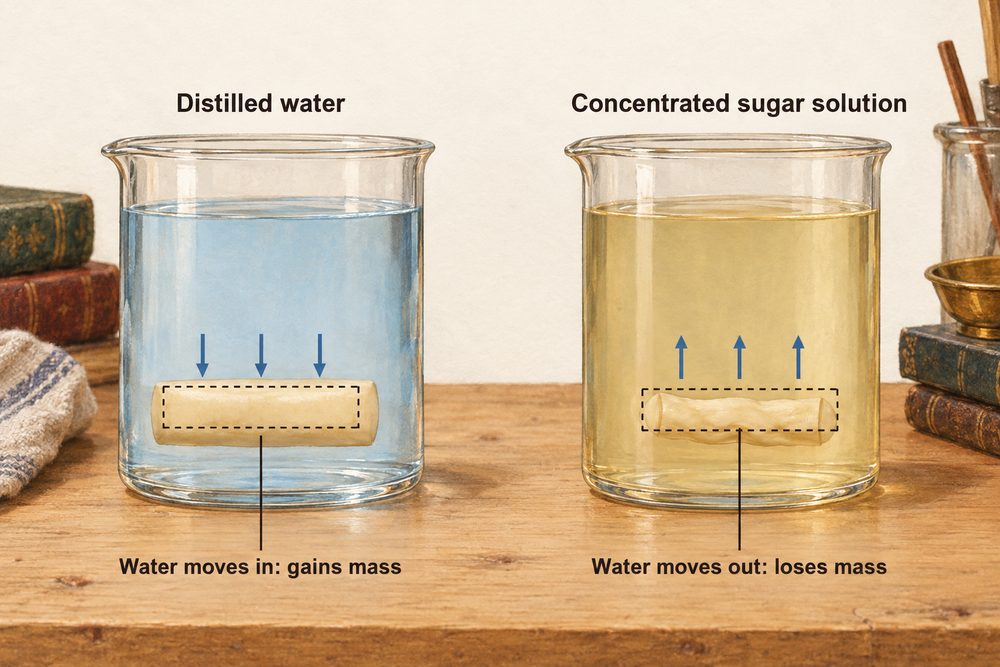
Osmosis is the movement of water molecules through a partially permeable membrane from a region of higher water potential to a region of lower water potential. It is a type of diffusion, but refers specifically to water. Plant cells placed in distilled water gain mass (water enters by osmosis); in concentrated sugar solution they lose mass.
Diffusion: net movement of particles down a concentration gradient — no energy needed. Osmosis: movement of water through a partially permeable membrane from high to low water potential — no energy needed. Active transport: movement of particles against the concentration gradient — energy from respiration required.
Active transport moves substances against the concentration gradient — from low to high concentration. This requires energy from cellular respiration (ATP produced in mitochondria). Examples: root hair cells absorb mineral ions from the soil even though the soil concentration is lower than inside the root; glucose is absorbed from the small intestine into the blood even when the gut glucose concentration is already lower than in the blood.
Potato cylinders (equal length and mass) are placed in solutions of different sucrose concentrations. After a set time, each cylinder is dried and reweighed. The change in mass (or percentage change) is calculated:
$$\text{percentage change in mass} = \frac{\text{final mass} - \text{initial mass}}{\text{initial mass}} \times 100$$
Cylinders in distilled water gain mass (water enters by osmosis). Cylinders in concentrated sucrose solution lose mass (water leaves by osmosis). At the concentration where there is no change in mass, the solution has the same water potential as the potato cells. Percentage change is used rather than absolute change so that results from cylinders of slightly different starting masses can be compared fairly.
Food Tests (Triple Only)
You are required to know four chemical food tests. Each identifies a specific food molecule using a reagent and a colour change.
Iodine test for starch: Add iodine solution to the food sample. Blue-black colour = starch present; orange-brown = no starch.
Benedict’s test for reducing sugars (e.g. glucose): Add Benedict’s solution and heat in a water bath. Brick-red (or orange/yellow) precipitate = reducing sugar present; remains blue = no reducing sugar.
Biuret test for protein: Add biuret reagent (sodium hydroxide then copper sulfate solution) to the food sample. Purple/violet colour = protein present; remains blue = no protein.
Emulsion (ethanol) test for lipid: Dissolve food in ethanol, then add water. A white, cloudy emulsion = lipid present; remains clear = no lipid.
Calorimetry is used to measure the energy content of foods. A food sample is burned and the heat energy released is used to raise the temperature of a known volume of water. The energy content is calculated using: $$Q = mc\Delta T$$ where \(m\) is the mass of water in grams, \(c\) is the specific heat capacity of water (4.2 J g−1 °C−1), and \(\Delta T\) is the temperature rise in °C.
Iodine → blue-black for starch. Benedict’s (heated) → brick-red for reducing sugars. Biuret → purple for protein. Ethanol emulsion → white cloudy for lipid.