Cells and Control: Mitosis, Stem Cells and the Brain
The Cell Cycle and Mitosis
Cells divide to allow organisms to grow, to repair damaged tissue and to replace worn-out cells. This follows the cell cycle. Most of the cycle is spent in interphase, when the cell grows, manufactures more organelles and replicates all of its DNA so that each daughter cell will receive a complete set of chromosomes.
After interphase, the cell enters mitosis. During mitosis the chromosomes condense and become visible, then the copies are pulled to opposite ends of the cell. The cytoplasm and cell membrane then divide to produce two genetically identical daughter cells, each with the full chromosome complement.
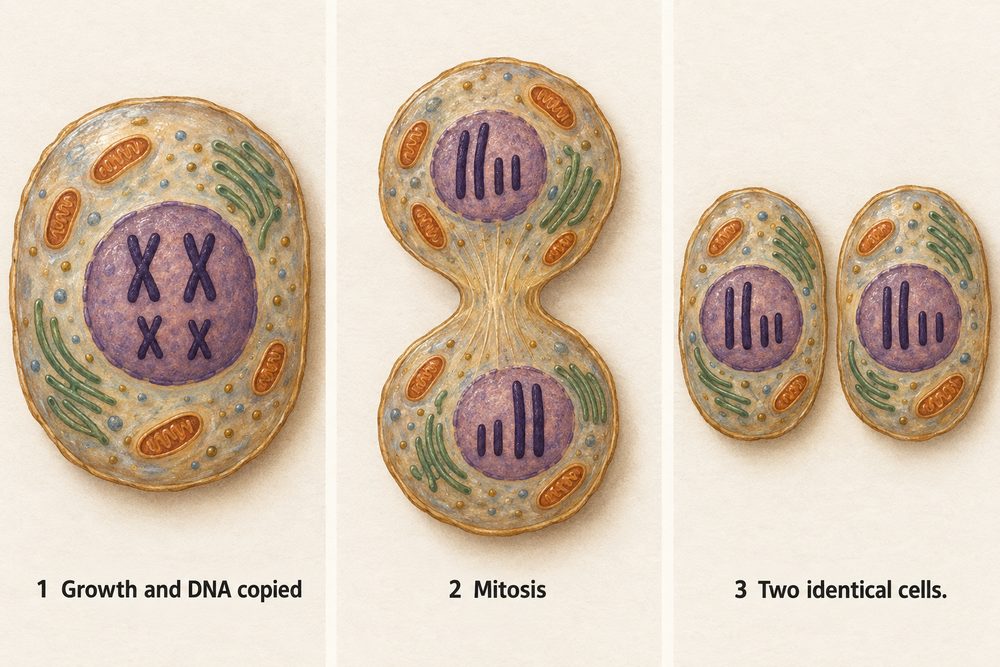
Mitosis has four main phases:
- Prophase — chromosomes condense and become visible; the nuclear envelope breaks down.
- Metaphase — chromosomes line up along the centre (equator) of the cell, attached to spindle fibres.
- Anaphase — spindle fibres contract and pull the chromosome copies to opposite poles.
- Telophase and cytokinesis — nuclear envelopes reform around each set of chromosomes; the cytoplasm divides, producing two cells.
Mitosis: Prophase (chromosomes condense, nuclear envelope breaks down) → Metaphase (chromosomes align at equator) → Anaphase (copies pulled to poles) → Telophase & cytokinesis (two identical daughter cells form).
Cancer results when the cell cycle is no longer controlled. Cells divide repeatedly and uncontrollably, forming a tumour. Tumours that spread to other parts of the body are called malignant.
Cell Differentiation and Growth
As cells divide and grow, they become specialised through a process called differentiation. Most animal cells differentiate during embryonic development and then lose the ability to become other cell types. Plant cells retain the ability to differentiate throughout life because they have meristem tissue at root and shoot tips.
Growth in organisms can be measured by mass, length or percentage change. In children, growth is monitored using percentile charts. A percentile line, such as the 50th percentile, means that 50% of children of that age have a measurement below that value. Percentile charts allow doctors to identify children whose growth is unusually slow or unusually fast, prompting further investigation.
Stem Cells
Stem cells are undifferentiated cells that can divide to produce more stem cells or differentiate into a range of specialised cells. Embryonic stem cells (from the inner cell mass of an early embryo) can differentiate into almost any cell type. Adult stem cells are more limited; bone marrow stem cells, for example, produce all types of blood cell.
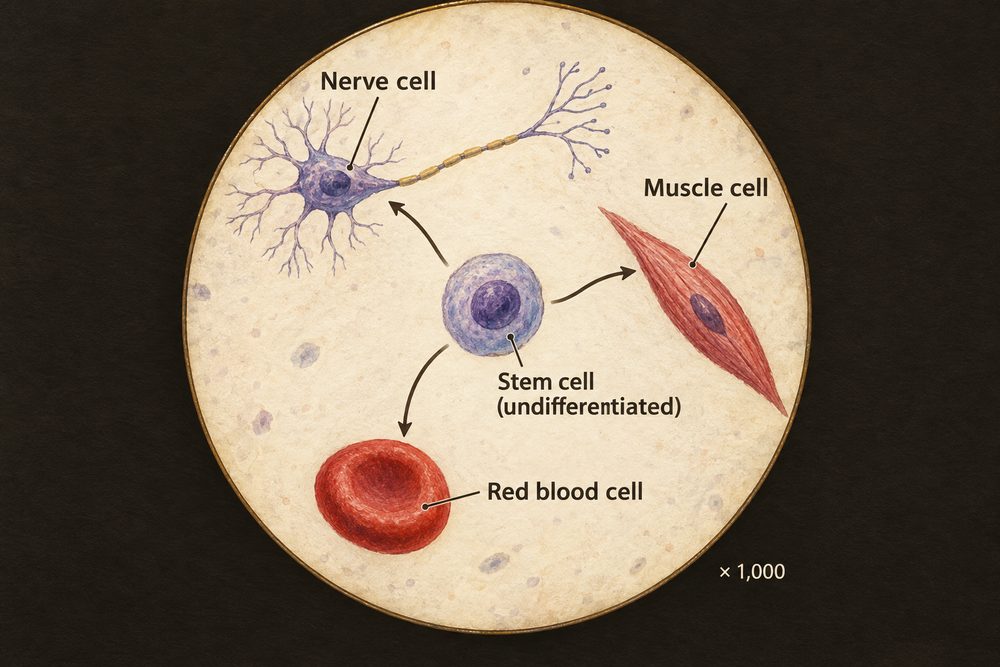
Stem cells have potential therapeutic uses: replacing damaged nerve cells in spinal cord injuries, producing insulin-secreting cells to treat diabetes, and growing replacement tissue for burns patients. These therapies are at various stages of research and clinical trials.
Embryonic stem cells raise ethical concerns because extracting them destroys the embryo. Some people argue the embryo is a potential human life and should not be used for research. Others argue that the potential to relieve suffering outweighs this concern. Adult stem cells and stem cells from umbilical cord blood avoid this ethical issue. Plant meristem cells can also be used in tissue culture to grow new plants from a single cell.
Embryonic stem cells can differentiate into any cell type (pluripotent) but their use is controversial because extracting them destroys the embryo. Adult stem cells are less versatile but raise fewer ethical concerns. Plant meristems can generate whole new plants in tissue culture.
The Brain (Triple Only)
The brain controls most of the body’s functions and is made of billions of interconnected neurones. Three key regions you must know are:
- Cerebral hemispheres (cerebrum) — the largest region. Controls conscious thought, memory, language, personality and voluntary movement. The outer layer (cerebral cortex) is deeply folded to increase surface area.
- Cerebellum — at the back of the brain. Coordinates balance, posture and precise muscle movements such as riding a bicycle or playing a musical instrument.
- Medulla oblongata (medulla) — connects the brain to the spinal cord. Controls automatic, life-sustaining functions: breathing rate, heart rate and blood pressure.
Brain research relies on scanning techniques that allow scientists to investigate brain structure and function without surgery.
CT scanning (computed tomography) uses X-rays taken from multiple angles. A computer reconstructs these to produce detailed cross-sectional images of brain structure. CT scans are good for identifying physical abnormalities such as tumours, bleeds or structural damage.
PET scanning (positron emission tomography) uses a radioactive tracer (usually a form of glucose) injected into the blood. Active brain regions use more glucose, so they emit more radiation. The PET scanner detects this and produces a colour-coded map showing which areas of the brain are most active during a particular task. PET scans reveal function rather than structure, making them useful for studying conditions such as Alzheimer’s disease or mapping speech and memory regions before surgery.