Genetics: DNA, Inheritance and Punnett Squares
DNA Structure and the Genome
DNA (deoxyribonucleic acid) is the molecule that carries genetic information. Each molecule consists of two strands wound around each other to form a double helix. Each strand is made of repeating units called nucleotides. Each nucleotide contains a deoxyribose sugar, a phosphate group and one of four nitrogenous bases: adenine (A), thymine (T), cytosine (C) and guanine (G).
The two strands are held together by complementary base pairing: A pairs only with T (A–T), and C pairs only with G (C–G). This complementarity is central to how DNA replicates and how genetic information is read. A gene is a section of DNA that codes for a specific protein. The complete set of genetic information in an organism is called its genome. The Human Genome Project, completed in 2003, sequenced the entire human genome and identified the location of around 20,000 protein-coding genes.
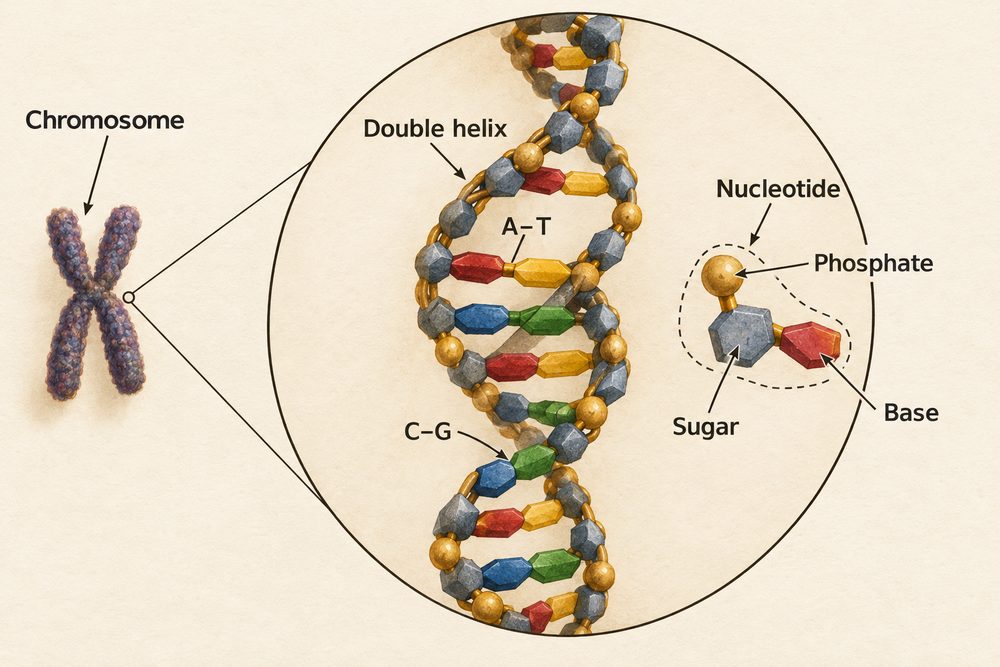
DNA base pairing: A pairs with T; C pairs with G. A gene is a section of DNA that codes for one protein. The genome is the complete set of an organism’s DNA. The Human Genome Project mapped all human genes.
Protein Synthesis: Transcription and Translation (Triple Only)
The information stored in a gene is used to build a specific protein through a two-stage process: transcription and translation.
Transcription (in the nucleus): An enzyme called RNA polymerase binds to the gene and reads the template strand of DNA. It builds a complementary strand of messenger RNA (mRNA) using RNA bases (U replaces T in RNA; uracil pairs with adenine). The mRNA strand leaves the nucleus through pores in the nuclear envelope.
Translation (at the ribosome): The mRNA strand attaches to a ribosome. Each set of three bases on the mRNA (called a codon) codes for one specific amino acid. Transfer RNA (tRNA) molecules carry amino acids to the ribosome; each tRNA has an anticodon complementary to the mRNA codon. Amino acids are joined together in the correct sequence to build a polypeptide chain, which folds into the final protein.
A mutation in the DNA sequence can change the base sequence of the mRNA, which may alter the amino acid sequence of the protein. If the protein’s shape changes, it may no longer function correctly.
Mendel’s Work and the Principles of Inheritance
Gregor Mendel (1822–1884) was a monk working in Brno who carried out carefully controlled breeding experiments with pea plants between 1856 and 1863. He crossed plants with different traits (e.g. tall vs short, round vs wrinkled peas) and recorded the ratios of traits in offspring across thousands of plants. His results led him to propose two key principles: that hereditary ‘factors’ (what we now call alleles) come in pairs, and that one factor can mask the other.
Mendel’s work was largely ignored during his lifetime, partly because he lacked a mechanism to explain his results. When chromosomes and cell division were discovered after his death, scientists realised that Mendel’s hereditary factors were genes on chromosomes. His work was then recognised as the foundation of genetics.
The key terminology you need:
- Allele — a different version of a gene. We inherit two alleles of each gene, one from each parent.
- Dominant — expressed whenever present (one or two copies). Capital letter.
- Recessive — only expressed when two copies are present. Lower-case letter.
- Homozygous — both alleles the same (BB or bb).
- Heterozygous — two different alleles (Bb).
- Genotype — the allele combination (e.g. Bb). Phenotype — the expressed characteristic (e.g. brown eyes).
Punnett Squares and Genetic Crosses
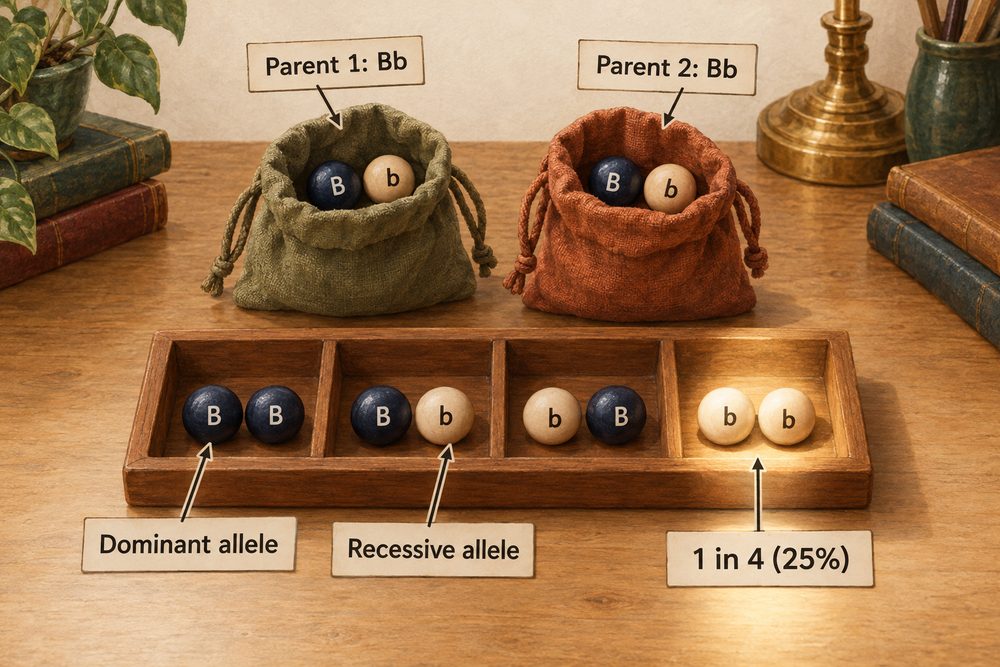
A Punnett square is a grid that shows all possible allele combinations in offspring from a genetic cross. Parent alleles go along the top and down the side; each cell shows the genotype of a possible offspring.
Both parents are carriers of cystic fibrosis (genotype Ff, where f is recessive). What are the possible genotypes and phenotypes of their offspring?
Punnett square: cross Ff × Ff gives FF, Ff, Ff, ff. Genotype ratio: 1 FF : 2 Ff : 1 ff. Phenotype ratio: 3 unaffected (FF or Ff) : 1 affected (ff). Probability of an affected child = \(\frac{1}{4}\) or 25%. Each pregnancy carries the same probability.
Sex determination: Humans have 23 pairs of chromosomes; the 23rd pair determines sex. Females are XX; males are XY. A Punnett cross shows a 50% chance of XX (female) and 50% chance of XY (male) in any pregnancy.
Codominance and ABO Blood Groups (Triple Only)
Codominance occurs when both alleles are equally expressed in the heterozygote, so the phenotype is a blend or shows both traits simultaneously. The ABO blood group system illustrates codominance.
Blood group is controlled by one gene with three alleles: IA, IB and IO. IA and IB are codominant with each other; IO is recessive to both.
- Blood group A: IAIA or IAIO
- Blood group B: IBIB or IBIO
- Blood group AB: IAIB (both A and B antigens expressed — codominance)
- Blood group O: IOIO
ABO blood groups use codominance: IA and IB alleles are both expressed when present together, giving blood group AB (genotype IAIB). Blood group O requires two copies of the recessive IO allele.