Natural Selection, Evolution and Genetic Engineering
Natural Selection
Evolution is the gradual change in the inherited characteristics of a population over many generations. The mechanism that drives evolution is natural selection, independently proposed by Charles Darwin (1809–1882) and Alfred Wallace (1823–1913) in the mid-nineteenth century.
The four-step process of natural selection:
- Within a population there is variation in heritable characteristics, arising from random mutations and sexual reproduction.
- Individuals with characteristics better suited to the environment are more likely to survive long enough to reproduce (‘survival of the fittest’).
- These successful individuals reproduce and pass on their advantageous alleles to offspring.
- Over many generations the frequency of the advantageous allele increases in the population, gradually changing its characteristics.
Natural selection: variation exists → individuals with advantageous traits survive and reproduce → advantageous alleles passed to offspring → frequency of the advantageous allele increases over generations. This process never acts on an individual during its lifetime — only populations evolve.
A critical misconception to avoid: evolution does not happen in an individual’s lifetime. Giraffes did not ‘grow’ longer necks to reach leaves. Rather, variation in neck length already existed in the population; individuals with longer necks survived and reproduced more successfully, passing on the alleles for longer necks. Over many generations, the average neck length increased.
Evidence for Evolution
Your exam requires knowledge of three named human fossil finds and the use of stone tools as evidence for human evolution:
Ardi (Ardipithecus ramidus) — approximately 4.4 million years old. Discovered in Ethiopia by Tim White’s team (fossils recovered 1992–1994, formally announced 2009). One of the earliest known hominid fossils, showing features of upright walking alongside features suited to tree living.
Lucy (Australopithecus afarensis) — approximately 3.2 million years old. Discovered in 1974 by Donald Johanson in Ethiopia. Lucy’s skeletal remains show clear evidence of bipedalism (walking upright on two legs), yet a small braincase closer in size to that of a chimpanzee.
Richard Leakey — palaeoanthropologist who led fossil discoveries in East Africa attributed to hominin species living approximately 1.6 million years ago, including specimens of Homo erectus. These fossils show a larger brain and more sophisticated stone tools than earlier hominids.
Stone tools provide indirect evidence for human cognitive evolution. Increasingly complex tool-making (from basic Oldowan flakes to more refined Acheulean hand axes) correlates with increasing brain size over time.
The pentadactyl limb is the five-digit limb structure shared by all vertebrates, though modified for different functions — the human hand, bat wing, dolphin flipper and horse leg all contain the same set of homologous bones. This is strong evidence for common ancestry.
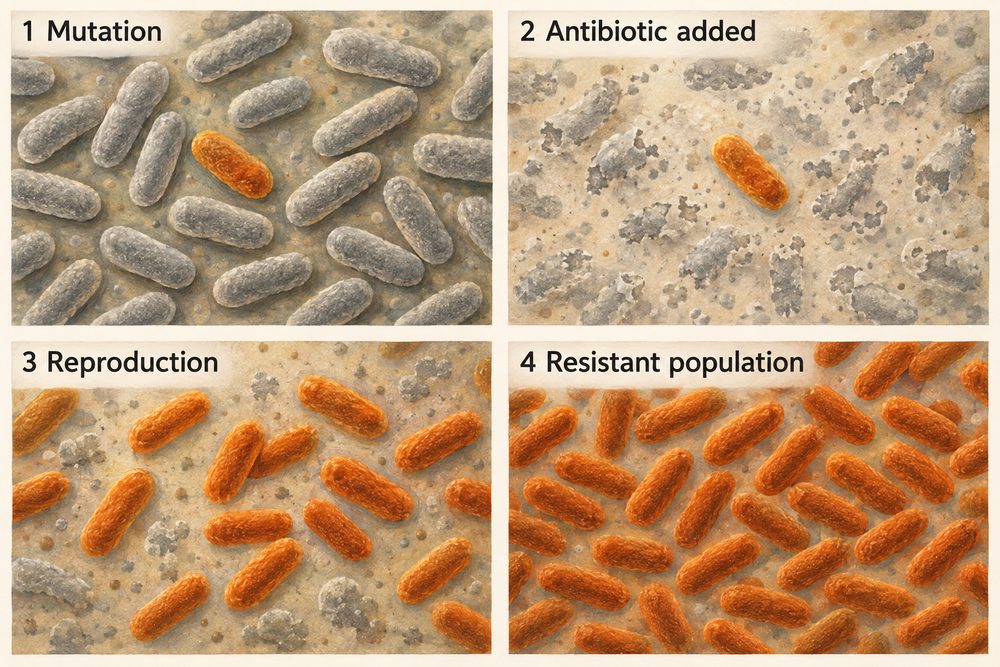
Antibiotic resistance is natural selection observed in action on a short timescale. When a bacterium acquires a random mutation that allows it to survive exposure to an antibiotic, it survives while others die. It reproduces rapidly, passing on the resistance gene. Over many generations, the resistant strain dominates. This is why completing a course of antibiotics and not overusing them is essential to slow resistance.
Classification: Three Domains
Living organisms are classified using a hierarchical system. This exam uses the three-domain classification proposed by Carl Woese, which divides life into: Archaea (ancient prokaryotes), Bacteria (true bacteria) and Eukarya (all eukaryotes including plants, animals, fungi and protists). Within each domain, organisms are further classified into kingdom, phylum, class, order, family, genus and species. The species is the most precise level: members of the same species can breed and produce fertile offspring.
Selective Breeding
Selective breeding (artificial selection) is the human-directed version of natural selection. Humans select organisms with desirable traits and breed them together. Repeating this over generations concentrates the desired characteristics.
Examples: selectively breeding cows for higher milk yield, wheat for disease resistance, dogs for specific sizes or temperament. A key disadvantage is that it reduces genetic variation within a population (inbreeding), making the population more vulnerable to disease or environmental change. Tissue culture allows selective breeding to be extended to plants: identical plants can be produced from meristem cells and selected for desirable traits.
Genetic Engineering and GM Crops (Triple Only)
Genetic engineering involves inserting a gene from one organism into the DNA of another. The general process:
Step 1 — Identify and isolate the gene: The desired gene (e.g. the human insulin gene) is identified. Restriction enzymes cut the gene from the donor organism’s DNA at specific base sequences, leaving ‘sticky ends’.
Step 2 — Insert into a vector: A vector (commonly a bacterial plasmid) is cut with the same restriction enzyme, leaving complementary sticky ends. The gene is inserted; ligase enzyme joins the sticky ends, sealing the gene into the plasmid.
Step 3 — Transform the host: The recombinant plasmid is introduced into a host cell (e.g. a bacterium such as E. coli). The bacterium then replicates, with each daughter cell containing the new gene and expressing the desired protein.
GM crop example — Bt crops: The bacterium Bacillus thuringiensis naturally produces a protein (Bt toxin) that kills insect pests. The gene for Bt toxin has been inserted into crop plants (e.g. cotton, maize), making the crops resistant to pest damage without needing as many insecticide sprays.
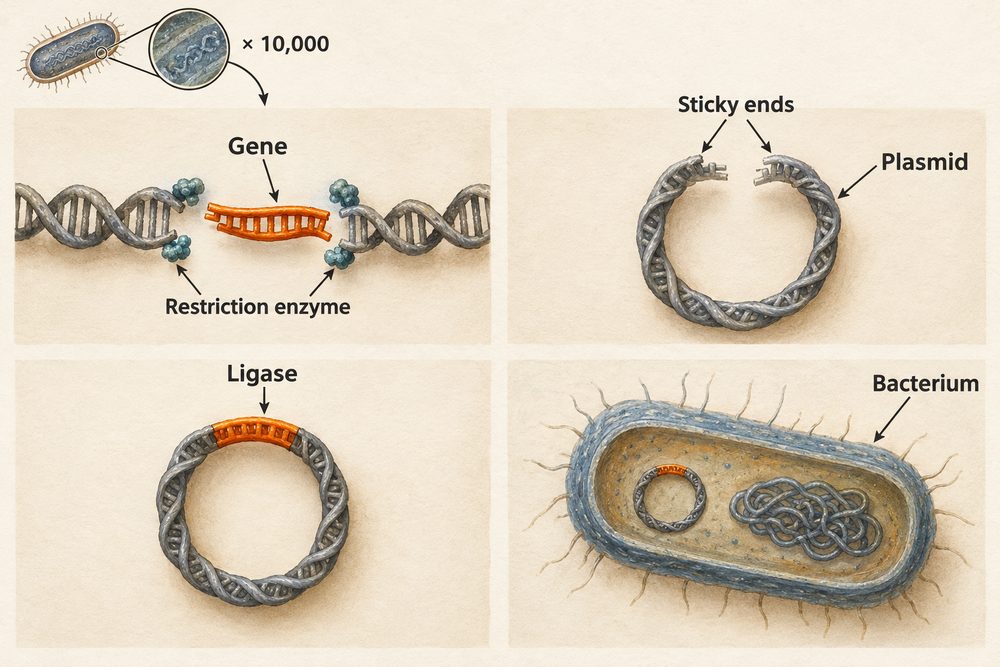
Genetic engineering uses restriction enzymes (cut DNA), ligase (joins sticky ends) and vectors such as plasmids (carry the gene into the host cell). Example: Bacillus thuringiensis (Bt) gene inserted into crops gives pest resistance without insecticides.