Photosynthesis, Limiting Factors and the Inverse Square Law
Photosynthesis: The Equation
Photosynthesis is an endothermic reaction: it absorbs light energy and stores it as chemical energy in glucose. It takes place in the chloroplasts of plant cells, where the green pigment chlorophyll absorbs light.
The word equation is:
$$\text{carbon dioxide} + \text{water} \xrightarrow{\text{light}} \text{glucose} + \text{oxygen}$$
The balanced symbol equation is:
$$6CO_2 + 6H_2O \xrightarrow{\text{light}} C_6H_{12}O_6 + 6O_2$$
Photosynthesis is endothermic: \(6CO_2 + 6H_2O \rightarrow C_6H_{12}O_6 + 6O_2\). It occurs in chloroplasts, uses light energy absorbed by chlorophyll, and produces glucose (for energy and biosynthesis) plus oxygen (released as a by-product).
Plants use photosynthetically produced glucose for multiple purposes: respiration (releasing energy for cell processes); converting to starch for storage in roots and leaves; producing cellulose for cell wall synthesis; combining with mineral ions (especially nitrates from the soil) to make amino acids and then proteins; and producing lipids for storage in seeds and cell membranes.
Leaves are adapted to maximise photosynthesis: a broad, flat surface area captures light; a thin leaf means CO₂ does not have to diffuse far to reach chloroplasts; a network of veins supplies water and removes glucose. The waxy cuticle on the upper surface is transparent, so light still reaches the chloroplasts, and waterproof, so the leaf loses less water.
Limiting Factors
A limiting factor is one that, when in short supply, prevents photosynthesis from proceeding faster regardless of how much of the other factors is available. Three main factors limit the rate of photosynthesis:
- Light intensity — as light increases, the rate of photosynthesis increases (more energy for the light-dependent reactions), until another factor becomes limiting.
- Carbon dioxide concentration — CO₂ is a raw material; increasing its concentration raises the rate until light or temperature limits it.
- Temperature — higher temperatures speed up enzyme-controlled reactions in the chloroplast up to an optimum (around 25–35°C for most plants); above the optimum, enzymes denature and the rate falls sharply.
A common exam graph shows rate of photosynthesis on the y-axis against light intensity on the x-axis, at two different CO₂ concentrations. The curve for high CO₂ rises more steeply and reaches a higher plateau. Where the curve flattens, the current factor (light) is no longer limiting — another factor (CO₂ or temperature) has become limiting. Adding more CO₂ shifts the plateau upwards; raising temperature (to a safe level) also lifts the plateau. These graphs test whether you can identify which factor is limiting at each part of the curve.
The Inverse Square Law
Light intensity decreases with distance from the source according to the inverse square law:
$$\text{light intensity} \propto \frac{1}{d^2}$$
where \(d\) is the distance from the light source. This means that if you move a lamp from 10 cm to 20 cm away from a plant — doubling the distance — the light intensity falls to \(\frac{1}{4}\) of its original value (not half). If the distance triples, intensity falls to \(\frac{1}{9}\).
Problem: A lamp is placed 15 cm from pondweed and produces a rate of 20 bubbles per minute. The lamp is moved to 30 cm. Predict the new rate.
Step 1: Distance doubles (15 → 30 cm), so the intensity becomes \(\frac{1}{2^2} = \frac{1}{4}\) of the original.
Step 2: New rate \(= 20 \times \frac{1}{4} = 5\) bubbles per minute.
Note: this assumes light is the only limiting factor. In practice, the curve may already be at a plateau, in which case the prediction would overestimate the change.
Core Practical: Investigating the Effect of Light Intensity on Photosynthesis
The standard method uses aquatic pondweed (such as Elodea) or algae beads. Oxygen produced by photosynthesis is collected as bubbles (or measured as percentage O₂ saturation with a sensor) as a proxy for photosynthesis rate.
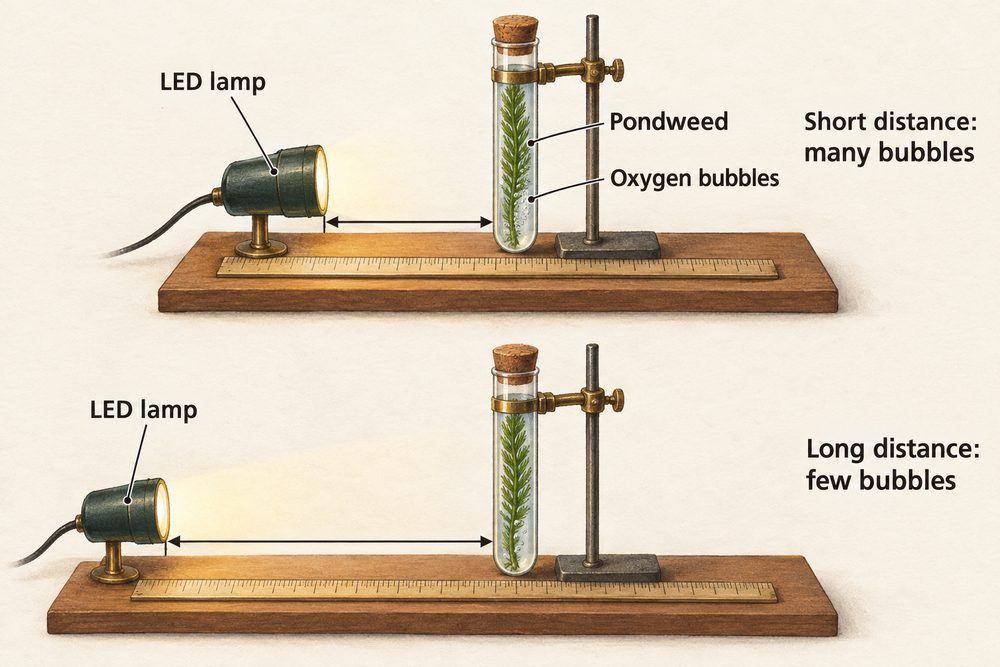
Independent variable: Distance of the lamp from the plant (used as a measure of light intensity).
Dependent variable: Number of oxygen bubbles produced per minute (or O₂ sensor reading).
Control variables: CO₂ concentration (maintained by adding sodium hydrogen carbonate solution to the water); temperature (water jacket around the plant, or temperature-controlled water bath); same plant cutting for each measurement.
Key precautions: Allow the plant to equilibrate at each distance for several minutes before counting bubbles. A thermometer measures temperature — it does not control it; the water bath or jacket controls temperature. Repeat each distance at least three times and calculate a mean to reduce the effect of anomalous results.
Analysing results: Plot rate of photosynthesis against distance (or against light intensity calculated using the inverse square law). A curved relationship indicates a limiting factor effect. If plotting rate vs. \(\frac{1}{d^2}\) gives a straight line through the origin, light intensity is the sole limiting factor at those distances.
In the light intensity core practical: the independent variable is lamp distance; the dependent variable is bubble rate. A thermometer measures temperature — a water bath or jacket controls it. Adding sodium hydrogen carbonate to the water controls CO₂ concentration, ensuring light is the only variable changing.