Plant Transport: Xylem, Phloem and Transpiration
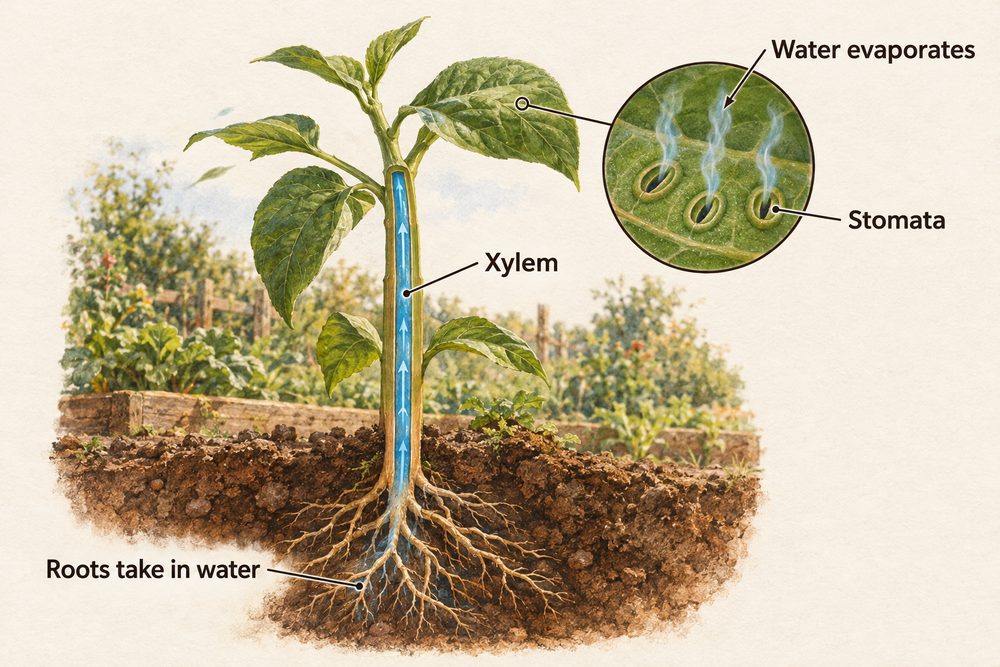
Absorbing Water: The Root Hair Cell
Root hair cells are found on the outer layer of plant roots, just behind the growing tip. Each cell has a long, thin extension — the root hair — that projects into the soil between soil particles. This extension dramatically increases the surface area in contact with soil water.
Water enters root hair cells by osmosis: soil water has a higher water potential than the cell contents, so water moves down the water potential gradient across the partially permeable cell membrane. Mineral ions (such as nitrates and phosphates) enter by active transport, using energy from respiration to move ions from the soil (low concentration) into the cell (higher concentration) — against the concentration gradient.
Water enters root hair cells by osmosis (high to low water potential). Mineral ions enter by active transport, which requires energy from respiration. Root hairs are adapted with a large surface area and thin walls to maximise absorption.
Xylem: Water Transport Upwards
Xylem is a vascular tissue made of dead cells whose end walls have broken down, forming long hollow tubes. The cell walls are reinforced with lignin, which makes the tubes rigid and waterproof so they can withstand the tension created by water moving upward. Xylem transports water and dissolved mineral ions from the roots, up through the stem, and to the leaves — in a continuous column called the transpiration stream.
The water moves because of a continuous pull from above: as water evaporates from the leaves, it creates tension that ‘sucks’ more water up through the xylem. This cohesion–tension mechanism works because water molecules are attracted to each other (cohesion) and to the xylem walls (adhesion), maintaining a continuous unbroken column.
Phloem: Translocation of Sugars
Phloem is a vascular tissue made of living cells arranged in columns. Sieve plates at the end of each cell allow substances to flow between cells. Phloem transports dissolved sugars — mainly sucrose — produced during photosynthesis in the leaves, to all other parts of the plant that need them, including growing roots, developing fruits and storage organs. This transport process is called translocation.
Xylem cells are dead and hollow, with lignified walls; they transport water and minerals upward only (unidirectional). Phloem cells are living, with sieve plates; they transport dissolved sugars in both directions (bidirectional — from source to sink, wherever the plant needs them). Both xylem and phloem run through the vascular bundle in the stem, root and leaf veins.
Transpiration
Transpiration is the loss of water vapour from plant leaves, mainly through stomata. When stomata are open (to allow CO₂ in for photosynthesis and O₂ out), water vapour diffuses out down its concentration gradient. The evaporation at the leaf surface creates a ‘pull’ that draws water up from the xylem to replace what was lost.
Light intensity: Light causes stomata to open (guard cells become turgid in light). More open stomata = more water vapour lost = higher transpiration rate.
Temperature: Higher temperature gives water molecules more kinetic energy, increasing the rate of evaporation and diffusion from the leaf.
Humidity: In humid air, the concentration gradient of water vapour between the leaf and the air is smaller, so diffusion (and transpiration rate) is lower. In dry air, the gradient is steeper and transpiration is faster.
Air movement (wind): Wind removes humid air from around the leaf, maintaining a steep concentration gradient and increasing the transpiration rate.
Leaf Adaptations for Efficiency
The leaf is adapted to balance photosynthesis and water conservation. A waxy cuticle covers the upper epidermis, reducing evaporation from the flat leaf surface. Stomata (controlled by guard cells) are mostly on the underside of the leaf (lower epidermis), away from direct sunlight, further limiting unnecessary water loss. The spongy mesophyll layer below contains air spaces that allow CO₂ and O₂ to diffuse to and from photosynthesising cells efficiently.
Leaves reduce unnecessary water loss through: (1) the waxy cuticle on the upper surface; (2) stomata mostly on the lower (shaded) surface; (3) guard cells closing stomata in the dark or when water is scarce. These adaptations balance gas exchange for photosynthesis against water conservation.
Calculating Transpiration Rate
A potometer measures water uptake by a plant cutting as a proxy for transpiration rate. Water uptake is recorded as the distance a bubble moves in a capillary tube over a set time. The rate of water uptake (in cm per minute, or cm³ per minute if the bore area is known) is calculated as:
$$\text{rate of water uptake} = \frac{\text{distance moved by bubble (cm)}}{\text{time (min)}}$$
Problem: A student sets up a potometer and records that the air bubble moves 4.5 cm in 3 minutes under normal conditions. Calculate the rate of water uptake.
Step 1: Rate = distance ÷ time = 4.5 ÷ 3 = 1.5 cm per minute.
Step 2: The student then turns a fan on. If the bubble moves 9.0 cm in 3 minutes, rate = 9.0 ÷ 3 = 3.0 cm per minute — the wind has doubled the transpiration rate by maintaining a steeper water-vapour concentration gradient.