Plant Adaptations and Hormones
Adapting to Extremes: Xerophytes and Hydrophytes
Plants cannot move away from unfavourable conditions — they must be structurally adapted to survive where they grow. Two contrasting environments pose particular challenges: very dry (arid) habitats and waterlogged or aquatic habitats.
Xerophytes are plants of dry environments (deserts, semi-arid grasslands) where water is scarce. Their adaptations focus on reducing transpiration and storing any water that is available. Examples include cacti, marram grass and the Prickly Pear.
Thick, waxy cuticle: A thickened waterproof cuticle on leaf or stem surfaces greatly reduces evaporation.
Reduced or modified leaves: Cacti have leaves reduced to spines, minimising the surface area available for transpiration. The photosynthetic function is taken over by the green stem.
Sunken stomata: Some xerophytes (e.g. marram grass) have stomata sunk into pits or grooves, where air movement is reduced. A layer of humid air builds up around the stomata, reducing the concentration gradient and therefore the rate of water vapour loss.
Rolled leaves: Marram grass rolls its leaves inward when water is scarce, trapping humid air inside and further reducing the humidity gradient.
Water storage tissue: Cacti and succulents have large parenchyma cells in stems or leaves for storing water taken up rapidly after rare rainfall events. Deep or widespread root systems also help collect water from a large soil volume.
Hydrophytes face the opposite challenge: too much water and often too little oxygen in waterlogged soil. They are adapted to float or grow in water and to obtain oxygen for their submerged tissues. Examples include water lilies and pondweed. Hydrophyte adaptations include: large air spaces (aerenchyma) in stems and leaves to transport oxygen from air to submerged roots; broad flat leaves that float on the surface to capture light; and flexible stems that bend rather than break in flowing water.
Xerophytes reduce water loss through: thick waxy cuticles (waterproof barrier); sunken or rolled stomata (trap humid air, reduce concentration gradient); reduced leaf surface area (less surface for transpiration). Hydrophytes are adapted to waterlogged environments with aerenchyma (air spaces) for oxygen transport to submerged roots.
Plant Hormones: An Overview
Plant hormones are chemical messengers that coordinate growth and development. They are produced in small quantities in one region of the plant and transported to where they are needed, where they alter cell behaviour — typically by promoting or inhibiting cell elongation, division or differentiation. The three main plant hormones you need to know are auxins, gibberellins and ethene.
Auxins and Tropisms
Auxins are produced in the growing tips of shoots. They promote cell elongation — cells in the presence of auxin take up more water and grow longer. The unequal distribution of auxins explains two key tropisms:
Phototropism (response to light): when light comes from one side, auxin migrates to the shaded side of the shoot. Higher auxin concentration on the shaded side causes faster elongation there, so the shoot bends towards the light. This positive phototropism maximises the leaf area exposed to light for photosynthesis.
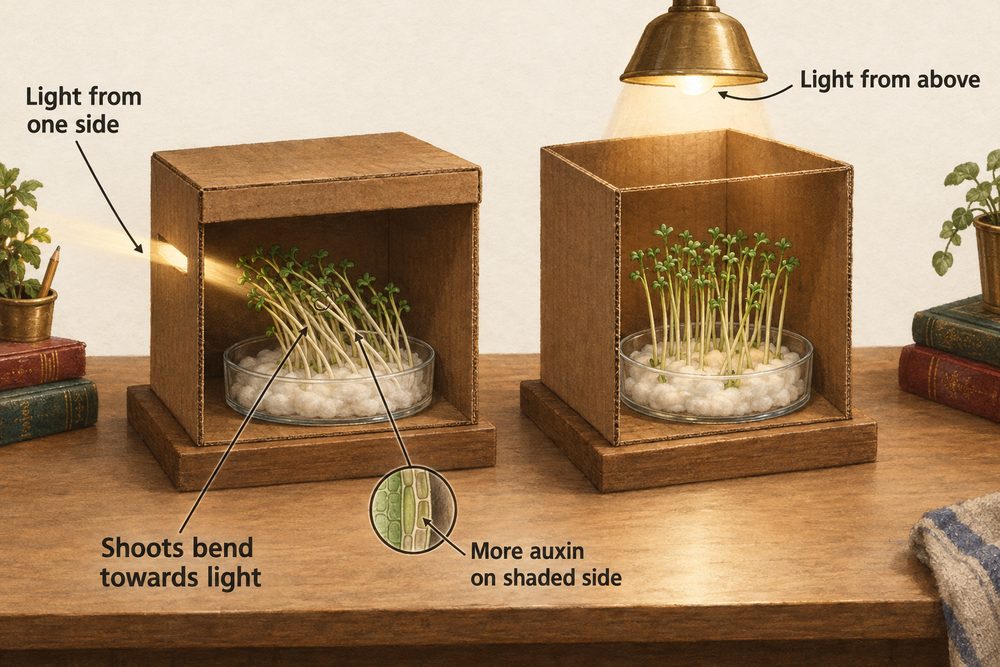
Gravitropism (response to gravity): in roots, auxin accumulates on the lower side due to gravity. However, root cells are more sensitive to auxin — high auxin concentration inhibits elongation in roots. So, the lower side of a horizontal root grows less, causing the root to bend downward (positive gravitropism). Shoots show negative gravitropism — they bend away from gravity.
Commercial uses of auxins: Synthetic auxins (weedkillers) are applied to broad-leaved weeds. At high concentrations, auxins cause uncontrolled, unsustainable growth that kills the plant. Narrow-leaved grass plants are less sensitive to these auxin concentrations, so selective weedkillers kill broad-leaved weeds in lawns without harming the grass. Auxin is also the active ingredient in rooting powder, which stimulates root development when applied to plant cuttings, enabling growers to produce genetically identical plants efficiently.
Gibberellins
Gibberellins are hormones produced throughout the plant that promote growth and development in several ways:
- Seed germination: Gibberellins break seed dormancy by activating enzymes that digest food stores in the seed (e.g. converting starch to glucose), providing energy and building materials for the germinating embryo.
- Stem elongation: Gibberellins stimulate internode elongation, promoting taller plants by causing cells in the stem to elongate more than they would otherwise.
- Fruit development: Applied to grape flowers, gibberellins cause fruits to form without fertilisation (parthenocarpy), producing larger, seedless grapes. This is a major commercial application in viticulture.
Gibberellins have three key roles: breaking seed dormancy by activating food-store enzymes; promoting stem elongation; and stimulating fruit development. Commercially, they are used to produce seedless grapes (parthenocarpy) and to accelerate germination in crops such as barley for brewing.
Ethene
Ethene is unusual among plant hormones because it is a gas. It diffuses through and between plant cells and coordinates several processes:
Fruit ripening: Ethene triggers the breakdown of chlorophyll (causing colour change from green to yellow or red), conversion of starch to sugars (increasing sweetness), and softening of cell walls. This makes fruit more palatable and attractive to seed-dispersing animals.
Commercial fruit ripening: Bananas and other fruits are shipped when unripe (hard and green) to reduce bruising during transport. On arrival, they are exposed to controlled doses of ethene gas in ripening rooms to trigger uniform ripening. This allows supermarkets to sell ripe fruit with minimal waste.
Preventing over-ripening: Conversely, fruits can be stored in low-oxygen, low-ethene atmospheres (controlled atmosphere storage) to delay ripening and extend shelf life. Removing ethene from the storage atmosphere pauses the ripening signal.
Leaf abscission: Ethene also promotes the formation of an abscission layer at the base of leaf stalks, causing leaves to fall in autumn. It coordinates senescence (ageing and breakdown) of plant organs at the end of the growing season.