Hormones: Adrenalin, Thyroxine and the Menstrual Cycle
The Endocrine System
The endocrine system uses hormones as chemical messengers. Hormones are secreted directly into the blood by endocrine glands and are carried to target organs, where they bind to specific receptors and trigger a response. Unlike nervous signals (fast, localised, short-lived), hormonal responses are slower to initiate but longer-lasting and affect a wider area of the body.
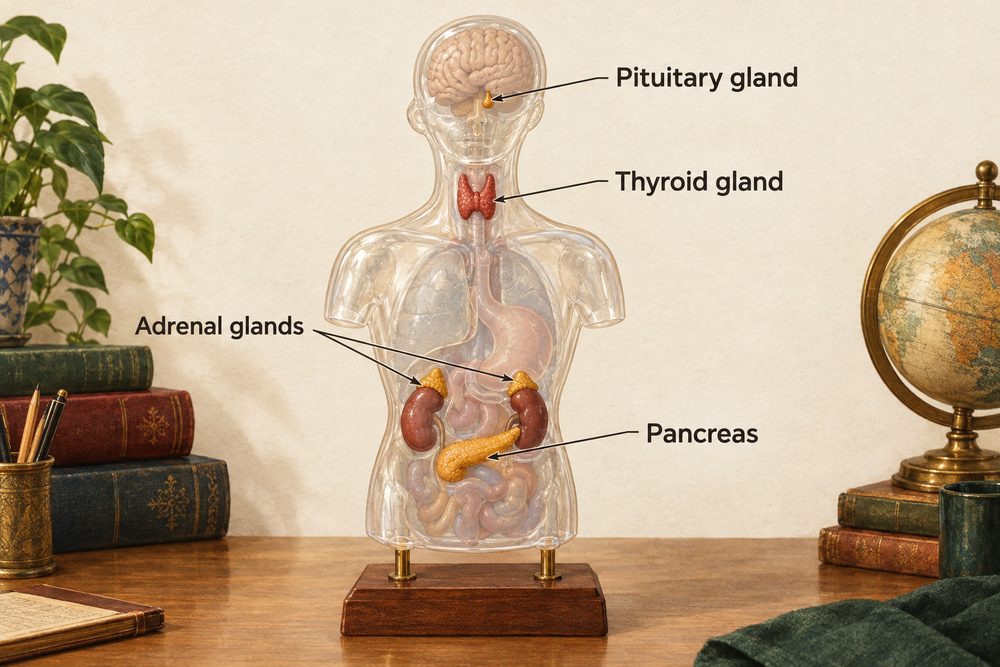
The pituitary gland in the brain is the master gland: it detects hormone levels in the blood and secretes hormones that stimulate other glands to produce or stop their own hormones. Key glands and their hormones include:
- Pituitary gland (base of brain) — produces FSH, LH, TSH, growth hormone and ADH.
- Thyroid gland (neck) — produces thyroxine, which regulates metabolic rate.
- Pancreas (abdomen) — produces insulin and glucagon to control blood glucose.
- Adrenal glands (above kidneys) — produce adrenalin for the fight-or-flight response.
- Ovaries (female) — produce oestrogen and progesterone.
- Testes (male) — produce testosterone.
The pituitary gland is the ‘master gland’ — it controls other endocrine glands. Hormones travel in the blood to target organs. Hormonal responses are slower but longer-lasting and more widespread than nervous responses.
Adrenalin and the Fight-or-Flight Response
Adrenalin is secreted by the adrenal glands in response to sudden stress, danger or excitement. It prepares the body for immediate action by triggering the fight-or-flight response:
- Heart rate increases — more blood (and therefore more oxygen and glucose) delivered to muscles per minute.
- Blood glucose rises — adrenalin stimulates the liver to break down glycogen into glucose, providing fuel for muscle contraction.
- Blood diverted to muscles — arterioles to digestive organs constrict; those to muscles dilate, redirecting blood flow.
- Airways dilate — bronchioles widen to allow greater air flow, increasing oxygen delivery to the blood.
- Pupils dilate — to increase the amount of light entering the eye, improving vision for detecting threats.
Every component of the fight-or-flight response increases the body’s capacity for explosive physical activity — either fighting or fleeing. The non-essential processes (digestion, fine motor control) are temporarily suppressed; resources are redirected to the systems needed for survival. The response is rapid because it involves the nervous system triggering adrenalin release, which then acts on multiple organs simultaneously — demonstrating how the nervous and endocrine systems work together.
Thyroxine and Negative Feedback
Thyroxine is produced by the thyroid gland and regulates the body’s basal metabolic rate — the rate at which cells use energy at rest. It is essential for normal growth, development and cell function.
Thyroxine levels in the blood are regulated by a negative feedback loop involving three organs:
1. The hypothalamus in the brain monitors blood thyroxine levels. When thyroxine is low, it releases TRH (thyrotropin-releasing hormone).
2. TRH signals the pituitary gland, which releases TSH (thyroid-stimulating hormone) into the blood.
3. TSH reaches the thyroid gland, stimulating it to produce and release more thyroxine into the blood. Metabolic rate rises.
4. As thyroxine levels rise back to normal, the hypothalamus detects this and reduces TRH release — which reduces TSH — which reduces thyroxine production. This ‘switching off’ of the stimulus when the outcome is achieved is negative feedback. It prevents thyroxine from rising indefinitely.
Thyroxine regulation: hypothalamus releases TRH → pituitary releases TSH → thyroid produces thyroxine → high thyroxine suppresses TRH and TSH release (negative feedback). This keeps metabolic rate within a normal range.
The Menstrual Cycle
The menstrual cycle is approximately 28 days long and is controlled by four hormones interacting through feedback mechanisms. It prepares the uterus for potential pregnancy each month:
FSH (follicle-stimulating hormone): released by the pituitary gland in the first half of the cycle. It stimulates a follicle in the ovary to mature (the egg inside begins to develop) and causes the ovary to produce oestrogen.
Oestrogen: produced by the ovaries as the follicle matures. It causes the uterus lining to thicken and build up with blood vessels, ready for a fertilised egg. Oestrogen inhibits further FSH release (negative feedback — preventing multiple follicles maturing) and at high levels stimulates a surge in LH from the pituitary.
LH (luteinising hormone): its surge around day 14 triggers ovulation — the mature egg is released from the follicle into the fallopian tube.
Progesterone: produced by the empty follicle (now called the corpus luteum) after ovulation. It maintains the uterus lining and inhibits FSH and LH. If no fertilisation occurs, the corpus luteum breaks down, progesterone levels fall, the uterus lining breaks down, and menstruation begins. The cycle then restarts.
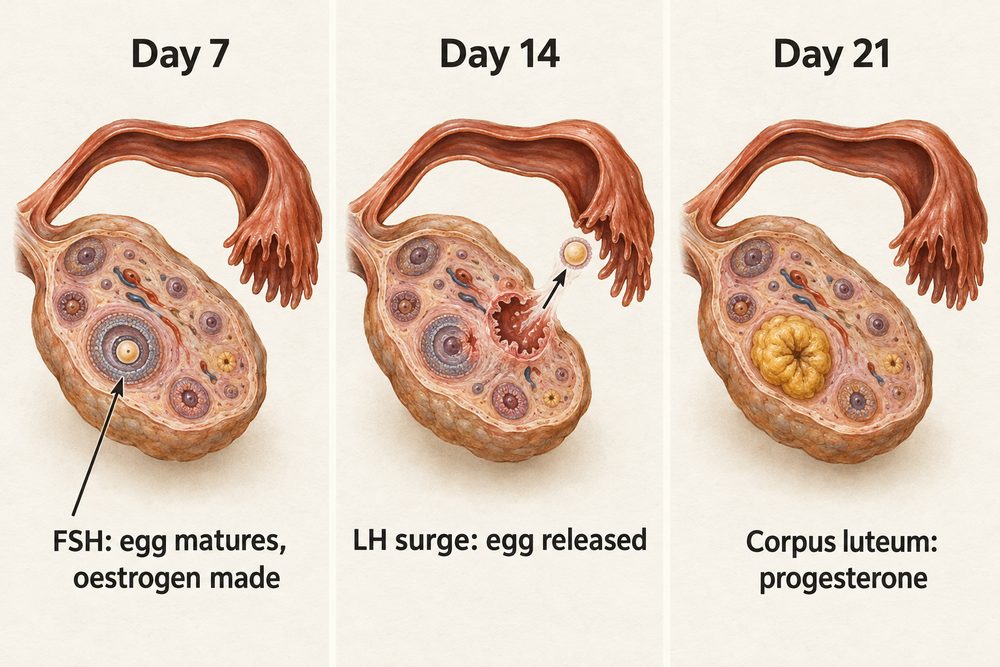
Menstrual cycle hormones: FSH (pituitary → matures follicle, triggers oestrogen) → Oestrogen (ovaries → thickens uterus lining, triggers LH surge) → LH surge (pituitary → ovulation on day ~14) → Progesterone (corpus luteum → maintains lining; drops if no fertilisation → menstruation).
Fertility Treatments: IVF and Clomifene
Some women have difficulty conceiving because they do not produce enough FSH to mature eggs. Clomifene is a fertility drug that blocks oestrogen receptors in the hypothalamus. The hypothalamus interprets this as low oestrogen and increases its release of signals that stimulate FSH production. Higher FSH levels stimulate follicle maturation and ovulation, increasing the chance of conception.
IVF (in vitro fertilisation) involves: giving the woman FSH and LH injections to stimulate multiple follicles to mature; collecting the eggs by minor surgery; fertilising them with sperm in a laboratory dish; allowing embryos to develop for a few days; and transferring one or two embryos to the uterus. IVF raises ethical questions — it is emotionally and physically demanding, expensive, has a limited success rate, can result in multiple pregnancies, and raises questions about the status of unused embryos.