Homeostasis: Thermoregulation, Blood Glucose and Diabetes
What Is Homeostasis?
Homeostasis is the maintenance of a stable internal environment inside the body. Your cells need precise conditions to carry out chemical reactions — particularly for enzyme activity. If conditions drift too far from the optimum, enzymes stop working efficiently and cells can be damaged or die. The body therefore constantly monitors and adjusts conditions including body temperature, blood glucose concentration, and water balance (osmoregulation).
Homeostasis maintains optimum internal conditions for enzyme activity. All control systems share three components: receptors (detect change), a coordination centre (processes information) and effectors (produce the response).
Most homeostatic systems work through negative feedback. When a variable rises above its set point, the response brings it back down. When it falls below the set point, the response pushes it back up. This keeps internal conditions within a narrow, safe range.
Thermoregulation — Controlling Body Temperature
The core human body temperature is approximately 37°C — the optimum for most enzymes. The hypothalamus acts as the body’s thermostat. It contains thermoreceptors that detect the temperature of the blood flowing through it and compares this to the set point. The hypothalamus also receives information from thermoreceptors in the skin about the external temperature.
The skin is the main organ of thermoregulation. It has two structural layers: the outer epidermis, which is avascular and protective, and the deeper dermis, which contains capillaries, sweat glands and hair follicles. Adjustments in the dermis drive most of the body’s temperature responses.
When body temperature rises above the set point, the hypothalamus coordinates four responses. First, blood vessels in the skin undergo vasodilation — the arterioles supplying skin capillaries widen, bringing more warm blood close to the skin surface so heat radiates outward. Second, sweating increases — sweat glands secrete more sweat, and as water evaporates from the skin surface it absorbs latent heat from the body, cooling it. Third, hair follicle muscles relax so hairs lie flat, reducing the insulating layer of trapped air. Fourth, skeletal muscles reduce any involuntary shivering.
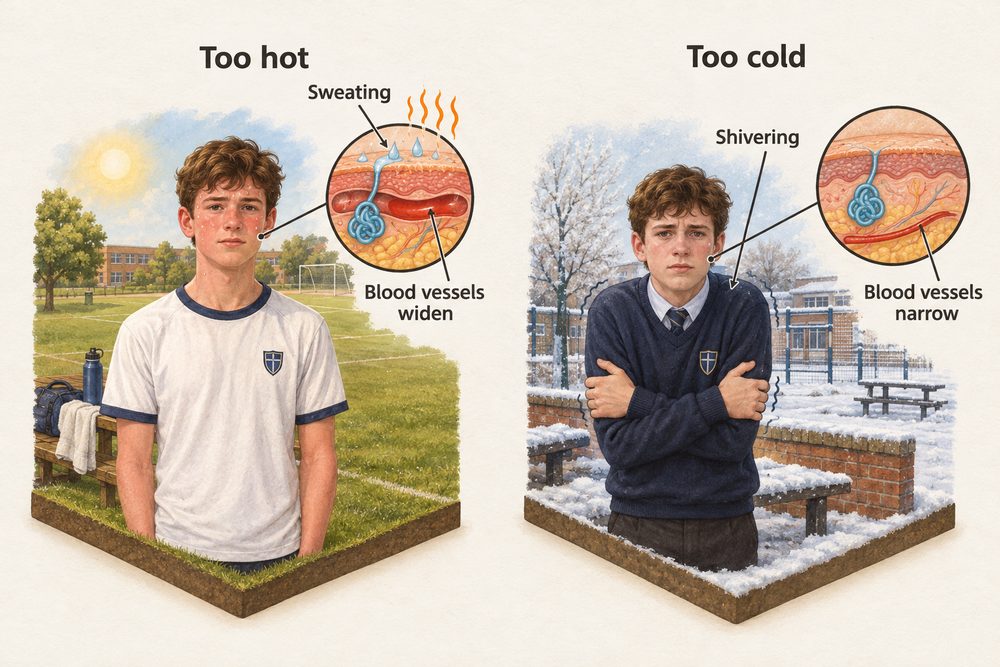
When temperature drops below the set point, the hypothalamus coordinates opposite responses. Arterioles near the skin surface undergo vasoconstriction — they narrow, diverting blood away from the skin so less heat radiates outward. Sweating decreases. Hair erector muscles contract, pulling hairs upright to trap a thicker layer of insulating air. The body also begins shivering — rapid, involuntary contractions of skeletal muscles generate heat through respiration.
Vasodilation widens skin blood vessels, bringing more blood to the surface and increasing heat loss by radiation. Vasoconstriction narrows them, conserving heat. Vasodilation and vasoconstriction are Higher tier only, and are often tested in extended-response questions.
Blood Glucose Control
Blood glucose concentration must stay within a narrow range. After eating, it rises; during exercise it can fall. The pancreas continuously monitors blood glucose and secretes two hormones to correct deviations.
When blood glucose rises above the set point, the pancreas secretes insulin. Insulin causes body cells (especially muscle and liver cells) to take up more glucose from the blood. It also stimulates the liver to convert excess glucose into glycogen through glycogenesis. Both actions lower blood glucose back toward the set point.
When blood glucose falls below the set point, the pancreas secretes glucagon. Glucagon triggers glycogenolysis — the conversion of stored glycogen back into glucose, which is released into the blood. This raises blood glucose back to the set point. Together, insulin and glucagon maintain blood glucose in a classic negative feedback loop: each hormone opposes the effect of the other.
Insulin (beta cells) lowers blood glucose: glucose enters cells; liver converts glucose to glycogen. Glucagon (alpha cells) raises blood glucose: liver converts glycogen back to glucose. This is a negative feedback loop. Higher tier only.
Diabetes Mellitus
Diabetes is a condition in which blood glucose is not properly controlled. There are two main types.
Type 1 diabetes is an autoimmune condition in which the immune system destroys the beta cells of the pancreas. Without insulin, blood glucose rises dangerously after meals. It usually develops in childhood or adolescence and is not related to lifestyle. Treatment requires regular insulin injections (or an insulin pump), along with careful monitoring of diet and blood glucose levels. Without treatment, blood glucose can reach dangerously high levels.
Type 2 diabetes develops when body cells become resistant to insulin. The pancreas may still produce insulin but the cells no longer respond effectively. It is strongly associated with being overweight or obese. It is typically managed by dietary changes (reducing sugar and refined carbohydrates), increasing physical activity, and sometimes medication. In some cases, weight loss alone can reverse the condition.
Body mass index (BMI) is calculated as mass (kg) divided by height squared (m2): $$\text{BMI} = \frac{\text{mass (kg)}}{\text{height}^2 \text{ (m}^2\text{)}}$$ A BMI above 30 is classed as obese. Waist-to-hip ratio compares the circumference of the waist to the hips and is an indicator of where fat is stored; higher ratios are associated with greater health risk. Both measures can indicate elevated risk of type 2 diabetes.