Kidneys, Urinary System and ADH
The Urinary System
The urinary system removes metabolic waste from the blood and regulates the water and salt content of the body. It consists of two kidneys, each connected to the bladder by a ureter. Urine passes from the bladder to the outside through the urethra. The kidneys receive blood from the renal arteries and return filtered blood to the circulation via the renal veins.
The most important waste product removed by the kidneys is urea. Urea is produced in the liver when excess amino acids are broken down. It is toxic in high concentrations and must be continuously removed from the blood. The kidneys also remove excess water, excess mineral ions (such as sodium) and other soluble waste products.
The urinary system: kidneys → ureters → bladder → urethra. The kidneys filter urea (produced in the liver from excess amino acids), excess water and mineral ions from the blood to form urine.
The Nephron
Each kidney contains approximately one million tiny tubules called nephrons. The nephron is where filtration and reabsorption take place. Blood enters each nephron’s filtering unit at the glomerulus, which is a knot of capillaries enclosed in a cup-shaped structure called the Bowman’s capsule.
The high blood pressure in the glomerulus forces small molecules out of the blood and into the Bowman’s capsule — this is ultrafiltration. The filtrate contains water, glucose, urea, mineral ions and amino acids. Large molecules such as proteins and blood cells are too big to pass through and remain in the blood.
Selective reabsorption occurs as the filtrate travels along the nephron’s tubule. All glucose and amino acids are reabsorbed into the surrounding capillaries by active transport (which requires energy from respiration). Most water is reabsorbed by osmosis. Useful mineral ions are also reabsorbed. By the time the filtrate reaches the collecting duct, it contains mainly urea, excess water and excess mineral ions — this becomes urine.
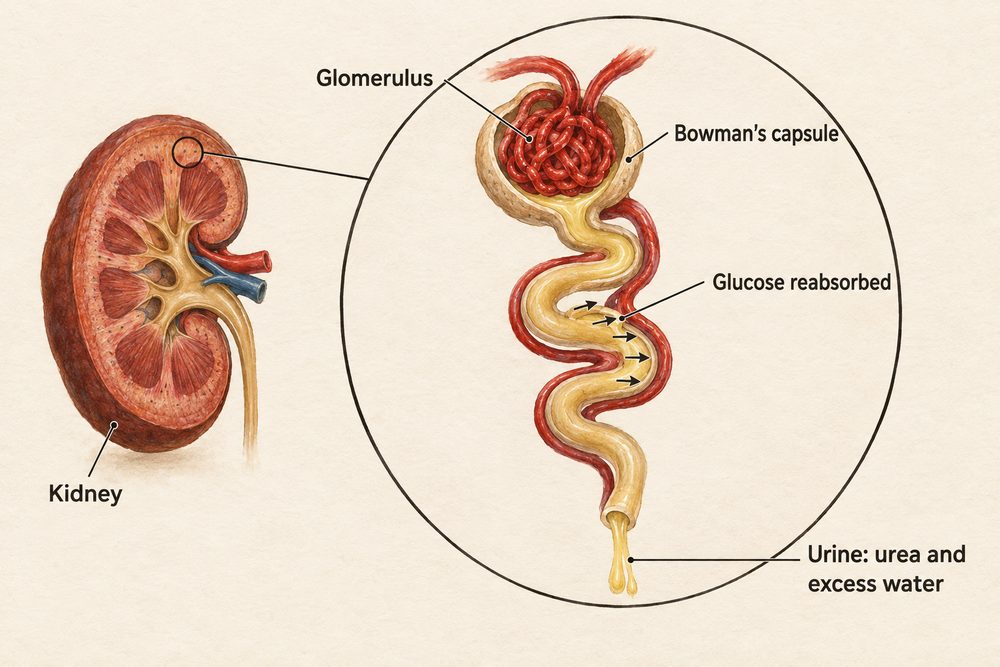
The cells lining the nephron tubule have microvilli (tiny projections that increase surface area) and many mitochondria to supply energy for active transport. These adaptations maximise the efficiency of reabsorption.
All glucose is reabsorbed from the filtrate by active transport in the nephron tubule. Healthy urine therefore contains no glucose. The presence of glucose in urine is an indication that blood glucose is too high for full reabsorption — a sign of uncontrolled diabetes.
ADH and the Control of Water Balance
The volume of water reabsorbed by the kidneys is controlled by ADH (anti-diuretic hormone). ADH is produced by the hypothalamus and released by the pituitary gland into the bloodstream.
When the blood becomes too concentrated (e.g. when you are dehydrated or have eaten a salty meal), the hypothalamus detects the low water potential of the blood. More ADH is released into the blood. ADH travels to the collecting duct of the nephron and makes it more permeable to water. More water is reabsorbed by osmosis into the surrounding capillaries, so a smaller volume of more concentrated urine is produced.
When blood water potential is too high (e.g. after drinking a large volume of water), the hypothalamus detects this and less ADH is released. The collecting duct becomes less permeable to water, so less water is reabsorbed. A larger volume of more dilute urine is produced. This is a classic negative feedback loop: the response (changing ADH levels) reverses the original change in blood water potential.
Kidney Failure: Dialysis and Transplants
If the kidneys fail, waste products and excess water accumulate in the blood. Without treatment, this is fatal. There are two main treatments.
Dialysis uses a machine to filter the blood artificially. Blood is passed through a machine where it flows on one side of a partially permeable membrane, while dialysis fluid flows on the other side. Urea and excess mineral ions diffuse across the membrane into the dialysis fluid. The dialysis fluid is carefully formulated to maintain the correct concentrations of glucose and mineral ions, so these are not lost from the blood. Patients typically require dialysis sessions several times per week, each lasting several hours.
A kidney transplant replaces the failed kidney with a healthy donor kidney. If the transplant is successful it gives the patient much greater freedom and quality of life than dialysis. However, the immune system may reject the new organ — to reduce this risk, donors are matched as closely as possible by tissue type and patients take immunosuppressant drugs for life, which increases their vulnerability to infection.
Dialysis is widely available and avoids major surgery, but it is time-consuming, requires repeated sessions, restricts diet and quality of life, and does not cure kidney failure. A kidney transplant restores near-normal function and is a long-term solution, but it requires matching a suitable donor, involves major surgery with associated risks, and requires lifelong immunosuppression. Organ availability is limited by the number of donors.