Ecosystems, Biodiversity and Material Cycles
Levels of Organisation in Ecosystems
Living things exist in a hierarchy of levels. An ecosystem is the largest level: it includes all the organisms in a habitat together with the non-living factors that affect them. Within the ecosystem, a community is made up of all the different species. A population is all the individuals of a single species.
Abiotic factors include light intensity, temperature, moisture level, soil pH, mineral content, wind speed and availability of water. Biotic factors include food availability, predators, pathogens and competition. Interactions between abiotic and biotic factors determine which species can live in a habitat and in what numbers.
Organisms in a community can interact in different ways. Parasitism is where one organism benefits at the direct expense of another (e.g. fleas living on a dog). Mutualism is where both organisms benefit (e.g. oxpecker birds eating insects on cattle — the bird gets food, the cattle lose parasites).
Ecosystem → community (all species) → population (one species). Abiotic factors are non-living; biotic factors are living. Stable communities maintain balanced populations when abiotic and biotic factors are in equilibrium.
Sampling Techniques: Quadrats and Belt Transects
To investigate the distribution and abundance of organisms in a habitat, scientists use systematic sampling methods. A quadrat is a square frame placed at random (using random numbers to generate coordinates) in the habitat. The number or percentage cover of organisms inside is recorded. Multiple quadrats are used to give a representative mean.
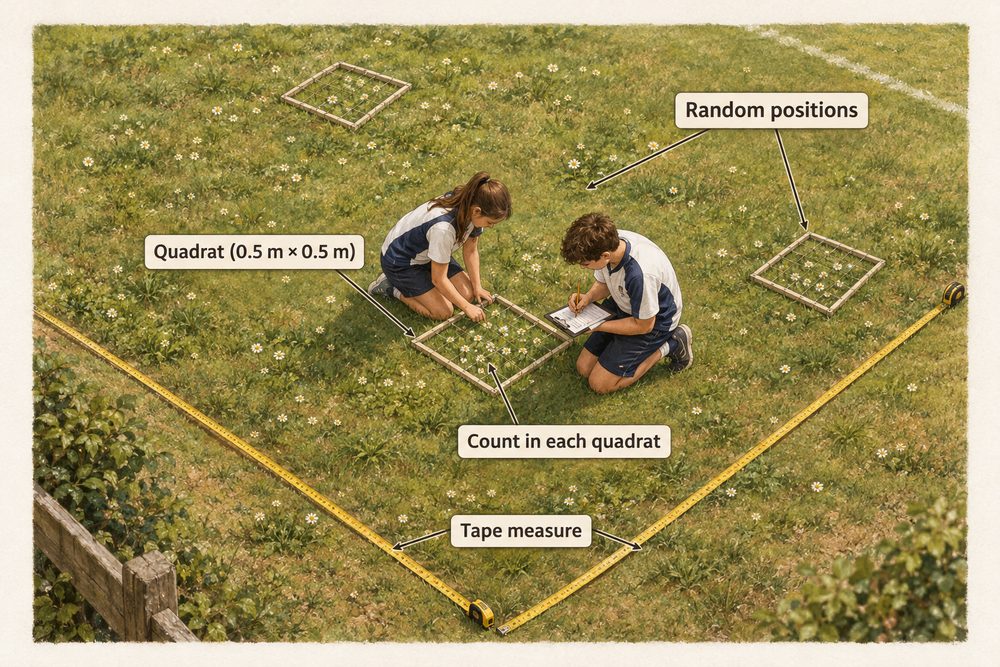
A belt transect is used to investigate how species distribution changes along an environmental gradient — for example, from the edge of a woodland into open grassland, or up a rocky shore. Quadrats are placed at regular intervals along the transect line and species recorded at each position. This reveals zonation: changes in species distribution that correlate with the changing abiotic conditions.
Quadrats are used to estimate the abundance or percentage cover of species in a habitat, using random sampling. Belt transects are used when species distribution is expected to change along a gradient. Both are core practical techniques — know the apparatus, method, control variables and how data are analysed.
Trophic Levels and Energy Transfer
Energy enters ecosystems through photosynthesis in producers (plants and algae). Energy then passes through organisms at each trophic level as organisms eat each other. At each transfer, most energy is lost as heat from respiration, through waste materials and in parts of organisms that are not eaten. Typically, only about 10% of energy at one trophic level is transferred to the next — this limits food chains to around four or five levels.
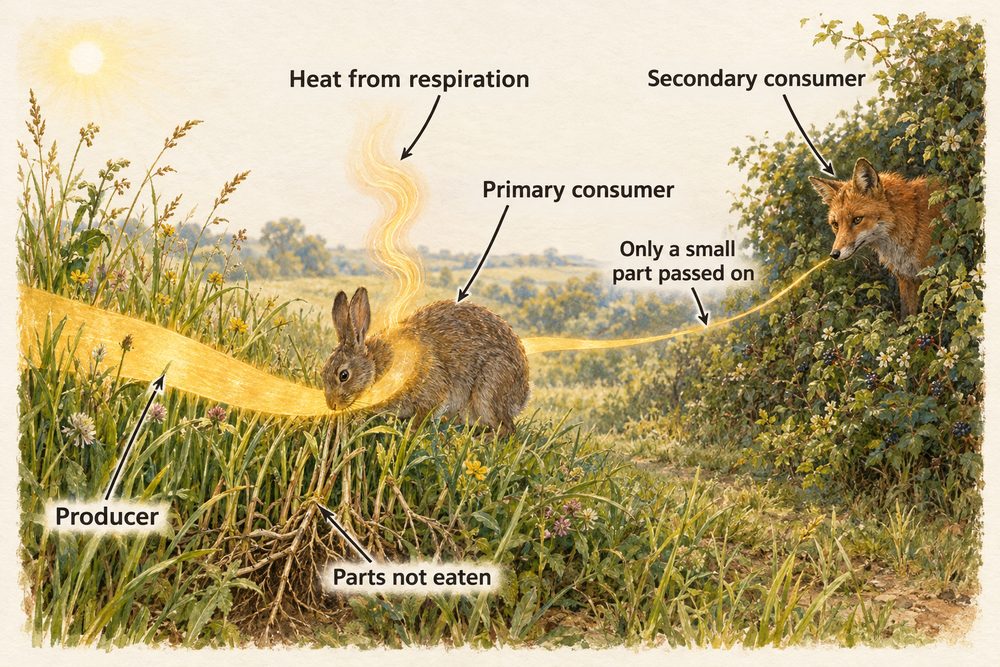
Energy transfer efficiency can be calculated: $$\text{efficiency (\%)} = \frac{\text{energy transferred to next level}}{\text{energy available at current level}} \times 100$$ For example, if 10,000 kJ is available at trophic level 1 (producers) and only 1,000 kJ reaches trophic level 2 (primary consumers), the transfer efficiency is 10%. This low efficiency is why fish farming (raising fish in enclosures and controlling feeding) can be more energy-efficient than wild fishing: energy is not lost through the fish swimming large distances or maintaining body temperature in cold water.
Non-indigenous (invasive) species introduced into a new habitat can outcompete native species, leading to population declines or local extinction. For example, grey squirrels introduced to the UK outcompete red squirrels for food and carry a disease (squirrelpox) to which red squirrels have no immunity.
Eutrophication occurs when excess fertiliser (nitrates and phosphates) runs off agricultural land into rivers and lakes. This causes rapid algal growth (an algal bloom), which blocks light from underwater plants, causing them to die. Decomposers break down the dead plant matter, consuming dissolved oxygen. The low oxygen levels kill fish and other aquatic organisms, reducing biodiversity.
Biodiversity and Food Security
Biodiversity refers to the variety of different species in an ecosystem. High biodiversity means ecosystems are more stable and resilient — if one species declines, others can take over some of its roles. Human activities — deforestation, pollution, overexploitation of natural resources — are driving a significant loss of biodiversity worldwide.
Strategies to maintain biodiversity include habitat protection and restoration, reforestation (replanting trees where forests have been cleared), wildlife breeding programmes for endangered species, and seed banks that preserve plant genetic diversity. Maintaining biodiversity also supports food security by preserving the genetic diversity of crop species and the wild species that act as pollinators and pest controllers.
Food security means that people have reliable access to sufficient, safe and nutritious food. Threats include growing global population, changes in climate affecting crop yields, spread of new crop diseases, and limited freshwater supplies. Solutions include developing drought-resistant crop varieties through selective breeding or genetic technology, reducing food waste and improving the efficiency of food production systems.
The Carbon Cycle and the Water Cycle
Carbon is constantly cycled through the environment. Producers remove carbon dioxide from the atmosphere through photosynthesis, incorporating it into organic molecules. Animals eat producers and use carbon in their own bodies. When organisms respire, carbon is returned to the atmosphere as CO2. When organisms die, decomposers break down dead organic matter through respiration and decay, releasing CO2 back into the atmosphere. Combustion of fossil fuels is an additional pathway that returns carbon stored over millions of years to the atmosphere in a short time.
The water cycle describes the continuous movement of water between the atmosphere, land and living organisms. Water evaporates from oceans, lakes and soil; plants release water vapour through transpiration. Water vapour rises and condenses to form clouds, then falls as precipitation. Run-off and rivers return water to the sea. Desalination can supplement freshwater supplies in arid regions but requires significant energy input.