Cellular Respiration and Cell Structures
What is Cellular Respiration?
Cellular respiration is a chemical process that takes place continuously in every living cell. It is not the same as breathing — respiration is a series of chemical reactions inside cells that transfer energy from glucose to a molecule called ATP (adenosine triphosphate). This energy powers everything cells do: muscle contraction, nerve impulse transmission, protein synthesis and active transport.
Respiration is an exothermic reaction — it releases energy to the surroundings. This is why your body generates heat, and why your temperature rises during exercise.
Cellular respiration is a chemical reaction inside cells — it is NOT breathing. It breaks down glucose and transfers the energy to ATP. It is exothermic, and occurs continuously in all living cells — animals, plants, fungi and bacteria alike.
Aerobic Respiration
Aerobic respiration uses oxygen and takes place mainly in the mitochondria. Because glucose is completely broken down, aerobic respiration yields a large amount of ATP — far more than anaerobic respiration. This is why organisms with high energy demands (such as muscles during sustained exercise) rely primarily on aerobic respiration.
The word equation is:
$$\text{glucose} + \text{oxygen} \rightarrow \text{carbon dioxide} + \text{water} + \text{energy (ATP)}$$
The balanced symbol equation is:
$$C_6H_{12}O_6 + 6O_2 \rightarrow 6CO_2 + 6H_2O$$
Anaerobic Respiration
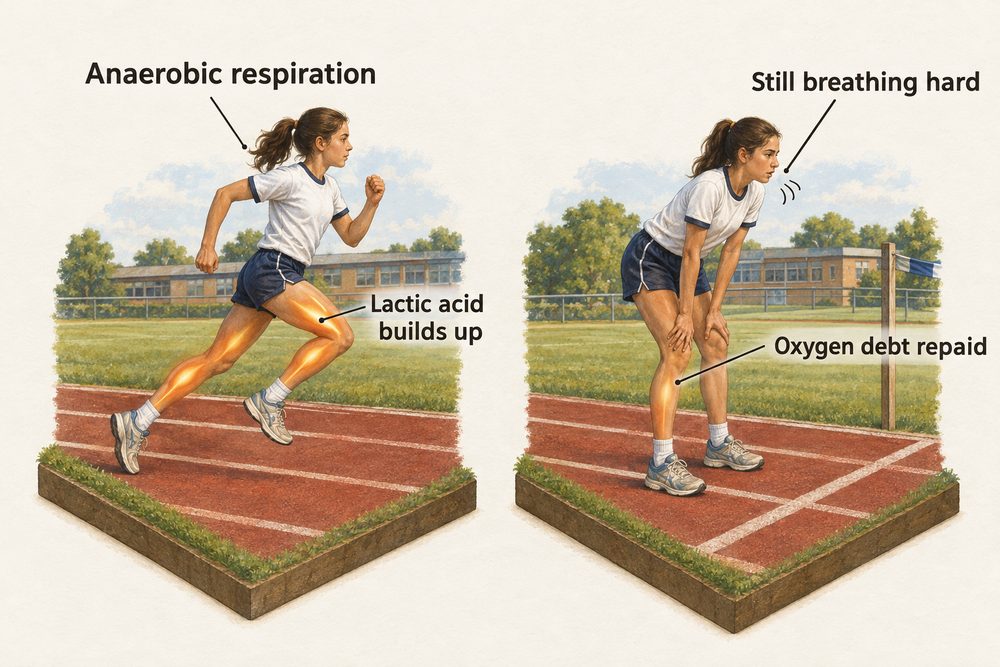
Anaerobic respiration occurs when oxygen supply cannot keep up with demand — for example, during intense exercise. Because glucose is not fully broken down, far less ATP is produced. In animals and humans, the product is lactic acid, which builds up in muscles causing the burning sensation of fatigue.
The word equation for anaerobic respiration in animals is:
$$\text{glucose} \rightarrow \text{lactic acid} + \text{energy (ATP)}$$
In yeast (and other microorganisms), anaerobic respiration produces ethanol and carbon dioxide — this process is called fermentation. The equations are:
$$\text{glucose} \rightarrow \text{ethanol} + \text{carbon dioxide} + \text{energy (ATP)}$$
Aerobic respiration produces a much larger ATP yield than anaerobic respiration because glucose is fully broken down. Anaerobic respiration in animals produces lactic acid; in yeast it produces ethanol + carbon dioxide (fermentation). Both of these happen when oxygen is in short supply; aerobic respiration needs oxygen.
After intense exercise, you continue to breathe heavily even though you have stopped moving. This is because your body needs extra oxygen to break down the lactic acid that accumulated during anaerobic respiration — this is called the oxygen debt. The liver converts lactic acid back to glucose using this extra oxygen. Heart rate and breathing rate remain elevated until all the lactic acid has been removed and the oxygen debt is repaid.
Mitochondria: The Cellular Power Stations
Mitochondria (singular: mitochondrion) are the site of aerobic respiration. They have two membranes: a smooth outer membrane and a highly folded inner membrane. The folds, called cristae, increase the surface area for the reactions of aerobic respiration to take place. Cells with high energy demands — muscle cells, liver cells, sperm cells — contain hundreds or thousands of mitochondria.
Mitochondria were first observed under light microscopes in the nineteenth century, but their function was unknown. Researchers working through the mid-twentieth century gradually worked out that these structures were the site of aerobic respiration by isolating them from cell homogenates and testing which reactions they could carry out. This is a good example of how scientific knowledge builds incrementally: first observation (structure), then experimental isolation (function), then detailed biochemical analysis of the reaction steps. Modern electron microscopy later revealed the cristae in detail, explaining why the surface area of the inner membrane is so large.
This progression from observation to mechanism illustrates a core principle of science: each new technique reveals a new level of detail, and earlier models are refined rather than discarded entirely.
Comparing Aerobic and Anaerobic Respiration
It is important to be able to compare the two types of respiration clearly:
- Oxygen required? Aerobic: yes. Anaerobic: no.
- ATP yield: Aerobic: high. Anaerobic: low.
- Products: Aerobic: CO₂ and water. Anaerobic: lactic acid (animals) or ethanol + CO₂ (yeast).
- Location: Aerobic: mainly mitochondria. Anaerobic: cytoplasm.
Applications: Fermentation in Industry and Food
The process of fermentation by yeast is exploited in several industries. In bread-making, yeast ferments sugars in dough, producing carbon dioxide that causes the bread to rise (the ethanol evaporates during baking). In brewing and wine-making, yeast converts sugars in grains or grapes into ethanol. The fermentation must be carefully controlled: too little oxygen at the start limits yeast growth; too much will switch yeast to aerobic respiration, reducing ethanol yield.
Bacteria also carry out anaerobic respiration. Lactobacillus bacteria ferment lactose in milk to produce lactic acid — which lowers the pH and causes the milk proteins to coagulate, forming yoghurt and cheese. Understanding the biochemistry of respiration has allowed scientists to optimise these processes and, more recently, to develop biofuels such as bioethanol as more sustainable alternatives to fossil fuels.