Transport in the Body
Diffusion
Diffusion is the net movement of particles from a region of high concentration to a region of low concentration — down a concentration gradient. Diffusion is passive: it requires no energy input from the cell. The particles move by random motion until they are evenly spread.
The rate of diffusion is increased by:
- A steeper concentration gradient (larger difference in concentration across a surface)
- A larger surface area
- A thinner membrane (shorter diffusion distance)
- A higher temperature (particles move faster)
Diffusion is the net movement of particles down a concentration gradient — from high to low concentration. It is passive (no energy needed). Rate increases with steeper gradient, larger surface area, thinner membrane and higher temperature.
Osmosis
Osmosis is a special case of diffusion involving water. Water molecules move from a region of higher water potential (a more dilute solution) to a region of lower water potential (a more concentrated solution) through a partially permeable membrane. Like diffusion, osmosis is passive and requires no energy.
Osmosis is vital for cells: if the fluid surrounding a cell is more dilute than the cell contents, water moves into the cell by osmosis — the cell swells. If the surrounding fluid is more concentrated, water moves out and the cell shrinks. Red blood cells and plant cells are particularly affected by changes in the water concentration of their environment.
Plant cells placed in a very dilute solution gain water by osmosis and become turgid — the vacuole expands and pushes the cytoplasm against the cell wall, making the cell firm. This turgor pressure is what keeps plant stems and leaves rigid. In a concentrated solution, plant cells lose water, the vacuole shrinks and the membrane pulls away from the cell wall — the cell is said to be plasmolysed.
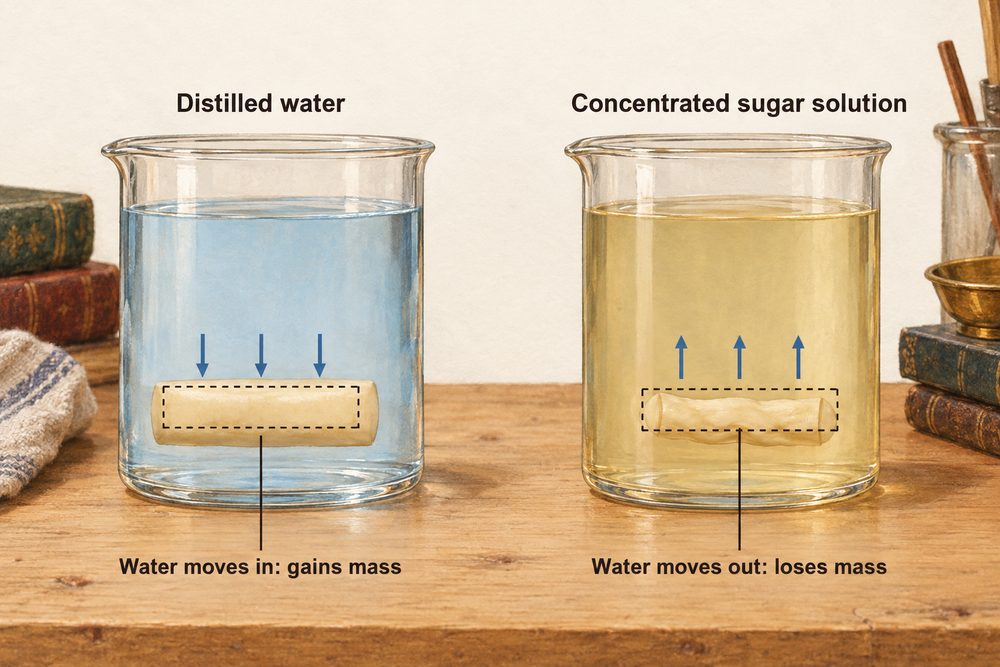
Animal cells, which have no cell wall, are more vulnerable to osmotic damage. A red blood cell placed in a very dilute solution will take in water until it bursts (lysis). In a concentrated solution it will shrink and become crenated (shrivelled). This is why intravenous fluids given in hospitals are carefully formulated to match the salt concentration of blood plasma.
Active Transport
Active transport moves substances against the concentration gradient — from low to high concentration. This requires energy from respiration and uses carrier proteins embedded in the cell membrane. Active transport is essential when cells need to absorb substances that are already present in higher concentration inside the cell.
Examples include: absorption of glucose from the small intestine into blood (when glucose concentration is already higher in the blood); uptake of mineral ions by root hair cells from soil (soil solution contains very low concentrations of minerals).
The Circulatory System
Humans have a double circulation: the blood passes through the heart twice for each complete circuit of the body — once through the lungs (pulmonary circuit) to pick up oxygen and remove carbon dioxide, and once through the body (systemic circuit) to deliver oxygen and nutrients to tissues. This allows mammals to maintain high blood pressure in both circuits and sustain the high metabolic rates needed for warm-blooded activity.
The human circulatory system is a double circulation: blood travels from the heart to the lungs (pulmonary circuit) and separately from the heart to the body (systemic circuit). The heart is the pump that drives both circuits.
Gas Exchange in the Alveoli
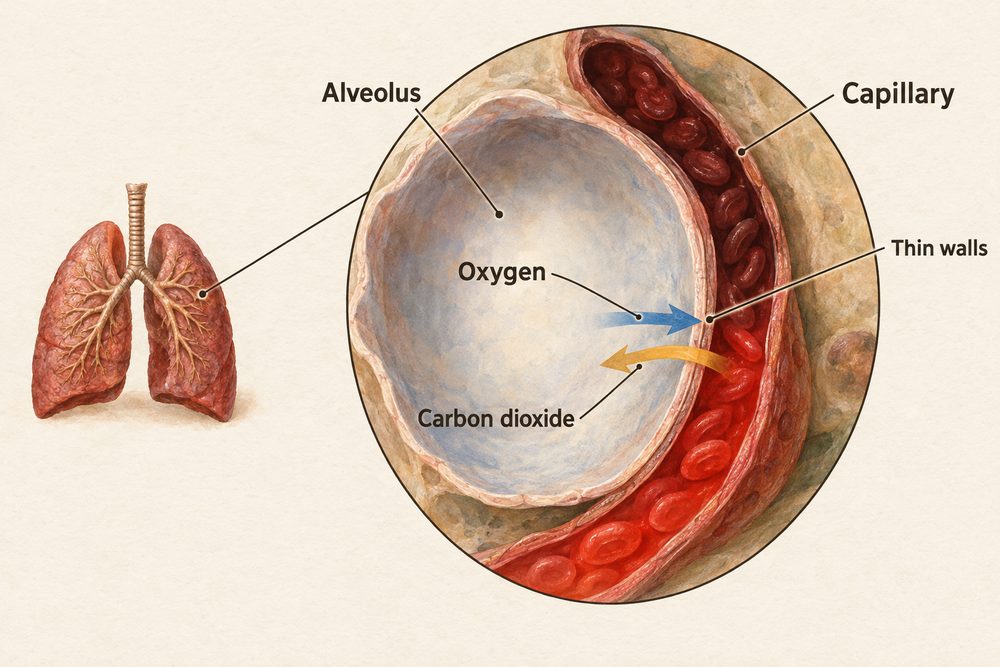
The lungs are adapted for efficient gas exchange through millions of tiny air sacs called alveoli. The alveoli have several adaptations that maximise the rate of diffusion:
- Very large surface area — millions of alveoli provide an enormous total surface area.
- Very thin walls — one cell thick, so the diffusion distance is minimal.
- Rich blood supply — capillaries surrounding each alveolus continuously carry oxygenated blood away and deliver deoxygenated blood, maintaining steep concentration gradients for both oxygen and carbon dioxide.
- Moist lining — gases must dissolve to cross cell membranes.
Blood Components and Their Functions
Blood is a tissue consisting of four main components, each transported around the body by the circulatory system:
- Red blood cells — contain haemoglobin, which binds to oxygen in the lungs and releases it in body tissues. Their biconcave shape gives a large surface area for oxygen uptake, and their lack of nucleus maximises haemoglobin content.
- White blood cells — part of the immune system. They engulf pathogens (phagocytes) or produce antibodies (lymphocytes) to defend the body against infection.
- Platelets — small cell fragments that trigger blood clotting at a wound site, preventing excessive blood loss and forming a barrier to infection.
- Plasma — the yellow liquid that carries red and white blood cells, platelets, dissolved glucose, amino acids, urea, hormones and carbon dioxide around the body.
All three processes move substances across membranes, but they differ in key ways:
- Diffusion — passive, down concentration gradient, any small molecule.
- Osmosis — passive, down water potential gradient, water only, through a partially permeable membrane.
- Active transport — requires energy from respiration, against concentration gradient, uses carrier proteins, specific molecules.
A common error is describing active transport as “pumping substances both ways” — it moves substances specifically against the gradient, not simply in a random direction.