Hormones, Homeostasis and Reproduction
Homeostasis and Hormonal Control
Homeostasis is the maintenance of a stable internal environment. Many homeostatic systems in the body use hormones — chemical messengers produced by glands and transported in the blood to target organs. Hormonal responses are slower than nervous responses but longer-lasting, making them well-suited for regulating sustained processes like blood glucose concentration and water balance.
Homeostatic control works through negative feedback: when a condition deviates from the normal range, the body detects the change and triggers a response that reverses it, returning conditions to the set point. This is how the body maintains blood glucose, temperature and water levels.
All homeostatic systems have three components: receptor (detects the change), coordination centre (processes the information — e.g. the pancreas or brain) and effector (brings about the corrective response). The system operates by negative feedback, reversing any deviation from the normal range.
Blood Glucose Regulation
Blood glucose concentration is controlled by the pancreas. When blood glucose rises after a meal, the pancreas secretes insulin. Insulin causes:
- Body cells (especially muscle and liver cells) to take up glucose from the blood.
- The liver to convert excess glucose into glycogen for storage (glycogenesis).
Blood glucose falls back to normal. If glucose stays too high, the condition is called diabetes mellitus.
Type 1 diabetes is an autoimmune condition in which the immune system destroys the insulin-producing beta cells in the pancreas. No insulin is produced, so blood glucose cannot be lowered. Management requires regular insulin injections or an insulin pump, and careful monitoring of carbohydrate intake.
Type 2 diabetes occurs when body cells become less sensitive (resistant) to insulin. The pancreas still produces insulin, but it is less effective. Risk factors include being overweight, physical inactivity and diet. It can often be managed through lifestyle changes (diet and exercise), though medication may also be prescribed. Type 2 diabetes is far more common than type 1 and is strongly linked to lifestyle factors, though genetic susceptibility also plays a role.
Glucagon and the Full Negative Feedback Loop
When blood glucose falls below the normal range (e.g. during exercise or fasting), the pancreas secretes glucagon. Glucagon stimulates the liver to convert stored glycogen back into glucose (glycogenolysis), raising blood glucose back to normal. This completes the negative feedback loop: insulin lowers glucose, glucagon raises it — together they maintain the blood glucose within a narrow normal range.
Water Balance and the Kidney
The body also regulates its water content through the kidneys. The kidneys filter blood and adjust how much water is reabsorbed into the blood before producing urine. This process is controlled by ADH (anti-diuretic hormone).
ADH is released by the pituitary gland when blood water potential falls (e.g. after sweating or not drinking enough). ADH travels in the blood to the kidneys, where it makes the collecting ducts more permeable to water. More water is reabsorbed into the blood, producing a smaller volume of more concentrated urine. As water potential returns to normal, ADH secretion decreases — a classic negative feedback loop.
The Menstrual Cycle
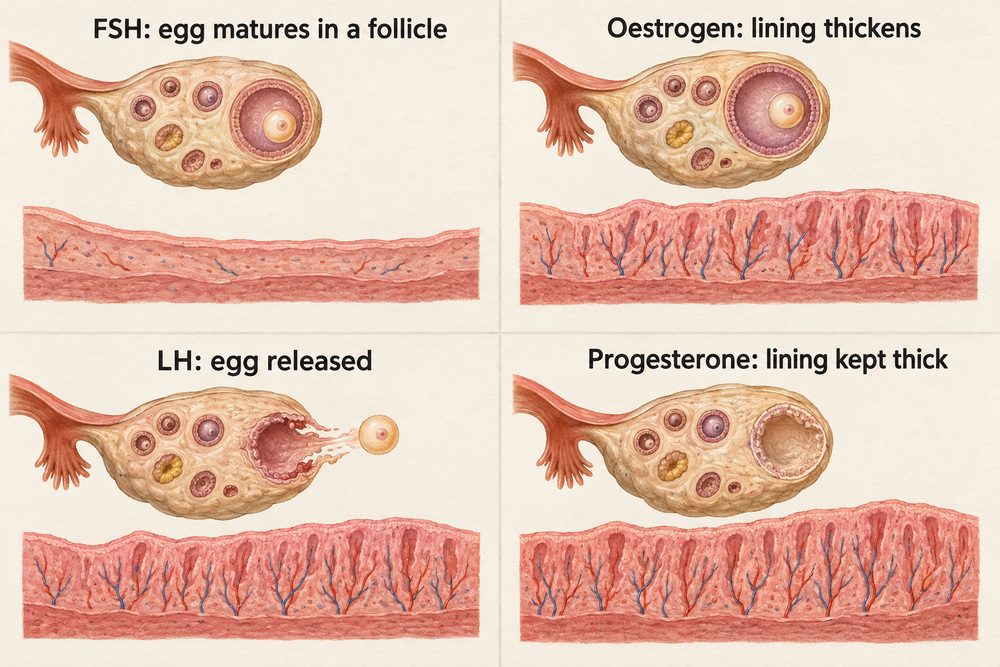
The menstrual cycle is a roughly 28-day hormonal cycle that prepares the uterus for possible pregnancy. It is controlled by four key hormones, all interacting through feedback mechanisms:
- FSH — released by the pituitary gland. It causes an egg to mature in the ovary and stimulates the ovary to produce oestrogen.
- Oestrogen — produced by the ovaries. It thickens the uterus lining and, at high levels, stimulates a surge of LH while inhibiting FSH.
- LH — the surge of LH triggers ovulation (release of the mature egg) around day 14.
- Progesterone — produced by the empty follicle after ovulation. It maintains the uterus lining. If no fertilisation occurs, progesterone levels drop, the lining breaks down, and menstruation begins.
Hormonal contraceptives (the pill, injection, implant or patch) prevent pregnancy by maintaining elevated levels of oestrogen and/or progesterone. This inhibits the release of FSH and LH from the pituitary gland, preventing follicle maturation and ovulation. Without ovulation, there is no egg to fertilise. Some hormonal contraceptives also thicken the cervical mucus, making it harder for sperm to reach any egg, and thin the uterus lining, making implantation less likely.
Thermoregulation: Maintaining Body Temperature
As well as blood glucose and water balance, the body must maintain a core temperature of around 37°C — the optimum for most human enzymes. The hypothalamus in the brain acts as the body’s thermostat, detecting changes in blood temperature and coordinating corrective responses (Higher tier).
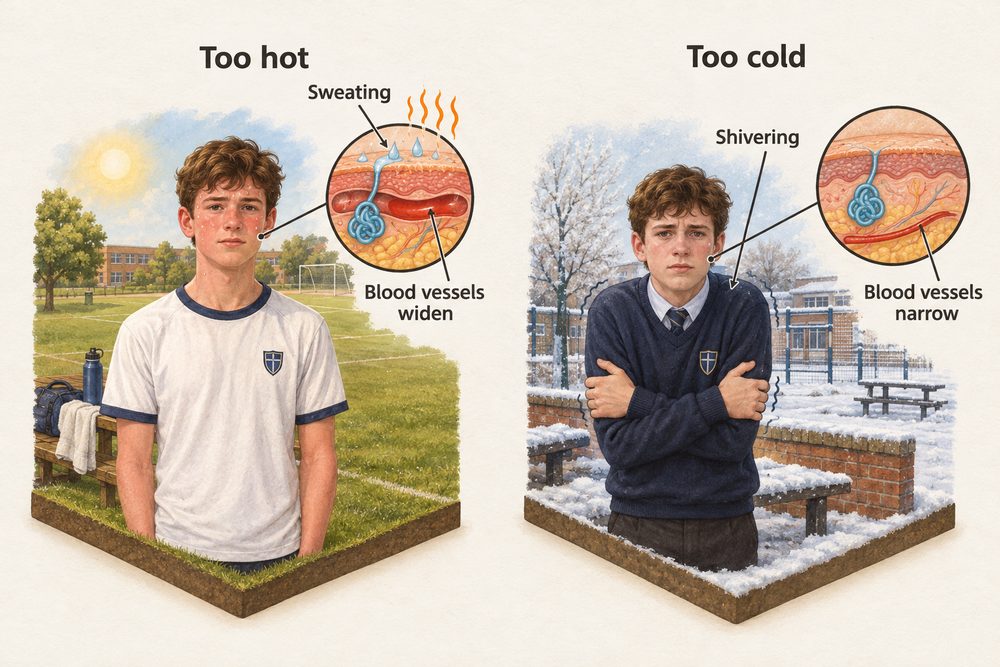
When body temperature rises too high (e.g. during exercise or in hot weather):
- Vasodilation — blood vessels near the skin surface widen (vasodilate), increasing blood flow to the skin so heat can be lost by radiation.
- Sweating — sweat glands release sweat onto the skin surface. As sweat evaporates, it takes energy (heat) from the skin, cooling the body.
When body temperature falls too low (e.g. in cold conditions):
- Vasoconstriction — blood vessels near the skin narrow, reducing blood flow to the skin and conserving heat for vital organs.
- Shivering — rapid, involuntary muscle contractions generate heat through increased respiration.
Both responses return body temperature to the set point by negative feedback — once temperature is restored, the hypothalamus switches off the corrective responses.