Pathogens and Disease
Health and Disease
Health is a state of physical and mental well-being — not simply the absence of illness. Disease disrupts the normal functioning of cells and tissues, producing symptoms. Diseases fall into two broad categories: communicable diseases, which can be passed between organisms, and non-communicable diseases, which cannot. Understanding the causes and routes of spread of communicable diseases is essential for preventing and controlling them in both human and plant populations.
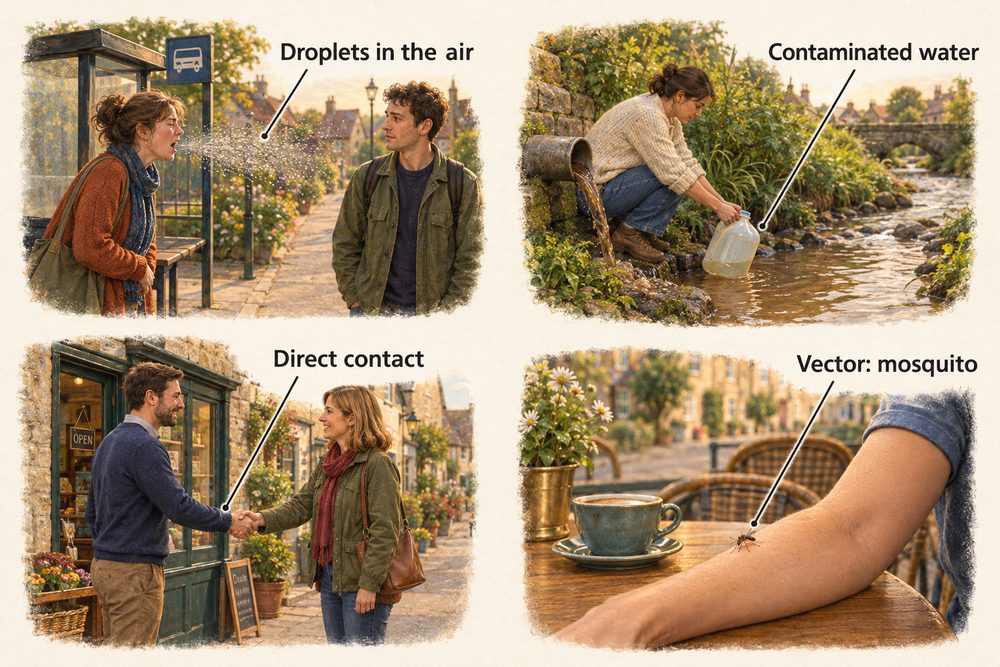
Communicable diseases are caused by pathogens — microorganisms that infect a host and cause harm. The four main types of pathogen are bacteria, viruses, fungi and protists. Each causes disease differently and requires a different approach to treatment or prevention.
The Four Types of Pathogen
Bacteria are single-celled prokaryotes. They can reproduce rapidly inside the body and cause disease in two main ways: by producing toxins (poisonous substances that damage host tissues) or by directly invading and destroying cells. Examples of human bacterial diseases include Salmonella food poisoning (transmitted through contaminated food or water) and Gonorrhoea (a bacterial sexually transmitted infection). Crown gall disease, caused by the bacterium Agrobacterium tumefaciens, affects plants by producing tumour-like growths on stems and roots.
Viruses are not cells — they are much smaller than bacteria and cannot reproduce outside a living host cell. Once inside, a virus injects its genetic material and hijacks the cell’s machinery to make thousands of new virus particles. The cell is often destroyed as new viruses burst out. Human viral diseases include influenza (spread by airborne droplets), HIV (spread through bodily fluids, causing AIDS), and in plants, tobacco mosaic virus (TMV) which causes distinctive mosaic patterning on leaves and reduces photosynthesis.
Fungi cause disease by growing on host tissue and releasing enzymes that break down cells. Athlete’s foot is a common human fungal infection affecting the skin between the toes. Ash dieback is a serious fungal disease that has devastated ash tree populations across Europe; the fungus prevents water flow through the tree, causing progressive dieback of branches and often death of the tree.
Protists are single-celled eukaryotes. The malaria parasite (Plasmodium) is a protist transmitted by the bite of infected female Anopheles mosquitoes. Once inside the human body, the parasite infects and destroys red blood cells, causing the cycles of fever that characterise malaria. Mosquitoes act as vectors — they carry the parasite between human hosts without being harmed by it themselves.
How Pathogens Spread
Different pathogens use different routes to move between hosts. Understanding transmission routes is central to designing effective prevention strategies. Common routes include:
- Airborne droplets: coughing or sneezing releases tiny droplets carrying pathogens. Influenza spreads this way.
- Direct contact: touching an infected person or surface. Athlete’s foot spreads through contact with contaminated surfaces in warm, damp places.
- Contaminated food or water: Salmonella is ingested in undercooked food or water contaminated with infected animal waste.
- Bodily fluids: HIV is transmitted through blood, sexual contact, and from mother to child during birth or breastfeeding.
- Animal vectors: malaria is transmitted through the bite of infected mosquitoes; the mosquito carries the parasite but does not develop the disease itself.
Plant diseases in this topic: tobacco mosaic virus (viral) — mosaic leaf patterns, reduced photosynthesis; ash dieback (fungal) — branch dieback and tree death; crown gall disease (bacterial) — tumour-like growths on stems and roots. All three can devastate populations of their host plant species.
The Body’s Natural Barriers
The human body has several non-specific defences that prevent pathogens from entering in the first place. These are described as non-specific because they act against any pathogen — they do not require the body to have encountered the pathogen before. The skin forms a physical barrier — unbroken skin is impermeable to most pathogens. In the respiratory tract, mucus traps pathogens and tiny hair-like structures called cilia sweep the mucus (with its trapped pathogens) away from the lungs. The stomach produces acid at a very low pH that kills most ingested pathogens. Tears and saliva contain enzymes (lysozyme) that break down bacterial cell walls. Beneficial bacteria in the gut occupy the available space and resources, competing with pathogens and making it harder for them to establish an infection.
If a pathogen does breach these first-line defences and enters the bloodstream or tissues, the immune system responds specifically to that pathogen. White blood cells called lymphocytes produce antibodies that bind to antigens on the pathogen’s surface, disabling or marking it for destruction. Other white blood cells can engulf and digest pathogens directly — a process called phagocytosis. Understanding these defences is essential for understanding how vaccines and other interventions work to enhance the body’s natural protection.
Plants have physical defences including a waxy leaf cuticle that prevents pathogen entry, and a cellulose cell wall that pathogens must breach to infect the cell. Plants also have chemical defences: they can produce antimicrobial substances in response to infection that slow or prevent pathogen spread within plant tissues. These active responses mean that the plant’s immune system, though simpler than a mammal’s, is dynamic — it responds to infection rather than simply acting as a passive barrier.