Stopping Infection — Vaccination and Hygiene
Strategies to Prevent Infection
Preventing communicable diseases requires strategies that target the pathogen, the host, or the route of transmission. For plant diseases, strategies include sourcing disease-free plant material, rotating crops so pathogens cannot persist in one site, destroying infected plants to prevent spread, and using chemical or biological controls. For human diseases, strategies include vaccination, hygiene measures, sterilising wounds, contraception (for sexually transmitted infections), and restricting movement of infected individuals or animals. Each strategy has costs, benefits and risks that must be weighed, and an individual’s right to choose must be balanced against what is best for the wider population.
Prevention strategies for communicable diseases vary by context. For humans: vaccination, hygiene and sanitation, sterilisation of wounds, contraception (for STIs), and travel restrictions. For plants: using healthy seeds, crop rotation, polyculture, destroying infected plants, and chemical or biological pesticide use.
How Vaccination Works
A vaccine introduces a safe form of a pathogen — or parts of it — into the body. The immune system responds by producing white blood cells called lymphocytes, which make antibodies specific to the pathogen’s antigens (surface markers). Some of these lymphocytes persist in the body as memory cells.
If the real pathogen is encountered in future, the memory cells recognise its antigens immediately and mount a rapid secondary response — producing the correct antibodies much faster than a first-time immune response could. This speed means the infection is usually cleared before symptoms develop. This is immunity.
First exposure (or vaccination): the immune system takes several days to identify the antigen, activate the correct lymphocyte clone, and produce antibodies in significant quantities. During this time, the pathogen may replicate and symptoms can develop. However, memory cells are formed.
Second exposure: memory cells recognise the antigen almost immediately. Antibodies are produced rapidly, typically before any symptoms appear. The infection is controlled quickly. This is the secondary immune response — faster and stronger than the primary response, which is why vaccination with a safe form of the pathogen can protect against future infection with the real pathogen.
Herd Immunity
When a large proportion of a population is immune to a pathogen — either through vaccination or previous infection — the spread of the pathogen slows dramatically. This is called herd immunity. Immune individuals cannot pass the pathogen on, so the chain of transmission breaks before the pathogen reaches those who are not immune — including vulnerable people (such as newborns or immunocompromised individuals) who cannot receive certain vaccines.
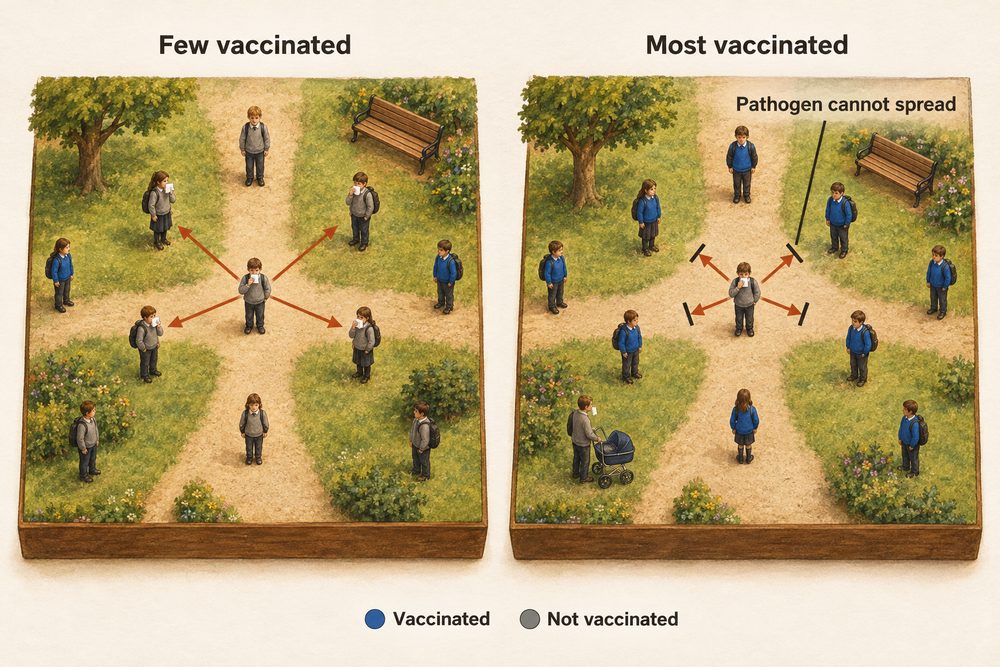
Vaccination decisions involve weighing individual risk against collective benefit. A vaccine may carry a small risk of side effects; a person might question whether that risk is worth taking if most others around them are vaccinated and herd immunity already provides protection. However, if too many people reason this way, the proportion of immune individuals falls below the threshold needed for herd immunity, and outbreaks can follow. This is a classic tension in public health between individual rights and collective responsibility.
The likely effectiveness, benefits, risks and cost of vaccination programmes must be assessed by scientists and public health bodies. Where evidence shows benefits substantially outweigh risks across the population, vaccination is recommended. Where uptake is low, disease resurges — as has occurred with measles in some regions following misinformation about vaccine safety. Sound decisions in this area require understanding of data, scientific evidence, and how to evaluate competing claims.
Herd immunity works by breaking chains of transmission. When enough of the population is immune, a pathogen cannot find new hosts easily enough to spread. Vulnerable individuals (the very young, elderly, or immunocompromised) are protected indirectly because the pathogen rarely reaches them. The proportion of the population that must be immune varies by pathogen — it is generally higher for very infectious pathogens.
Identifying Pathogens in the Lab: Monoclonal Antibodies
Identifying which pathogen is causing an infection is essential for choosing the right treatment. Traditional methods include culturing samples on nutrient agar, observing colonies under a microscope, and testing sensitivity to antimicrobials. A more modern and highly specific method uses monoclonal antibodies.
First, an antigen (the target molecule) is injected into an animal, stimulating the immune system to produce antibody-producing lymphocytes. Cells producing the correct antibody are then identified and isolated. These cells are cultured to produce large quantities of identical antibodies, all of which recognise the same specific antigen. Because they come from a single clone of cells, they are called monoclonal (‘one clone’) antibodies.
Monoclonal antibodies can be used in diagnostic tests: if the target antigen is present in a sample (such as blood or urine), the antibody binds to it, producing a detectable signal. This approach is used in pregnancy tests (detecting a hormone produced in early pregnancy), in rapid diagnostic tests for certain infections, and in more sophisticated ELISA tests (enzyme-linked immunosorbent assays) used in laboratories to identify pathogens or measure concentrations of substances in blood.
The high specificity of monoclonal antibodies — each antibody binds only to its precise target antigen — means diagnostic tests using them are more accurate and can produce results faster than traditional culture methods. This matters when rapid diagnosis allows quicker treatment decisions and reduces the spread of infections while a patient waits for results. New technologies based on monoclonal antibodies continue to be developed, with the potential to improve diagnosis of a wide range of conditions.