Lifestyle, Genes and Non-Communicable Disease
What Makes a Disease Non-Communicable?
Not all diseases spread from person to person. Non-communicable diseases (NCDs) are conditions linked to how we live, the genes we inherit, and the environment around us. They include cardiovascular diseases, type 2 diabetes, many cancers, and obesity-related conditions. Because NCDs develop slowly and are often preventable, understanding their causes is one of the most powerful tools in public health.
Scientists and doctors identify risk factors — variables that increase the probability of a disease developing. Identifying risk factors guides both individual choices and government health policy. Crucially, a risk factor is not the same as a cause: this distinction is at the heart of how we reason about evidence in science.
Non-communicable diseases cannot be transmitted between people. They are associated with risk factors — genetic, lifestyle or environmental — that raise the probability of disease. Having a risk factor does not guarantee a person will develop the disease.
Correlation vs Causation — The Critical Distinction
One of the most important ideas in science is the difference between correlation and causation. When two things tend to change together — for example, people who smoke more tend to have higher rates of lung cancer — we say there is a correlation. But correlation alone does not tell us that one variable is causing the other.
A confounding variable is a hidden factor that might explain a correlation without there being a direct causal link. For example, people who sleep very little also tend to drink more caffeine, exercise less, and have higher stress levels — any of these could be the true driver of a health outcome. Good epidemiological research tries to control for confounding variables by studying very large populations and using statistical techniques to isolate individual factors.
Moving from correlation to causation requires multiple lines of evidence. Scientists look for: (1) a plausible biological mechanism — can we explain why the factor might cause the disease at the cellular or physiological level? (2) a dose-response relationship — does more of the risk factor lead to greater disease risk? (3) consistency across studies — do researchers in different countries with different populations reach the same conclusion? (4) temporality — does exposure to the factor come before the disease develops?
Peer review is essential here. Results from a single study — even a large one — are not treated as definitive until they have been scrutinised by independent scientists and replicated. This is why scientific consensus on lifestyle and health has built up gradually over decades, not from a single dramatic finding.
Major Risk Factors for Non-Communicable Diseases
Research has identified a range of lifestyle, genetic and environmental factors associated with increased risk of NCDs. These include diet, physical activity, alcohol consumption, smoking, and inherited genetic variants.
Diet and obesity: A diet consistently high in saturated fats and added sugars is associated with raised blood cholesterol, fatty deposits in arteries, and increased risk of cardiovascular disease and type 2 diabetes. Carrying excess body fat — particularly around the abdomen — is correlated with insulin resistance, hypertension, and cardiovascular risk. BMI is commonly used as a screening tool, though it does not distinguish between muscle and fat mass.
Physical inactivity: Regular physical activity is associated with lower blood pressure, improved blood sugar regulation, and a reduced risk of both cardiovascular disease and certain cancers. Inactivity is itself treated as a risk factor, not just the absence of benefit.
Smoking: Tobacco smoke contains hundreds of harmful chemicals. Long-term smoking is strongly and causally linked (multiple mechanisms established) to lung cancer, coronary heart disease, and stroke. It also raises the risk of several other cancers. Smoking during pregnancy is associated with lower birth weight in babies.
Alcohol: Excessive alcohol consumption over time is associated with liver disease, certain cancers, hypertension, and cardiovascular disease. There is a dose-response relationship — risk generally rises with increasing consumption. Occasional, moderate alcohol intake is harder to categorise from the evidence; confounding variables make this area complex.
Genetic Risk Factors
Some people inherit gene variants that raise their susceptibility to certain NCDs, regardless of lifestyle. For example, some individuals inherit a tendency to produce high levels of LDL cholesterol (LDL cholesterol), which increases cardiovascular risk even in people who eat a healthy diet. Similarly, certain gene variants increase the lifetime risk of developing type 2 diabetes.
Genetic risk factors interact with lifestyle factors — someone with a genetic predisposition to heart disease who also smokes and is physically inactive faces a compounded risk. This interaction makes it misleading to separate “genes” from “lifestyle” as if they operate independently. Understanding your genetic risk can motivate earlier lifestyle changes and more frequent health screening.
Genetic risk factors (inherited gene variants) and lifestyle risk factors (diet, exercise, smoking) interact. A person with a genetic predisposition to high LDL cholesterol faces even greater cardiovascular risk if their lifestyle also includes smoking or physical inactivity.
Cardiovascular Disease and Type 2 Diabetes
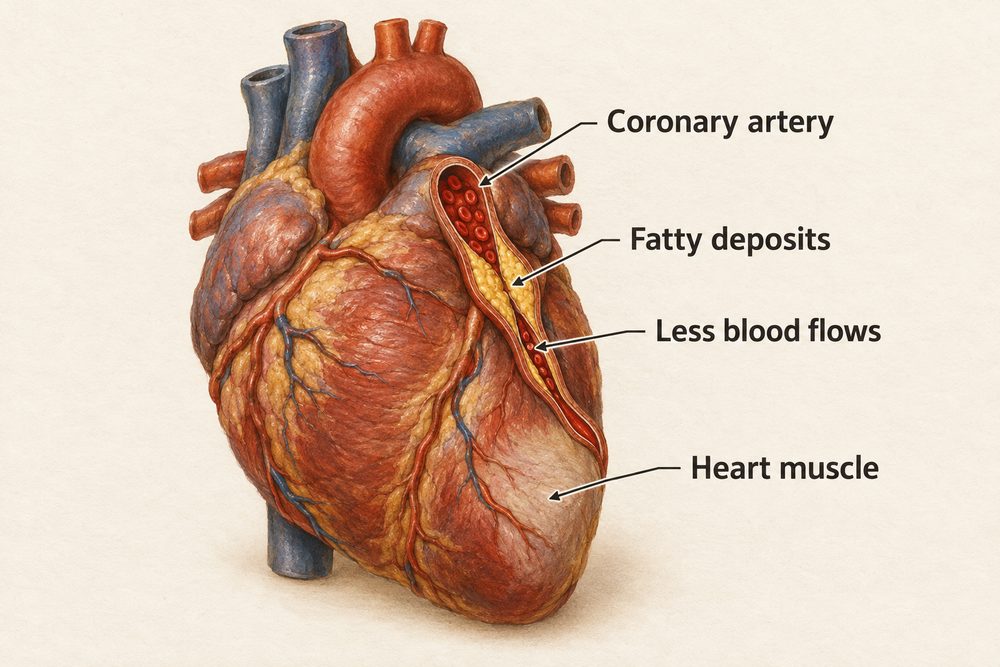
Cardiovascular disease (CVD) develops when fatty deposits accumulate inside artery walls — a process called atherosclerosis. These deposits narrow the artery, reducing blood flow and raising blood pressure. If a coronary artery becomes severely blocked, the heart muscle is starved of oxygen, leading to a heart attack. If a cerebral artery is blocked or bursts, the result is a stroke.
Type 2 diabetes involves the body’s cells becoming resistant to insulin. Blood glucose levels remain elevated after eating, putting stress on blood vessels and organs over time. It is strongly associated with obesity, physical inactivity and a diet high in refined sugars — but genetic factors also contribute. Unlike type 1 diabetes (an autoimmune condition), type 2 is often preventable through lifestyle changes, though it has a complex genetic component too.
Epidemiology is the scientific discipline that investigates the patterns of disease across populations. Epidemiologists use data from sources such as national health surveys, hospital records, and large cohort studies (which follow groups of people over many years) to identify which factors are associated with higher or lower rates of disease.
One challenge in epidemiology is the outlier. Within any large dataset, some individuals will have a very different outcome from the majority — a lifelong smoker who lives to a very old age, for example. Outliers do not disprove a risk factor; they remind us that risk is probabilistic, not deterministic. Scientists do not automatically remove outliers from data; they investigate whether there is a genuine reason (measurement error, a different genetic background) before deciding how to handle them.
Correlation means two variables tend to change together. Causation means one directly produces the other. To establish causation, scientists need a plausible biological mechanism, a dose-response relationship, consistency across studies, and evidence that exposure precedes disease.