Treating Disease — Drugs and Trials
Why We Need New Medicines
Developing a new medicine is one of the longest and most expensive processes in science. From initial discovery to reaching patients, it can take more than a decade. Most candidate compounds fail somewhere along the way — they may prove toxic, ineffective, or only marginally better than existing treatments. Understanding the pipeline from laboratory to pharmacy shelf is important both scientifically and as a lesson in how evidence informs decisions.
Medicines work by interacting with specific biological targets — receptors, enzymes, or pathways — to alter the body’s response to disease. Before any new drug reaches a patient, it must pass through a series of testing stages designed to establish that it is safe and effective. These stages generate the evidence base that regulators and clinicians use to decide whether a drug should be approved.
Stage 1: Preclinical Testing
Preclinical testing is carried out in the laboratory before any human volunteers are involved. Candidate compounds are tested on cells grown in culture and on animal models. These tests look at whether the drug has any biological activity against the target, whether it is toxic to cells at the doses being considered, and how the body metabolises and eliminates it.
Preclinical testing narrows down a large number of candidates to a smaller set that appears promising enough to justify human trials. It does not guarantee safety in humans — human physiology differs from animal physiology in important ways — but it removes the most obviously dangerous or ineffective candidates before any person is put at risk.
Preclinical testing uses cells and animals to check a drug’s basic safety and biological activity before any human testing begins. It eliminates the most dangerous or ineffective candidates but cannot guarantee human safety.
Stage 2: Clinical Trials
Clinical trials test new drugs in human participants. They proceed in phases, each with a different goal. Early phases use small numbers of healthy volunteers to establish that the drug is safe and to find an effective dose range. Later phases involve larger groups of patients with the target disease to test whether the drug actually works.
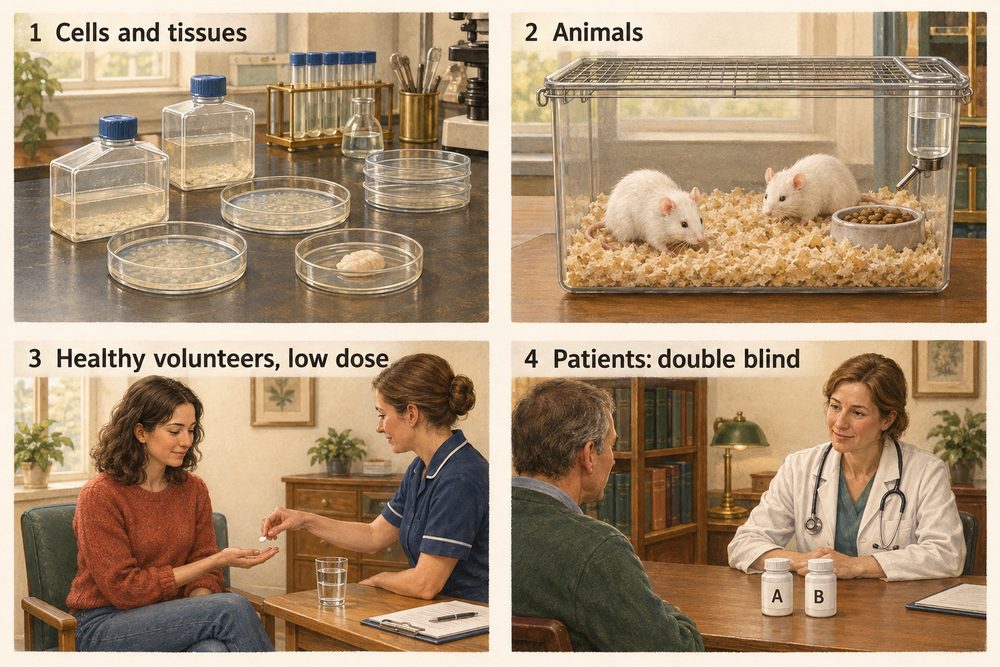
Phase 1 — a small number of healthy volunteers (typically a few dozen). The aim is to test safety, identify side effects, and determine how the drug behaves in the human body (pharmacokinetics). Doses start very low and are gradually increased.
Phase 2 — a larger group of patients with the target condition (typically hundreds). The aim is to gain initial evidence of effectiveness and to refine the dosing. Researchers also continue monitoring safety.
Phase 3 — a large-scale trial involving many hundreds or thousands of patients, often across multiple hospitals and countries. The drug is compared against the current best treatment (or a placebo, if no treatment exists). This phase provides the main evidence used by regulators to decide on approval.
Post-approval surveillance (Phase 4) — once a drug is approved and in use, monitoring continues in the general population. This can detect rare side effects that were too uncommon to appear in clinical trials.
Placebo Controls and Blind Trials
A placebo is an inactive substance that looks and feels identical to the real drug. Using a placebo as a control is essential because patients who believe they are receiving treatment often report improvements in symptoms — this is the placebo effect. Without a placebo control, it is impossible to know whether any improvement is due to the drug itself or to the psychological expectation of getting better.
To prevent bias from influencing results, trials use blinding. In a double-blind trial, neither the participants nor the researchers who are administering the treatment know who is in which group. The allocation is randomised and the code is only broken after all data have been collected. This prevents both patients and doctors from unconsciously behaving differently based on their knowledge of who received the drug.
A placebo control allows the true drug effect to be separated from the placebo effect. In a double-blind trial, neither the patient nor the administering researcher knows who receives the drug — this removes bias from both reporting and administration. Randomisation ensures the groups are comparable.
Antibiotics and the Problem of Resistance
Antibiotics are medicines that kill or slow the growth of bacteria. They work by targeting structures or processes that bacteria have but human cells lack — for example, bacterial cell walls or particular enzymes. This selectivity is what makes them useful: they harm the pathogen without (ideally) harming the patient.
However, bacteria reproduce rapidly and can evolve resistance. Antibiotic resistance arises when random mutations give some bacterial cells a survival advantage against the drug. These bacteria survive, reproduce, and pass on the resistance. Over time, if antibiotics are overused or misused — for example, taken for viral infections, or not completed as prescribed — resistant strains become dominant in a population.
MRSA (methicillin-resistant Staphylococcus aureus) is a well-known example of a drug-resistant bacterium. It is resistant to many commonly used antibiotics, making infections difficult to treat. MRSA spreads most readily in environments where many people are in close contact and where antibiotic use is high — hospitals are a particular concern.
Reducing antibiotic resistance requires coordinated action: doctors prescribing antibiotics only when appropriate, patients completing their courses, and researchers developing new classes of antibiotics. The pipeline for new antibiotics has slowed in recent decades because the development costs are high and the commercial returns are lower than for drugs used long-term. This creates a genuine public health challenge that involves both scientific and economic decision-making.
Peer Review and Evaluating Drug Evidence
When clinical trial results are published, they are subject to peer review. Reviewers who were not involved in the trial examine the methodology, statistical analysis, and conclusions. They may identify flaws, request additional data, or reject the paper if the evidence is insufficient. Peer review does not guarantee a paper is correct — errors can still slip through — but it provides an important quality filter.
Evaluating drug evidence also involves considering conflict of interest. Research funded by a pharmaceutical company that manufactures the drug being tested may be subject to reporting bias — the tendency for positive results to be published more readily than negative ones. Independent replication by separate research groups, and access to full trial data (not just selected results), strengthens the evidence base considerably.
Peer review subjects scientific findings to scrutiny by independent experts before publication. Conflict of interest — especially industry funding — can introduce bias. Independent replication and full data access are important safeguards.