Photosynthesis and Plant Growth
Producers and the Flow of Energy
All food chains begin with a producer. Green plants and algae are producers because they capture light energy and use it to manufacture glucose — a process called photosynthesis. Without producers, no energy would enter the food web and life as we know it could not exist. This makes understanding photosynthesis central to understanding ecosystems.
Photosynthesis is an endothermic reaction: it takes in energy from the surroundings rather than releasing it. The light energy absorbed by the green pigment chlorophyll is converted into chemical energy stored in glucose molecules. This stored energy can then be released by respiration — in the plant itself and in every consumer that feeds on the plant.
Photosynthesis is endothermic and occurs in chloroplasts:
carbon dioxide + water → glucose + oxygen (using light energy)
\(6CO_2 + 6H_2O \rightarrow C_6H_{12}O_6 + 6O_2\)
Inside the Chloroplast
Photosynthesis occurs in chloroplasts, which are found mainly in the mesophyll cells of leaves. Chloroplasts contain stacks of membrane discs called grana, which have a large surface area for capturing light. Chlorophyll molecules embedded in these membranes absorb light — mainly red and blue wavelengths — which is why leaves appear green (green light is reflected, not absorbed).
Photosynthesis can be thought of in two stages. In the first stage, light energy is used to split water molecules, releasing oxygen as a by-product. In the second stage, the hydrogen ions released are used to convert carbon dioxide into glucose. Both stages take place within the chloroplast. The oxygen released enters the atmosphere, making photosynthesis the source of almost all atmospheric oxygen on Earth.
What Happens to Glucose in the Plant?
Once glucose is produced, the plant uses it in several ways:
- Respiration — glucose is broken down to transfer energy for the plant’s own metabolic processes, such as active transport and protein synthesis.
- Starch storage — excess glucose is converted to starch, which is insoluble and can be stored without drawing water into cells by osmosis.
- Cellulose — glucose is polymerised into cellulose for cell wall construction, giving the plant structural support.
- Amino acids and proteins — by combining glucose with nitrate ions absorbed from the soil, the plant makes amino acids, which are assembled into proteins for growth and enzymes.
Plants absorb mineral ions from the soil through their root hair cells by active transport. Nitrate ions (NO₃⁻) are used to make amino acids and proteins, and hence DNA. A deficiency in nitrate leads to stunted growth and yellowing of leaves because the plant cannot make adequate protein.
Magnesium ions (Mg²⁺) are needed to make chlorophyll. Without sufficient magnesium, chlorophyll production falls and leaves turn pale yellow-green — a condition called chlorosis. In the absence of chlorophyll, photosynthesis is severely limited, reducing the plant’s ability to grow.
Limiting Factors
The rate of photosynthesis is controlled by whichever factor is in shortest supply. A limiting factor is the one variable that, if increased, would allow the rate to rise. When conditions are otherwise ideal, increasing a limiting factor speeds up photosynthesis; when that factor is no longer limiting, a different one takes over.
Three main abiotic factors act as limiting factors: light intensity, carbon dioxide concentration, and temperature. Understanding them allows growers to optimise crop yields — for example, in a commercial greenhouse where all three factors can be controlled.
Light intensity: As light intensity increases, more energy is available for the light-driven stage of photosynthesis, so the rate rises. Eventually the rate plateaus because a different factor (CO₂ or temperature) becomes limiting. (Higher tier) Light intensity decreases with the square of the distance from the source: double the distance, quarter the intensity.
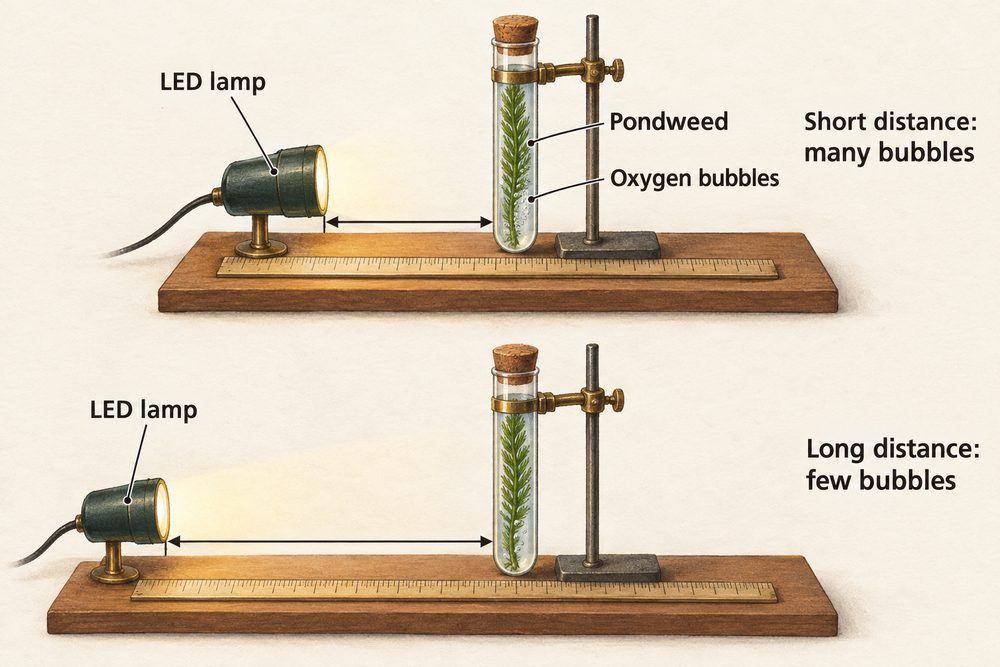
Carbon dioxide concentration: CO₂ is a raw material for the second stage of photosynthesis. Increasing CO₂ supplies more substrate for the carbon-fixation reactions, raising the rate. In greenhouses, farmers sometimes add CO₂ gas to boost yields.
Temperature: Photosynthesis is enzyme-controlled. As temperature rises, enzyme and substrate molecules move faster, increasing the collision rate and the reaction rate. Above the optimum temperature, enzymes begin to denature and the rate falls sharply.
Limiting factors for photosynthesis: light intensity, CO₂ concentration, temperature. At the plateau on a rate-vs-light-intensity graph, light is no longer limiting — another factor (CO₂ or temperature) has taken over. Increasing all three together can allow the rate to rise further.
Transpiration and Water Loss
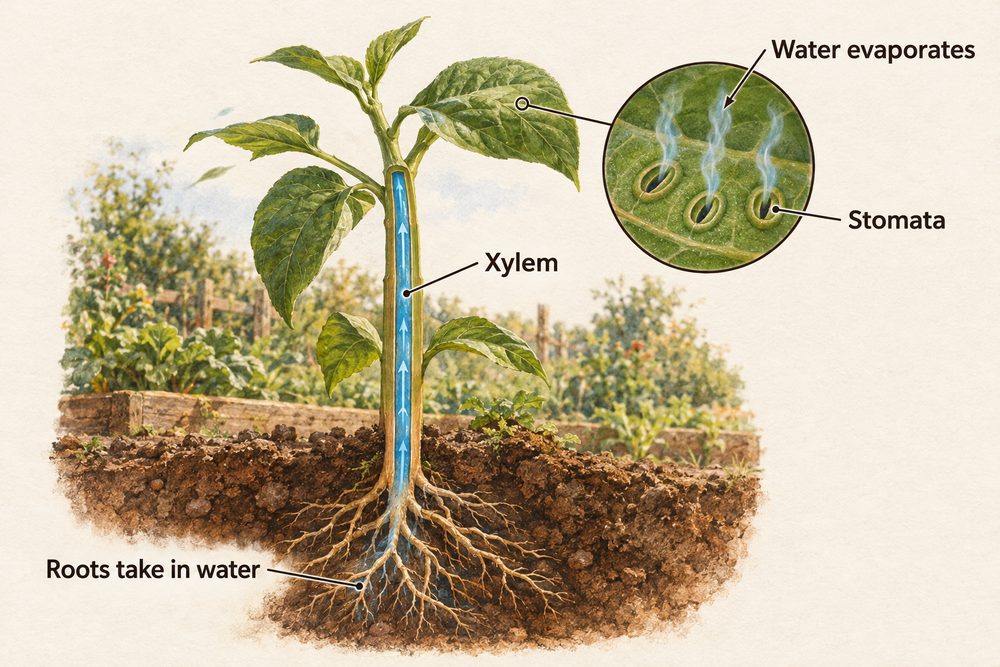
Water taken in through the roots travels up the plant in xylem vessels and eventually evaporates from the leaf surface through tiny pores called stomata. This process — transpiration — drives a continuous column of water up from the roots. Stomata must be open to allow CO₂ in for photosynthesis, but opening them also allows water vapour to escape. Plants balance this trade-off using guard cells, which open and close the stomata in response to conditions such as light and water availability.
At Higher Tier, you need to be able to interpret rate-of-photosynthesis graphs where multiple limiting factors interact. For example, if increasing CO₂ concentration raises the plateau on a rate-vs-light graph, this confirms that CO₂ was previously limiting at that light intensity. If increasing temperature also raises the plateau, temperature was also limiting. Only by holding two factors constant while varying the third can you identify each factor’s individual contribution.