Ecosystems and Interdependence
What is an Ecosystem?
An ecosystem consists of all the living organisms in an area together with the non-living environment they inhabit. The living (biological) part is called the community; the non-living surroundings are the abiotic environment. A habitat is the place where a particular organism lives. Ecosystems can range enormously in scale — from a garden pond to an oak woodland to the open ocean — but all share the same fundamental structure: producers capture energy, consumers transfer it, and decomposers recycle it.
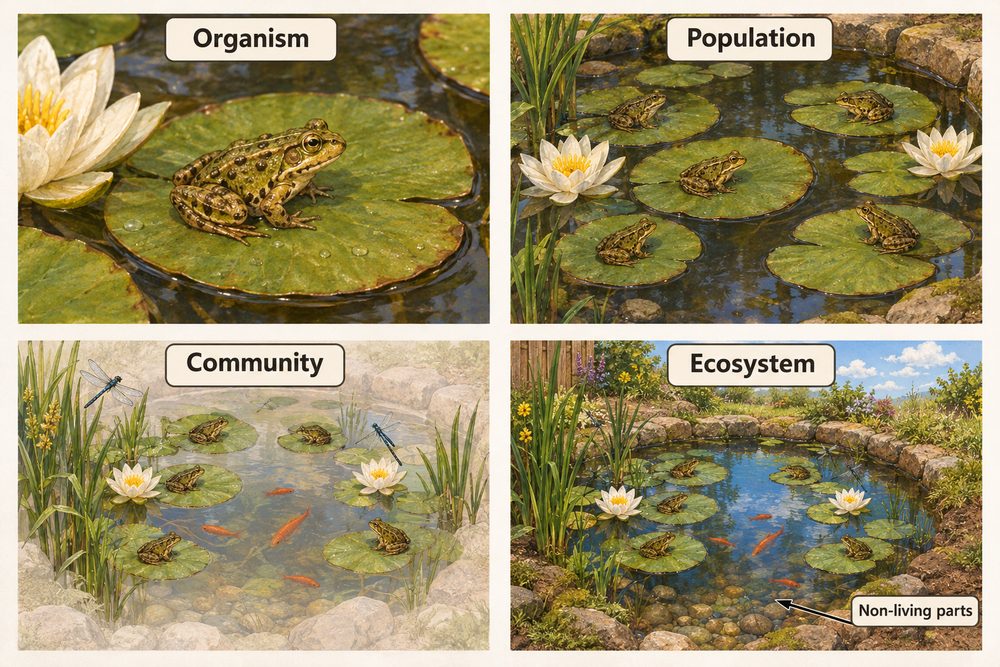
The conditions of an ecosystem are shaped by abiotic factors (non-living) and biotic factors (living). Abiotic factors include temperature, rainfall, light intensity, pH, and mineral availability. Biotic factors include competition for food or space, predation, disease, and the availability of mates. Both sets of factors determine which species can survive in a given place and how abundant they become.
Abiotic factors (non-living): temperature, light intensity, rainfall, pH, mineral availability. Biotic factors (living): competition, predation, disease, parasitism. Both shape which species survive and in what numbers.
Food Chains and Food Webs
A food chain shows the linear transfer of energy from one organism to the next. It always begins with a producer — a photosynthetic organism such as a plant or alga — followed by a series of consumers. Each feeding step is called a trophic level. Primary consumers (herbivores) eat producers at trophic level 2; secondary consumers eat primary consumers at trophic level 3, and so on.
In reality, most species eat and are eaten by multiple other species. A food web is a more accurate model of feeding relationships in an ecosystem. For example, in a UK oak woodland, caterpillars may be eaten by blue tits, warblers, or spiders — and blue tits themselves may be eaten by sparrowhawks or cats. Removing or adding any species can have cascading effects throughout the web.
Arrows in a food web point in the direction of energy flow — from the organism being eaten to the organism eating it. Each arrow represents a feeding relationship. To trace energy, follow arrows from producer to apex predator.
When answering questions about what happens when a species is removed, work through the web systematically. If a prey species is removed, its predators lose a food source and may decline; if a predator is removed, its prey may increase — and then the prey’s food source (the next level down) may decrease because it is being over-consumed. These knock-on effects are called trophic cascades.
Ecological Niches and Competition
Every species occupies a niche: its unique role in the ecosystem. The niche includes not just what the organism eats, but where it feeds, when it is active, how it reproduces, and how it interacts with other species. No two species can occupy exactly the same niche in the same ecosystem indefinitely — one will out-compete the other and drive it to local extinction or force it to adapt. This is the competitive exclusion principle.
Competition occurs when two or more organisms require the same limited resource. Intraspecific competition (between individuals of the same species) drives natural selection within species. Interspecific competition (between different species) shapes the composition of communities over time. In UK woodlands, for example, red and grey squirrels compete for hazelnuts — because grey squirrels can digest acorns more efficiently and carry squirrelpox virus without symptoms (which is fatal to reds), they have displaced red squirrels from most of England and Wales.
A niche is the full role of a species in its ecosystem — what it eats, where it lives, and how it interacts with others. No two species can share an identical niche: the more competitive will prevail over the other in the long term.
Interdependence
Interdependence means that species in a community depend on one another. These dependencies include feeding relationships, but also more subtle interactions: plants depend on bees for pollination; bees depend on flowers for nectar; trees depend on mycorrhizal fungi for mineral uptake; fungi benefit from tree sugars in return. These relationships mean that the loss of one species can ripple through an entire community.
A striking example of interdependence is the relationship between predators and their prey. Predator and prey populations often oscillate in linked cycles: when prey is abundant, predator numbers rise; as more predators hunt, prey numbers fall; with less prey, predator numbers also fall; prey then recovers — and the cycle repeats. This oscillation keeps both populations in a dynamic balance, provided no external factors intervene.
Some species form particularly close interdependent relationships called symbioses. In mutualism, both species benefit: clownfish hide among sea anemone tentacles for protection while deterring fish that would eat the anemone. In parasitism, one species (the parasite) benefits at the expense of the host: fleas feed on mammal blood, reducing the host’s fitness without immediately killing it. Parasites are very different from predators — predators kill and consume their prey, while parasites live on or in the host long-term.
Population Size and Carrying Capacity
The maximum population size a habitat can support is called the carrying capacity. When a population reaches the carrying capacity, limiting factors — food shortage, disease, predation, or competition for space — keep it in check. A population that overshoots its carrying capacity will decline as resources are exhausted, and may even crash below it temporarily before recovering.
This framework explains why populations in stable ecosystems rarely undergo extreme booms or crashes. Feedback mechanisms between predators, prey, disease organisms, and resource availability buffer the system, maintaining a dynamic equilibrium. Human activity can disturb this equilibrium — by over-hunting, habitat destruction, or introducing non-native species — pushing populations outside the range that natural feedback can correct.