Carbon, Nitrogen and Water Cycles
Why Elements Must Cycle
Energy flows through ecosystems in one direction: it enters as sunlight, is captured by producers, and is lost as heat at each trophic level. But matter is different. The atoms that make up living organisms — carbon, nitrogen, oxygen, hydrogen — are neither created nor destroyed. They move continuously between living organisms and the non-living environment through biogeochemical cycles. Understanding these cycles explains how the same carbon atom in your body may once have been in a dinosaur, and the same nitrogen atom may have been in the soil last year.
Human activity has altered all three major cycles: burning fossil fuels disrupts the carbon cycle; fertiliser use and sewage release disrupt the nitrogen cycle; urbanisation and deforestation alter the water cycle. Understanding each cycle helps us predict and address these disruptions — an important connection to the chemistry and physics content on climate change.
The Carbon Cycle
Carbon moves between the atmosphere, living organisms, and the Earth’s crust. In the atmosphere, carbon exists mainly as carbon dioxide (CO₂). Producers remove CO₂ from the atmosphere during photosynthesis, incorporating carbon into glucose and other organic molecules. This carbon then passes through food chains as organisms eat one another.
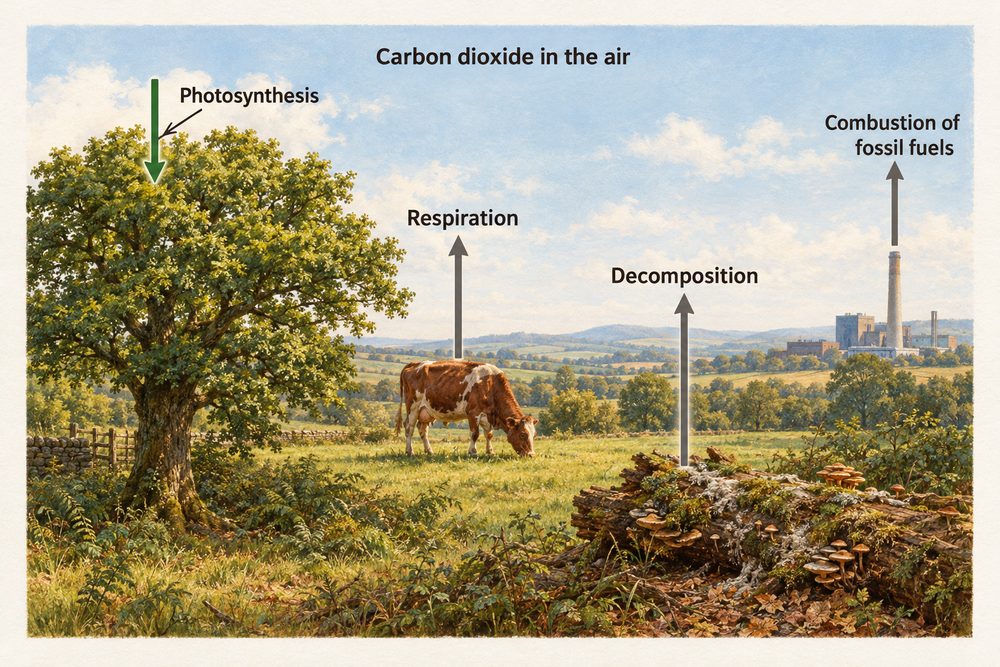
Respiration — all living organisms respire, oxidising glucose and releasing CO₂. This applies to producers, consumers, and decomposers alike.
Decomposition — when organisms die, decomposers (bacteria and fungi) break down organic molecules through their own respiration and enzymatic activity, releasing CO₂. Without decomposers, dead material would accumulate and nutrients would be locked away permanently.
Combustion — burning organic material (wood, fossil fuels, peat) releases CO₂ rapidly. Fossil fuels — coal, oil and natural gas — are ancient organic carbon that was buried before decomposition could occur and has remained locked underground for millions of years. Burning these fuels releases carbon that has been out of the active cycle for vast geological periods, raising atmospheric CO₂ concentrations.
Carbon enters the biotic cycle through photosynthesis (CO₂ → organic molecules). It returns to the atmosphere through respiration (all organisms), decomposition (bacteria and fungi), and combustion (burning of organic material). Burning fossil fuels adds ‘ancient’ carbon to the active cycle, raising atmospheric CO₂.
The Nitrogen Cycle
Nitrogen makes up the majority of the atmosphere as nitrogen gas (N₂), but most organisms cannot use it in this form. The nitrogen cycle describes how nitrogen is converted into usable compounds and then returned to the atmosphere. It depends heavily on specialised bacteria at each key step.
Nitrogen fixation — nitrogen-fixing bacteria convert N₂ gas into ammonia (NH₃) or nitrate ions (NO₃⁻). Some live freely in the soil; others live in root nodules of leguminous plants (peas, beans, clover), forming a mutualistic relationship where the plant provides sugars and the bacteria provide fixed nitrogen.
Nitrification — nitrifying bacteria in the soil convert ammonium ions (from decomposition) first into nitrite ions and then into nitrate ions. Nitrate ions can be absorbed by plant roots via active transport.
Denitrification — denitrifying bacteria operate in waterlogged, anaerobic soils. They convert nitrate ions back into nitrogen gas, which returns to the atmosphere. This is why waterlogged soils are less fertile — denitrification removes available nitrogen faster than nitrification can replace it.
Decomposition — decomposers break down dead organic matter and excretory products, releasing ammonium ions back into the soil. This connects the carbon and nitrogen cycles, because decomposers carry out both processes simultaneously.
The nitrogen cycle relies on bacteria: nitrogen-fixing bacteria (N₂ → NH₃/NO₃⁻), nitrifying bacteria (NH₄⁺ → NO₂⁻ → NO₃⁻), denitrifying bacteria (NO₃⁻ → N₂), and decomposers (organic N → NH₄⁺). Plants absorb nitrate ions from the soil to make amino acids and proteins.
Human Disruption of the Nitrogen Cycle
Farmers add nitrogen to the soil through fertilisers — either as inorganic compounds (manufactured using atmospheric nitrogen through the Haber process) or as organic material (manure, compost). When excess nitrate is washed out of soil by rain, it enters waterways. The nutrient enrichment that follows is called eutrophication. It triggers algal blooms that block light, causing aquatic plants to die. Decomposers feeding on the dead material consume oxygen, leaving the water depleted of dissolved oxygen and causing the death of fish and other aerobic organisms.
The Water Cycle
Water moves continuously between the oceans, atmosphere, land and living organisms. The main driving force is solar energy, which causes evaporation from water surfaces. When water vapour cools at altitude, it condenses into clouds. Precipitation (rain, snow, hail) returns water to the land, where it soaks into the ground (infiltration), flows as surface run-off into rivers and eventually the ocean, or is taken up by plants.
Organisms play an active role in the water cycle. Plants absorb water through their roots and release it as water vapour through their stomata — a process called transpiration. Forests return large amounts of water to the atmosphere through transpiration; deforestation therefore reduces local atmospheric moisture and can alter rainfall patterns. This links the water cycle to climate change — warmer temperatures increase evaporation rates and alter precipitation globally.
Urbanisation replaces permeable soil and vegetation with impermeable concrete and tarmac. This reduces infiltration and increases surface run-off, raising the risk of flash flooding after heavy rainfall. At the same time, less water soaks into groundwater reserves, reducing the natural replenishment of aquifers — an important freshwater resource.
Deforestation removes trees that would otherwise intercept rainfall and return it to the atmosphere through transpiration. The result is increased run-off, soil erosion, and a drier local climate. These effects are particularly significant in tropical regions where forests generate much of their own rainfall through the water vapour they release.