Evolution by Natural Selection
The Problem Darwin and Wallace Set Out to Solve
By the early nineteenth century, naturalists had amassed thousands of specimens from around the world. A pattern kept emerging: species in different parts of the world resembled each other in striking ways, yet were clearly distinct. Island species looked like mainland relatives but showed adaptations to local conditions. The fossil record showed species that no longer existed alongside forms that clearly gave rise to living ones. Something was driving this diversity — but what?
Charles Darwin (1809–1882) and Alfred Russel Wallace (1823–1913) independently arrived at the same answer: natural selection. Darwin had developed his ideas through years of observation, most famously during his voyage on the Beagle (1831–1836) and subsequent study of specimens. Wallace reached similar conclusions through fieldwork in South America and Southeast Asia. The two presented their ideas jointly to the Linnean Society in 1858; Darwin published On the Origin of Species in 1859.
Natural selection requires: (1) variation within a population, (2) some of that variation is heritable (passed to offspring), (3) a selection pressure (environmental challenge), (4) individuals with advantageous variations survive and reproduce more than others — passing those variations on.
The Mechanism of Natural Selection
Variation exists in every natural population. Some of this variation is heritable — it is encoded in the organism’s DNA and can be passed to offspring. Other variation arises from the environment (for example, a plant grown in shade is shorter than a genetically identical plant grown in full light) and is not passed on.
When a selection pressure is applied — a predator, a pathogen, a change in food availability, a change in climate — individuals whose heritable variation best suits them to the new conditions are more likely to survive and reproduce. Their offspring inherit the advantageous variation. Over many generations, this variant becomes more common in the population. Darwin called this process natural selection; the informal summary is “survival of the fittest,” where “fittest” means best adapted to the environment, not strongest or largest.
Antibiotic resistance in bacteria is natural selection in action, occurring rapidly because bacteria reproduce in minutes rather than years. Consider a bacterial population in which rare random mutations have given a tiny fraction of cells resistance to an antibiotic. Most of the population is susceptible. When antibiotic treatment begins, susceptible bacteria die; resistant bacteria survive and reproduce. The next generation is almost entirely resistant. Repeated antibiotic exposure over time can produce strains resistant to multiple drugs.
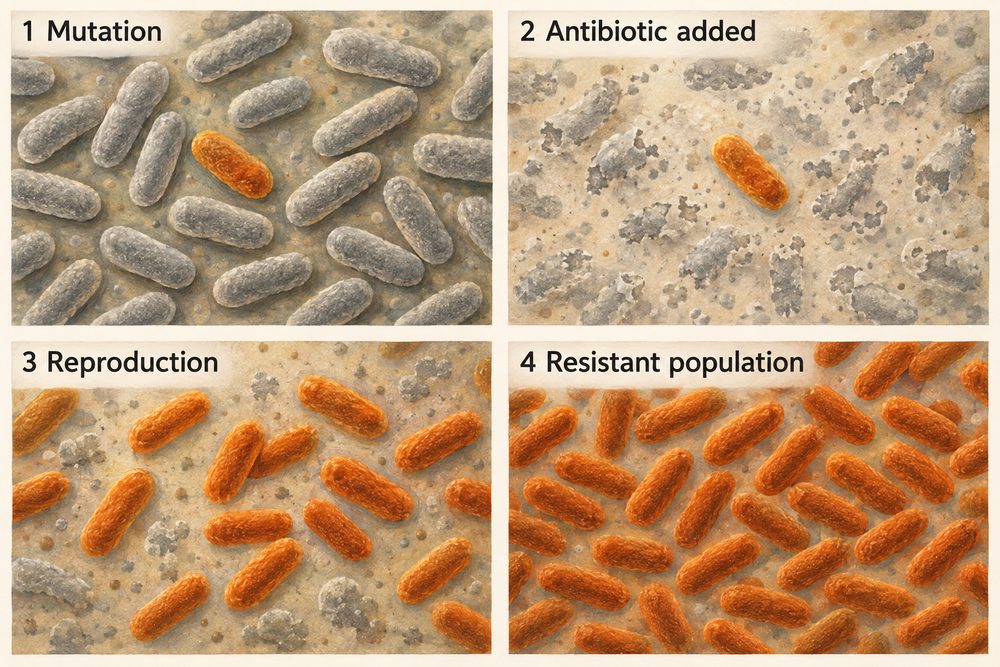
This is why doctors advise completing a full course of antibiotics: stopping early can leave the least affected bacteria alive, and those are the ones most likely to carry resistance. It also explains why antibiotics should only be prescribed when truly necessary — every unnecessary use is a selection pressure that can drive resistance.
Evidence for Evolution
Darwin’s explanation was compelling because it accounted for multiple independent lines of evidence. Today, the evidence is stronger than it was in 1859 — in part because molecular biology and genetics have provided powerful new tools. The convergence of evidence from completely different scientific fields greatly strengthens confidence in evolutionary theory as an explanation for the diversity of life.
The fossil record — fossils show the preserved remains of organisms in rock strata. Older strata contain simpler organisms; younger strata show progressively more complex and diverse forms. Transitional fossils show organisms with features intermediate between ancestral and descendant groups, exactly as natural selection predicts.
Comparative anatomy — species that share a common ancestor have inherited similar underlying body structures, even when those structures are used for very different purposes. The forelimb bones of a human arm, a whale’s flipper, a bat’s wing, and a horse’s leg all share the same set of bones arranged in the same pattern. This suggests a shared ancestor with that body plan.
DNA comparisons — species with a more recent common ancestor share a greater proportion of their DNA sequence. The most closely related species have the most similar DNA. This molecular evidence is independent of anatomical evidence but reaches the same conclusions about which species are closely related, which strongly supports the common ancestry predicted by natural selection theory.
Speciation
Over very long timescales, natural selection can produce new species. Speciation typically begins with a population being split by a geographical barrier — a mountain range, a river, an ocean. The two isolated groups can no longer interbreed. Each group then experiences different selection pressures — different predators, different food sources, different climates. Over many generations, natural selection produces adaptations suited to each group’s environment. Genetic differences accumulate. Eventually, the two groups become so genetically different that, even if brought back together, they can no longer interbreed and produce fertile offspring. At that point, two species exist where once there was one.
Darwin’s observations of finches on the Galápagos Islands illustrate this process. Different islands had different food sources: seeds, cacti, insects. Populations adapted to local conditions, with beak shape diverging markedly across islands. The different populations descended from a common ancestor but had undergone speciation through geographic isolation and differential selection.
Speciation occurs when geographic isolation separates populations, preventing interbreeding. Different selection pressures in each location drive divergence. Over many generations, genetic differences accumulate until the two populations can no longer interbreed — they are now separate species.
Ideas about Science: How Darwin’s Theory Developed
Darwin’s theory is an excellent example of how scientific explanations develop — and how they differ from simple observation. Before Darwin, the prevailing explanation for species diversity was that each species had been separately created. Darwin and Wallace’s contribution was not just to gather more observations, but to propose a mechanism — natural selection — that could account for all the observations already known.
A good scientific explanation does more than fit the existing data; it makes predictions about what else should be true if the explanation is correct. Natural selection predicts that fossils should show simpler organisms in older strata; that closely related species should share anatomical structures; that DNA sequences should be more similar between closely related species. Each of these predictions has been confirmed independently. The accumulation of evidence from multiple independent fields — geology, anatomy, genetics, ecology — is far more compelling than any single piece of evidence could be on its own.
Darwin did not know about DNA or genes — Gregor Mendel’s work on inheritance (mid-1850s to early 1860s) was largely unknown to the wider scientific community in Darwin’s lifetime. The modern synthesis, which united Darwinian selection with genetics in the twentieth century, strengthened the theory further by providing a molecular explanation for how variation arises (through mutation) and how it is inherited.