Biodiversity and Classification
What is Biodiversity?
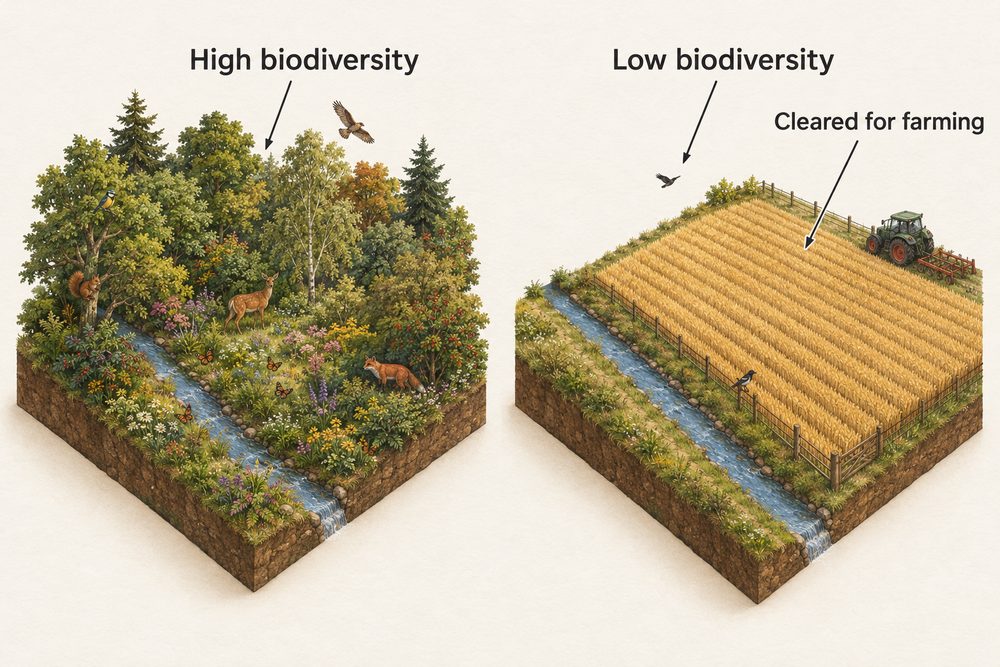
Biodiversity is the variety of life in a given area. It has three parts: the diversity of living organisms, the diversity of the genes they carry, and the diversity of ecosystems. High biodiversity makes ecosystems more stable and resilient — if one species declines, others can take over its ecological role. Low biodiversity makes an ecosystem fragile and more likely to collapse when conditions change.
High biodiversity increases ecosystem resilience. A diverse community has more species to fill each ecological role, so the system can absorb disturbances without collapsing. Coral reefs and tropical rainforests are two of the most biodiverse — and most threatened — ecosystems on Earth.
Threats to Biodiversity
Human activities are the main driver of biodiversity loss worldwide. Key threats include:
- Deforestation — clearing forests for agriculture, timber or development destroys habitats and the species within them. Tropical deforestation is particularly damaging because rainforests hold an exceptionally large proportion of the world’s species.
- Habitat destruction — converting land to farmland, draining wetlands and building on greenfield sites all reduce the area available for wild species.
- Climate change — rising temperatures shift the ranges where species can survive. Coral bleaching, caused by warmer sea temperatures, is a clear example: when sea temperatures rise above a threshold, coral reefs expel the algae they depend on, turning white and dying.
- Pollution — pesticides, fertiliser runoff, plastic waste and air pollution all harm organisms. Fertiliser runoff triggers eutrophication in freshwater, causing oxygen depletion and mass die-offs.
- Overexploitation — overfishing, illegal hunting and unsustainable harvesting reduce populations below sustainable levels.
UK wild bee and hoverfly populations have declined significantly in recent decades. Intensification of farming — which reduces wildflower meadows and hedgerows — is a major driver, alongside pesticide use and habitat fragmentation. Pollinators matter far beyond their own survival: almost nine in ten flowering plant species depend on animal pollinators to reproduce. A collapse in pollinator diversity would cascade through food chains, threatening crop yields and wild plant communities alike.
This case illustrates a key principle: biodiversity loss is rarely isolated. Losing one group of species weakens the ecological services that other species — including humans — depend on. Scientists describe this as the loss of ecosystem services.
Conservation Strategies
Scientists and governments use a range of strategies to protect biodiversity:
- Protected areas — national parks, nature reserves and Sites of Special Scientific Interest (SSSIs) restrict damaging human activity within ecologically important habitats.
- Captive breeding programmes — zoos and wildlife centres breed endangered species with the aim of reintroducing them into the wild when conditions are safe.
- Seed banks — repositories such as the Svalbard Global Seed Vault preserve plant genetic diversity, safeguarding against extinction.
- Legislation — international agreements and national laws restrict hunting and trade of threatened species, and regulate pollution.
- Habitat restoration — planting hedgerows, restoring wetlands and creating wildlife corridors help fragmented populations reconnect.
Classification: Grouping the Living World
Classification is the process of grouping organisms based on shared features. The modern system was developed by the Swedish scientist Carl Linnaeus (1707–1778), who introduced a hierarchy of groups and a formal naming system.
The classification hierarchy from most inclusive to least is: Kingdom → Phylum → Class → Order → Family → Genus → Species. A useful mnemonic is: King Philip Came Over For Good Soup. Members of the same species can interbreed and produce fertile offspring.
The Binomial Naming System
Every species is given a unique two-part Latin name — this is the binomial system. The first part is the genus name (always capitalised) and the second is the species name (always lowercase). For example, modern humans are Homo sapiens and the domestic cat is Felis catus. Using Latin ensures scientists worldwide share the same name for each species, avoiding confusion caused by different common names in different languages.
The Five Kingdoms
Organisms are traditionally divided into five kingdoms:
- Animals — multicellular, heterotrophic (cannot make their own food), no cell wall.
- Plants — multicellular, autotrophic (photosynthesise), cellulose cell wall.
- Fungi — multicellular (mostly), heterotrophic, chitin cell wall, reproduce by spores.
- Protists — mostly unicellular eukaryotes that do not fit the other kingdoms (e.g. Amoeba, algae).
- Prokaryotes (Bacteria) — unicellular, no nucleus, no membrane-bound organelles.
Classification is more than a filing system — it reflects evolutionary history. Species that are closely related share a more recent common ancestor and tend to share more DNA sequences. Modern genomic techniques allow scientists to compare the DNA of different organisms directly, refining classifications that were previously based only on visible (morphological) features. This is an example of a scientific model being updated as new evidence becomes available — early classifications based purely on appearance sometimes grouped unrelated organisms together just because they looked alike (convergent evolution).
For instance, dolphins were historically mistaken for fish because of their body shape. DNA evidence places them firmly within mammals, closely related to even-toed ungulates (cattle, pigs and deer). This illustrates why multiple lines of evidence — morphology, biochemistry and DNA — are all considered in modern classification.