Genome, DNA and Cells
What Is a Genome?
Every living cell carries a set of chemical instructions that tells it what to do, how to grow, and what to become. This complete set of instructions is called the genome. In humans, the genome is divided across 23 pairs of chromosomes — 46 chromosomes in total — packed tightly inside the nucleus of almost every cell in your body. Each chromosome is an enormously long molecule of DNA.
In organisms like bacteria, there is no nucleus. Their genetic material sits loose in the cytoplasm, typically as a single circular chromosome. Bacteria can also carry smaller, separate rings of DNA called plasmids. This contrast between cells with a nucleus (eukaryotes — plants, animals, fungi) and cells without one (prokaryotes — bacteria) is fundamental to biology.
The genome is the entire genetic material of an organism. Human body cells contain 46 chromosomes (23 pairs) in their nucleus. Bacterial cells have no nucleus — their DNA is in the cytoplasm, often alongside smaller plasmids.
DNA: A Polymer of Nucleotides
DNA is a polymer — a long chain built from repeating units called nucleotides. Each nucleotide contains a sugar (deoxyribose), a phosphate group, and one of four bases: adenine (A), thymine (T), cytosine (C) or guanine (G). The bases pair specifically across two strands — A with T, and C with G — forming the famous double helix shape.
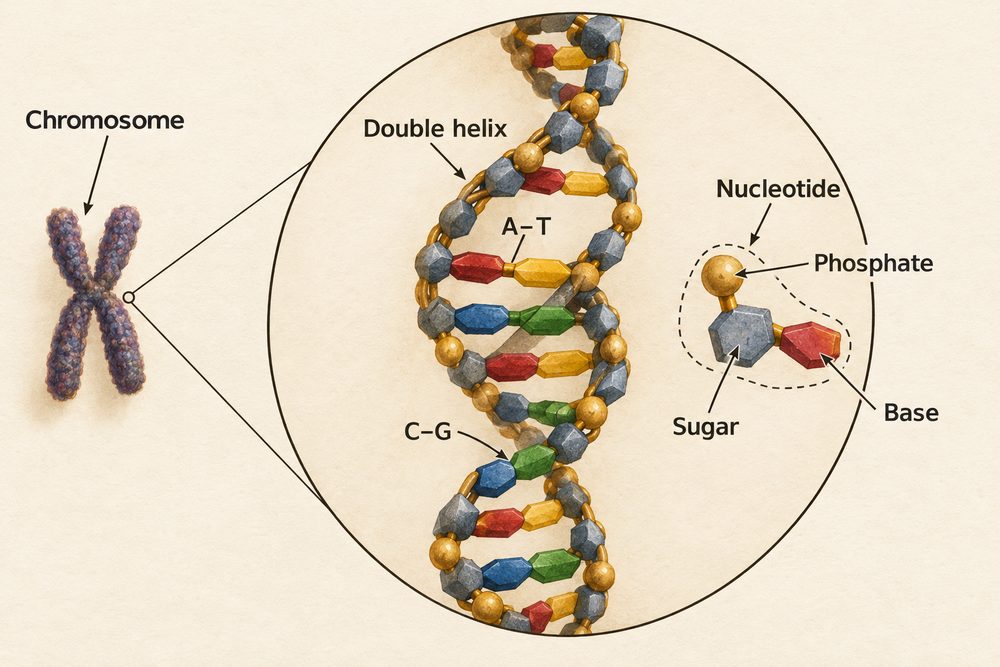
The order in which the bases appear along the DNA strand is the genetic code. Scientists use the letters A, T, C and G as a model to represent these bases (this is an example of using a model to represent reality — the letters are not the bases, they stand in for them). The sequence of bases in a particular section of DNA — a gene — carries the coded instructions for making a specific protein.
A gene is a section of DNA that contains the instructions for making one protein. The key is that every three consecutive bases — a triplet — codes for one amino acid. String enough amino acids together in the right order and you get a protein. Because there are four possible bases and triplets of three, there are 64 possible combinations — more than enough to code for the 20 amino acids used by living things.
The properties of a protein depend on which amino acids are present and the exact order they are joined. A change in just one amino acid can alter how a protein folds, and therefore whether it works properly. This is why the precise base sequence in a gene matters so much.
How Protein Synthesis Works
DNA is stored in the nucleus, but proteins are built in the cytoplasm, at ribosomes. This creates a logistical problem: how do the instructions get from the nucleus to the ribosome without the DNA itself having to leave? The answer is a messenger molecule called mRNA (messenger RNA).
In protein synthesis, a copy of a gene is made as mRNA inside the nucleus. This mRNA molecule then travels out through pores in the nuclear membrane and moves to a ribosome in the cytoplasm. At the ribosome, the mRNA sequence is ‘read’ three bases at a time. Each triplet signals which amino acid should be added next. The ribosome joins the amino acids in sequence to build the protein chain.
Protein synthesis: a copy of the gene is made as mRNA in the nucleus → mRNA travels to a ribosome in the cytoplasm → the ribosome joins amino acids in the order specified by the mRNA sequence. Each triplet of bases codes for one amino acid.
Genotype, Phenotype and the Environment
Chromosomes come in pairs, so you have two copies of each gene — one inherited from each parent. The different versions of a gene are called alleles. The specific combination of alleles you carry is your genotype. What you actually look like or how your body functions as a result is your phenotype.
Most characteristics are not controlled by a single gene acting alone — they depend on instructions in multiple genes working together, plus the influence of the environment. Consider height: genetic variants set the potential, but nutrition during childhood shapes the outcome. This gene–environment interaction explains why identical twins, sharing the same genotype, can end up with measurable differences in characteristics like body weight or even certain disease risks.
Commercial DNA-testing companies offer to sequence parts of your genome and report on your ancestry, inherited traits, or disease risks. This is real science — variations in specific regions of your DNA do correlate with ancestry and, in some cases, disease likelihood. However, reporting a ‘percentage risk’ for a complex condition requires careful interpretation: genetic variants interact with dozens of other factors, and a single allele rarely determines whether a disease will develop. Data privacy is also a live debate — who owns genomic data once it is uploaded to a company’s database, and how can it be used?
This illustrates a core scientific idea: a model (a letter-coded sequence representing your DNA) can provide useful information while also having limits. Understanding those limits is essential for interpreting results responsibly.
Not all DNA codes for proteins. Large sections of the genome are non-coding — they do not specify amino acid sequences. However, non-coding DNA is not simply ‘junk’. Much of it plays a regulatory role, controlling whether particular genes are switched on or off (expressed). If a mutation occurs in a non-coding regulatory region, it can alter gene expression: a gene that was previously active may be silenced, or one that was quiet may be turned on. This can affect the phenotype even though no protein sequence has been directly changed.