Inheritance and Single-Gene Crosses
How Genes Are Inherited
During sexual reproduction, each parent contributes one gamete — a sperm or egg cell. Each gamete carries one allele for every gene. When sperm and egg fuse at fertilisation, the resulting cell (and all body cells that develop from it) contains two alleles for each gene — one from each parent. This is how inherited characteristics are passed on.
The two alleles at a gene may be identical or different. If they are identical, the individual is homozygous for that gene. If they are different, the individual is heterozygous. Whether a characteristic appears in the phenotype depends on which alleles are present and how they interact.
A dominant allele is expressed whenever at least one copy is present — it masks the recessive allele. A recessive allele is only expressed when two copies are present (homozygous recessive). Capital letters denote dominant alleles; lower-case letters denote recessive alleles.
Punnett Squares
A Punnett square is a tool used to model and predict the outcomes of a single-gene cross. It does not guarantee what any individual offspring will be — it shows the probabilities of each possible outcome. Because inheritance involves random fertilisation, outcomes follow the laws of chance.
Suppose both parents are heterozygous for seed colour in a plant, where yellow (Y) is dominant over green (y). Each parent has the genotype Yy.
Set up the Punnett square with parent alleles Y and y across the top and Y and y down the side. The four possible offspring genotypes are: YY, Yy, Yy, yy. In ratio form: 1 YY : 2 Yy : 1 yy. In phenotype terms: 3 yellow seeds : 1 green seed (because both YY and Yy express the dominant yellow phenotype). The probability of any one offspring being green is 1 in 4, or 25%.
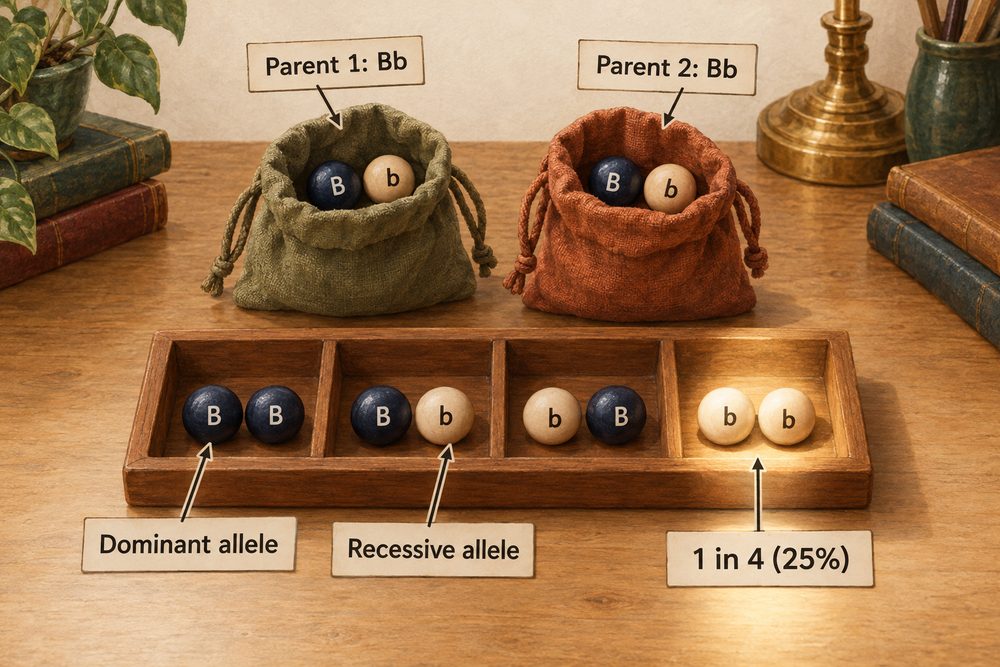
Key point: these ratios describe probability across many offspring. In a real family of four offspring, you might get 2 yellow and 2 green — or even all yellow. The ratio is a long-run statistical expectation, not a precise prediction for each individual.
Sex Determination
One of the 23 pairs of chromosomes in humans is the sex chromosomes. Females have two X chromosomes (XX); males have one X and one Y chromosome (XY). Genes on the Y chromosome trigger the development of testes during embryo development. All eggs carry an X chromosome; sperm carry either X or Y. Sex is determined at fertilisation by which sperm reaches the egg. The probability of any pregnancy resulting in a male or female is approximately 1 in 2.
Females are XX; males are XY. A Punnett square for sex determination: mother contributes X to every egg; father contributes either X or Y. Offspring: XX (female) or XY (male), each with probability 1 in 2 (50%). Sex is determined by the father’s sperm.
Gregor Mendel and the History of Genetics
Gregor Mendel worked in a monastery garden in what is now the Czech Republic, conducting plant breeding experiments across roughly a decade from the mid-1850s. He crossed pea plants that differed in clear traits — seed colour, seed shape, plant height — and kept careful records of how many offspring showed each characteristic in each generation.
Mendel observed consistent numerical patterns: for example, when two plants that were both ‘hybrid’ for seed colour were crossed, approximately three-quarters of offspring were yellow and one-quarter were green. He proposed an explanation: that each parent carries two ‘factors’ for each trait (what we now call alleles), and that these factors separate when gametes are formed. His explanation accounted for the data he had collected.
It is important to distinguish between Mendel’s data (the actual counts of yellow and green peas, tall and short plants) and his explanatory idea (that hereditary factors come in pairs and are passed separately to offspring). The data were observations; the explanation was a model proposed to account for those observations.
Mendel’s work was published in 1866 but was largely overlooked by the scientific community for several decades. When it was rediscovered around 1900, it was combined with growing knowledge about cell division and chromosomes, eventually forming the foundation of modern genetics. This illustrates how explanatory models develop over time as new evidence and technologies emerge — Mendel did not know about DNA or chromosomes, yet his explanation correctly predicted the patterns of inheritance we now explain in molecular terms.
Mendel studied traits determined by single genes with two clear alleles. Today, scientists can sequence an organism’s entire genome and compare variants across thousands of individuals. This has revealed that most phenotypic characteristics — height, skin colour, many diseases — are polygenic, controlled by variants in many genes across the genome simultaneously. The simple Punnett square model is a powerful teaching tool for single-gene inheritance, but real biology is considerably more complex.