Photosynthesis and Limiting Factors
What is Photosynthesis?
Photosynthesis is the process by which green plants and algae produce food. They are the main producers of biomass for life on Earth — almost all food chains begin with a photosynthetic organism. Photosynthesis takes place in the chloroplasts, which contain the green pigment chlorophyll that absorbs light energy.
Photosynthesis is an endothermic reaction — it takes in energy from the surroundings in the form of light. This is the opposite of respiration, which is exothermic. The word equation:
$$\text{carbon dioxide} + \text{water} \xrightarrow{\text{light}} \text{glucose} + \text{oxygen}$$
The balanced symbol equation: \(6CO_2 + 6H_2O \xrightarrow{\text{light}} C_6H_{12}O_6 + 6O_2\)
Photosynthesis is a two-stage process. In the first stage, light energy is absorbed by chlorophyll and used to split water molecules, releasing oxygen as a by-product. In the second stage, the hydrogen from water is combined with carbon dioxide to produce glucose. Both stages occur in the chloroplasts.
Photosynthesis is an endothermic reaction in chloroplasts: \(6CO_2 + 6H_2O \rightarrow C_6H_{12}O_6 + 6O_2\). Light energy is absorbed by chlorophyll. It is a two-stage process: light splits water, then hydrogen combines with CO\(_2\) to make glucose.
What Happens to the Glucose?
Glucose produced by photosynthesis has several important uses in the plant:
Respiration — glucose is broken down to transfer energy for the plant's life processes. Starch storage — excess glucose is converted to insoluble starch for storage (starch does not affect osmosis because it is insoluble). Cellulose — glucose is converted to cellulose for building cell walls. Amino acids and proteins — glucose is combined with nitrate ions absorbed from the soil to make amino acids, which are assembled into proteins. Lipids — glucose can be converted to lipids (fats and oils) for energy storage in seeds.
Limiting Factors
Three main factors affect the rate of photosynthesis: light intensity, carbon dioxide concentration and temperature. Each can become a limiting factor — the factor in shortest supply that prevents the rate from increasing.
Light intensity — as light intensity increases, the rate increases because more energy is available for the light-dependent stage. At high intensity, the rate levels off because CO\(_2\) concentration or temperature becomes the limiting factor. Higher tier: the inverse square law applies: \(\text{light intensity} \propto \dfrac{1}{\text{distance}^2}\). Doubling the distance from a light source quarters the light intensity reaching the plant.
Carbon dioxide concentration — increasing CO\(_2\) provides more raw material for the carbon fixation stage, so the rate increases. Eventually, the rate plateaus when another factor (light or temperature) becomes limiting. In commercial greenhouses, farmers pump in extra CO\(_2\) to maximise crop yields.
Temperature — enzymes controlling photosynthesis work faster as temperature increases up to an optimum. Above this, enzymes denature and the rate drops sharply. Below the optimum, molecules have less kinetic energy and collide less frequently with enzyme active sites.
The three factors interact (Higher Tier). On a graph of rate vs. light intensity, you might see the rate plateau even though light is still increasing — this means CO\(_2\) or temperature is now the limiting factor. To increase the rate further, you would need to increase whichever factor is limiting. All three must be sufficient for the maximum rate to be achieved.
A limiting factor is the one in shortest supply that prevents the rate from increasing further. On a graph, it shows as a plateau. The three limiting factors (light, CO\(_2\), temperature) interact — all must be sufficient for maximum rate. Higher tier: the inverse square law means doubling the distance quarters the light intensity.
A common practical uses Elodea (pondweed). Place the pondweed underwater in a beaker with a lamp nearby and count oxygen bubbles produced per minute at different distances from the lamp. As the lamp moves further away, light intensity decreases (inverse square law) and fewer bubbles are produced, indicating a lower rate of photosynthesis.
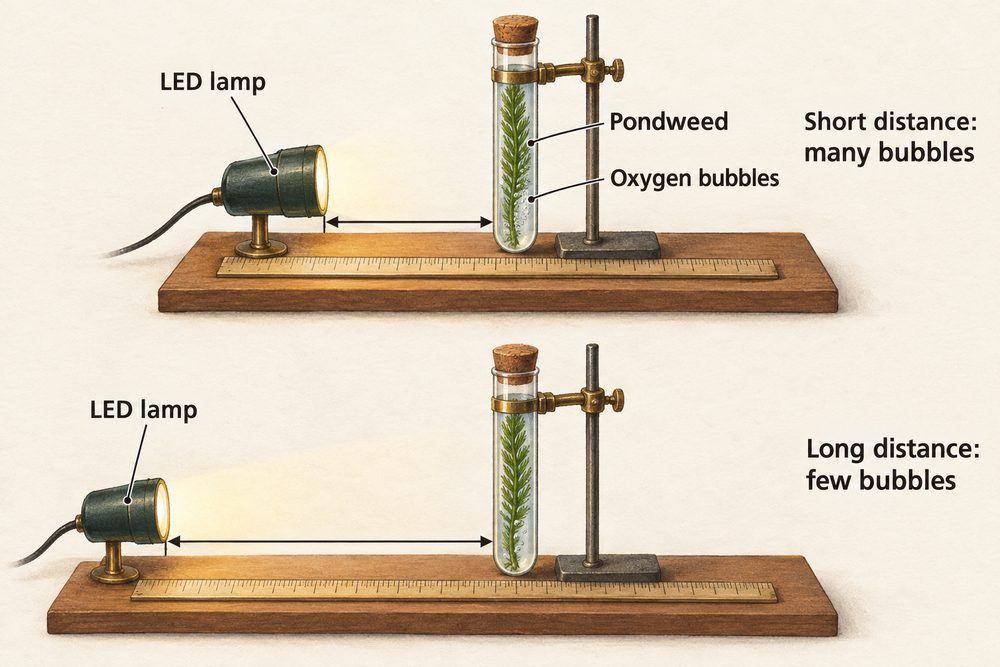
For more accurate results, collect the gas in a gas syringe or measuring cylinder over water and measure the volume per unit time, rather than counting individual bubbles. Repeat each distance at least three times and calculate a mean to improve reliability.
You can also test leaves for starch using iodine solution: boil the leaf in water to kill the cells, then in ethanol to remove chlorophyll (the green colour), rinse in water, and add iodine. Blue-black = starch present (photosynthesis occurred). Brown-orange = no starch (no photosynthesis). This test can show which parts of a variegated leaf photosynthesise — only the green parts.
The inverse square law states: \(\text{light intensity} \propto \dfrac{1}{d^2}\), where d is the distance from the light source.
Example: A lamp is 10 cm from pondweed and the rate of photosynthesis is 40 bubbles/min. If the lamp is moved to 20 cm (double the distance), the light intensity drops to \(\frac{1}{2^2} = \frac{1}{4}\) of its original value. Expected new rate ≈ 10 bubbles/min.
This relationship is important when interpreting experimental results — a graph of rate vs. distance should show a curved decline, not a straight line. A graph of rate vs. \(\frac{1}{d^2}\) should give a straight line through the origin if light is the only limiting factor.