Transport: Diffusion, Osmosis and Active Transport
Moving Substances Into and Out of Cells
Cells need to transport substances across their membranes to survive. There are three main mechanisms: diffusion, osmosis and active transport.
Diffusion is the net movement of particles from an area of high concentration to an area of low concentration — it is passive (no energy needed). Oxygen diffuses into cells for respiration; carbon dioxide and urea diffuse out. The steeper the concentration gradient, the faster the rate of diffusion. Temperature and surface area also affect the rate — higher temperature means faster-moving particles and more frequent collisions.
Osmosis is specifically the movement of water molecules through a partially permeable membrane from a dilute solution (high water potential) to a more concentrated solution (low water potential). Osmosis is a special case of diffusion — only water molecules move, driven by the difference in water potential across the membrane. No energy is required.
Active transport moves substances against the concentration gradient — from low to high concentration. This requires energy from respiration. Root hair cells use active transport to absorb mineral ions from the soil, where the concentration of minerals is lower than inside the cell. The energy comes from ATP produced by mitochondria in the root hair cells.
Diffusion and osmosis are passive processes (no energy needed, move down the concentration gradient). Active transport requires energy from respiration to move substances against the concentration gradient, from low to high concentration.
The classic osmosis practical uses potato cylinders placed in solutions of different sucrose concentrations. Cut cylinders of equal mass and length. Place one in distilled water, one in a low-concentration sucrose solution, one in a high-concentration sucrose solution. Leave for a set time (e.g. 30 minutes), remove, blot dry, and reweigh or remeasure.
In distilled water, water moves into the potato by osmosis (water potential of the potato cells is lower than the surrounding water), so the cylinder gains mass and becomes turgid. In a high-concentration sucrose solution, water moves out of the potato by osmosis (water potential of the sucrose solution is lower than the cells), so the cylinder loses mass and becomes flaccid or plasmolysed.
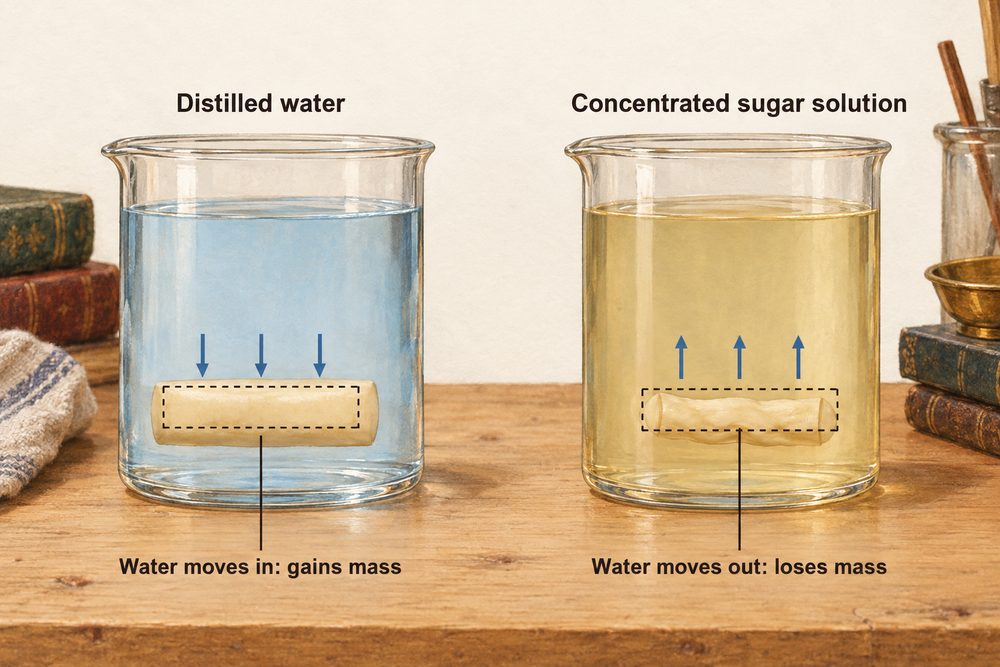
Plot a graph of percentage change in mass (y-axis) against sucrose concentration (x-axis). The intercept with the x-axis shows the isotonic point — where the water potential of the solution equals the water potential of the potato cells, so no net movement of water occurs.
A potato cylinder has an initial mass of 5.0 g. After being placed in distilled water for 30 minutes, its mass is 5.8 g. Calculate the percentage change in mass.
Percentage change = \(\dfrac{\text{change in mass}}{\text{original mass}} \times 100\) = \(\dfrac{5.8 - 5.0}{5.0} \times 100\) = \(\dfrac{0.8}{5.0} \times 100\) = +16%
A positive value means mass increased (water moved in by osmosis). A negative value would mean mass decreased (water moved out). Using percentage change rather than raw change in mass allows fair comparison between cylinders that had slightly different starting masses.
The Challenges of Size — Surface Area to Volume Ratio
As organisms get larger, their surface area to volume ratio (SA:V) decreases. Consider a cube: a 1 cm cube has SA = 6 cm², V = 1 cm³, SA:V = 6:1. A 2 cm cube has SA = 24 cm², V = 8 cm³, SA:V = 3:1. This means simple diffusion alone cannot supply enough substances or remove waste fast enough for large organisms. Multicellular organisms therefore need specialised exchange surfaces and transport systems.
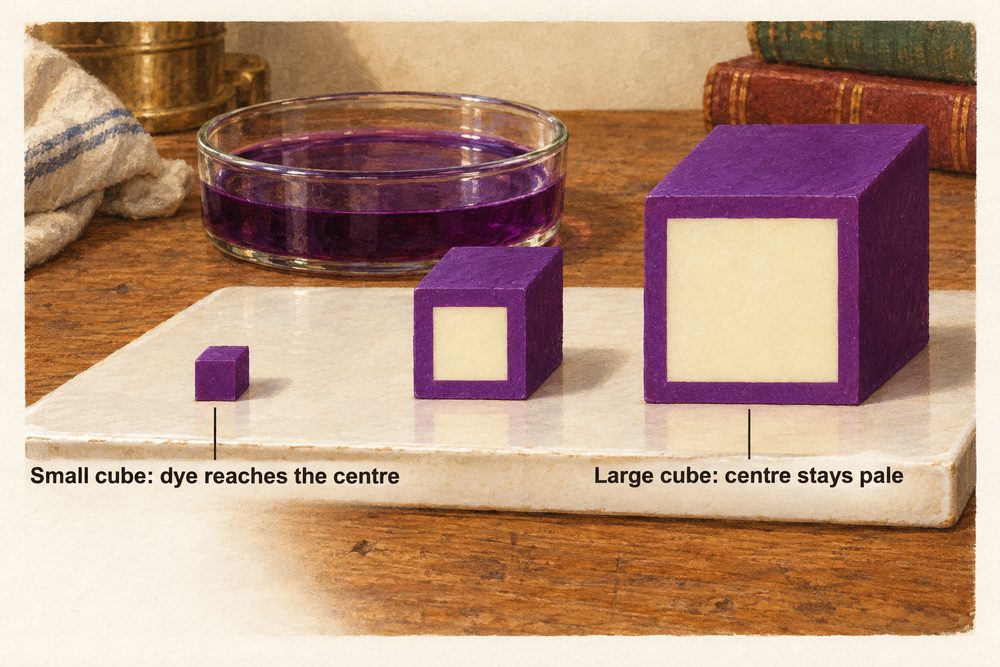
For a cube with side length l: SA = 6l², V = l³, SA:V ratio = 6l² ÷ l³ = 6/l.
Example: Calculate the SA:V ratio for cubes with sides 1 cm, 2 cm, and 4 cm:
1 cm cube: SA = 6 cm², V = 1 cm³, ratio = 6:1
2 cm cube: SA = 24 cm², V = 8 cm³, ratio = 3:1
4 cm cube: SA = 96 cm², V = 64 cm³, ratio = 1.5:1
As size doubles, SA:V ratio halves — larger organisms have a proportionally smaller surface area relative to their volume.
This is why a mouse loses body heat proportionally faster than an elephant — the mouse has a much higher SA:V ratio, so heat escapes more quickly relative to its body volume. It is also why single-celled organisms like amoeba can rely entirely on diffusion, while humans need a circulatory system.
As organisms get larger, their surface area to volume ratio decreases. This is why multicellular organisms need specialised exchange surfaces (e.g. alveoli in lungs, villi in the intestine) and transport systems to move substances efficiently. Single-celled organisms can rely on diffusion because their SA:V ratio is high.
Specialised Exchange Surfaces
Large multicellular organisms have evolved specialised exchange surfaces to overcome the limitations of a low SA:V ratio. These surfaces share common features: large surface area (to maximise the rate of exchange), thin walls (to minimise diffusion distance), good blood/fluid supply (to maintain steep concentration gradients), and in some cases ventilation (to maintain fresh supply of gases).
Alveoli in the lungs have a very large total surface area, walls just one cell thick, and a dense capillary network — all adaptations that maximise gas exchange. Villi in the small intestine have microvilli on their surface (brush border), increasing the surface area still further for absorption of digested food molecules into the blood.
Root hair cells in plants have long, thin extensions that greatly increase the surface area for absorbing water by osmosis and mineral ions by active transport from the soil. They contain many mitochondria to supply the ATP needed for active transport.