Hormones, the Menstrual Cycle and Plant Hormones
The Endocrine System
The endocrine system uses chemical messengers called hormones to coordinate and control body functions (B3.2a). Unlike the nervous system, which produces fast, short-lived responses via electrical impulses, the endocrine system produces slower, longer-lasting and more widespread responses.
Hormones are released directly into the blood by endocrine glands and travel to their target organs. Only cells with the correct receptor molecules for a hormone will respond to it. Key endocrine glands include the pituitary gland (often called the “master gland” because it controls other glands), the thyroid gland, the adrenal glands, the pancreas, and the ovaries or testes.
The endocrine system uses hormones transported in the blood. Responses are slower but longer-lasting than nervous responses. The pituitary gland is the “master gland” that controls other endocrine glands.
Thyroxine (produced by the thyroid gland) regulates metabolic rate. It is controlled by negative feedback (B3.2b): when blood thyroxine is high, the pituitary gland reduces release of thyroid-stimulating hormone (TSH), causing the thyroid to produce less thyroxine. When thyroxine is too low, the pituitary increases TSH output, stimulating more production. This loop maintains a stable metabolic rate.
Adrenaline (produced by the adrenal glands) triggers the “fight or flight” response in times of stress or danger. It rapidly increases heart rate, breathing rate and blood flow to muscles; it also stimulates the conversion of glycogen to glucose for extra energy. Unlike thyroxine, adrenaline acts very rapidly — it bridges the endocrine and nervous systems in speed of response.
The Menstrual Cycle
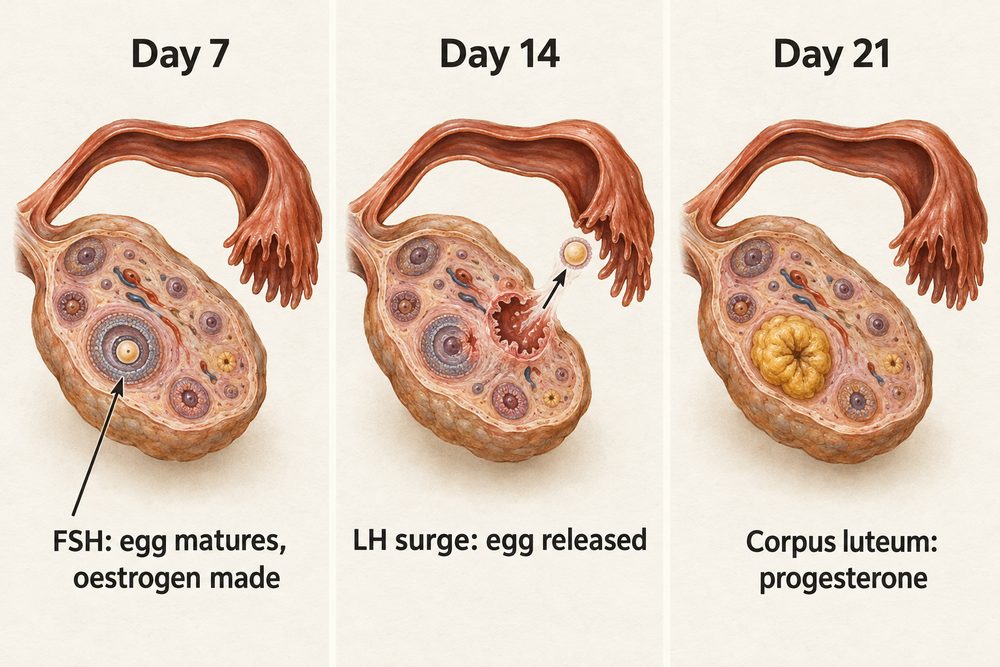
The menstrual cycle is controlled by four key hormones interacting through feedback mechanisms (B3.2c–d):
FSH (follicle-stimulating hormone) — produced by the pituitary gland; stimulates maturation of an egg inside a follicle in the ovary and causes the ovaries to produce oestrogen. Oestrogen — produced by the ovaries; repairs and thickens the uterus lining after menstruation, inhibits further FSH production (negative feedback), and stimulates the release of LH. LH (luteinising hormone) — produced by the pituitary gland; a surge of LH around day 14 triggers ovulation (release of a mature egg). Progesterone — produced by the empty follicle (now the corpus luteum) after ovulation; maintains the thick uterus lining. If no fertilisation occurs, progesterone levels fall, the lining breaks down and menstruation begins.
The menstrual cycle is controlled by FSH (matures egg), oestrogen (repairs lining, triggers LH), LH (triggers ovulation around day 14) and progesterone (maintains lining). These hormones interact through feedback loops over the ~28-day cycle.
Hormonal contraception (B3.2e) includes the combined pill (oestrogen and progesterone), the mini-pill (progesterone only), implants and injections. These work by maintaining high levels of oestrogen and/or progesterone, which inhibit FSH production from the pituitary gland. Without FSH, no egg matures, so ovulation does not occur. Hormonal methods are highly effective but can cause side effects such as headaches, mood changes and, rarely, blood clots.
Non-hormonal methods include condoms (barrier method — prevents sperm reaching the egg and protects against sexually transmitted infections), diaphragms (barrier placed over the cervix), copper IUDs (create an environment hostile to sperm), and surgical sterilisation (permanent). Non-hormonal methods avoid hormonal side effects but vary in effectiveness. The choice of method depends on effectiveness, convenience, reversibility and whether STI protection is needed.
Hormones can also be used to help people who have difficulty conceiving (B3.2f, Higher Tier). FSH and LH are administered to stimulate egg maturation and ovulation in women who do not produce sufficient natural levels. In IVF (in vitro fertilisation), FSH stimulates the ovaries to produce multiple eggs; these are collected, fertilised outside the body, and the resulting embryos are implanted into the uterus. Success rates are moderate and the treatment can have significant physical and emotional impacts — these must be weighed against the personal benefit of achieving pregnancy.
Plant Hormones
Plants also respond to stimuli using chemical messengers. The two most important for the specification are auxin and gibberellin (B3.2g–h).
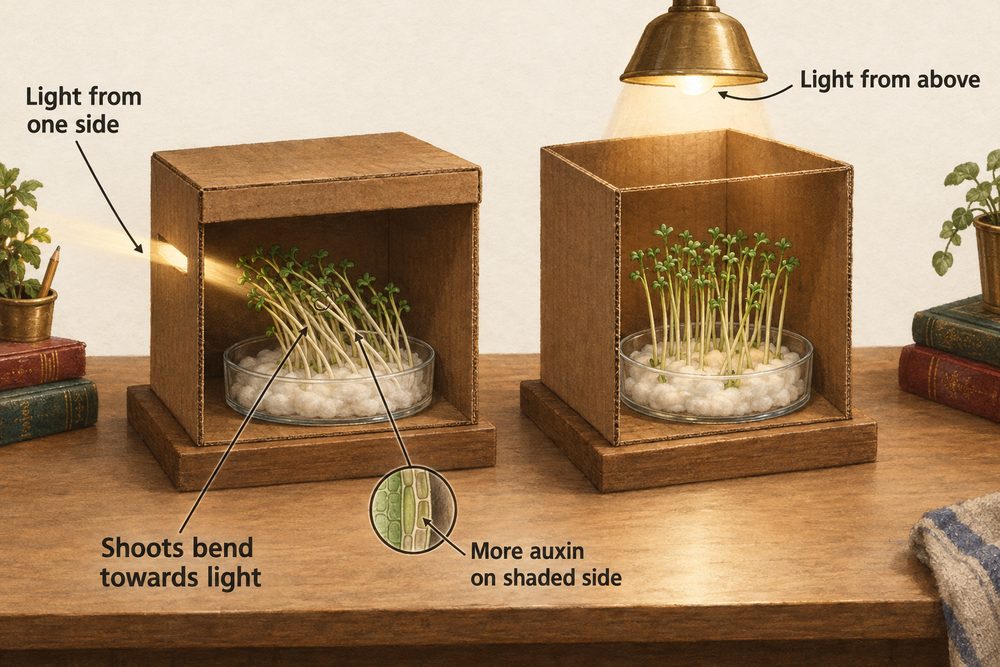
Auxin is produced in the growing tips of shoots and moves away from the tip. It promotes cell elongation — cells in regions with more auxin grow longer. When a shoot is illuminated from one side, auxin moves to the shaded side. Cells on the shaded side elongate more, causing the shoot to bend towards the light — a response called phototropism. This is advantageous because it maximises light capture for photosynthesis. Auxin also controls gravitropism, the growth response to gravity. In a root lying on its side, auxin gathers on the lower side and slows growth there, so the root bends downwards. In a shoot the same uneven spread speeds growth on the lower side, so the shoot bends upwards.
Rooting powders contain auxin. When cuttings are dipped in rooting powder, the auxin stimulates root growth at the cut end, allowing the cutting to establish quickly — useful for propagating plants commercially or in horticulture.
Weed killers (herbicides) exploit the fact that synthetic auxins at high concentrations disrupt normal plant growth. Broad-leaved weeds absorb the herbicide and grow uncontrollably, eventually dying. Narrow-leaved crop plants are less sensitive to the treatment, so the herbicide is selective.
Fruit ripening: ethene is a gaseous plant hormone that controls fruit ripening. Commercially, fruit is harvested unripe and stored in low-ethene conditions to slow ripening, then exposed to ethene gas to ripen quickly before sale. Gibberellins are used commercially to promote seed germination (for faster crop establishment) and to increase fruit size. Seedless grapes can be made larger using gibberellin sprays.