Homeostasis: Blood Glucose and Temperature
What is Homeostasis?
This lesson covers Topic B3 content, so it is examined on Biology Paper 1 (F1 / H3), not Paper 2. Homeostasis is the maintenance of a stable internal environment (B3.3a). This matters because enzymes and metabolic reactions work within narrow ranges of temperature, pH, blood glucose and water balance. If any of these drift too far from the optimum, cell processes slow down or stop — potentially with fatal consequences.
All homeostatic systems share the same three-part architecture: receptors detect deviations from the normal level, a coordination centre (such as the brain or pancreas) processes the information and sends instructions, and effectors (muscles or glands) carry out the response. The system operates through negative feedback: once conditions return to normal, the response is switched off.
Homeostasis maintains a stable internal environment using negative feedback. Every control system has three components: receptor (detects change), coordination centre (processes information), effector (produces the corrective response).
Blood Glucose Control
Blood glucose concentration is monitored continuously by the pancreas (B3.3c). When blood glucose rises after a carbohydrate-rich meal, specialised beta cells in the pancreas detect the increase and release insulin into the blood. Insulin has two effects: it causes body cells (especially muscles and liver) to absorb glucose from the blood, and it stimulates the liver to convert excess glucose into glycogen for storage. Both effects lower blood glucose back to normal.
When blood glucose falls — for example, during exercise or between meals — alpha cells in the pancreas detect the drop and release glucagon. Glucagon stimulates the liver to break glycogen back down into glucose (glycogenolysis) and release it into the blood, raising glucose back to normal. The opposing actions of insulin (lowering glucose) and glucagon (raising glucose) form a classic negative feedback loop that maintains blood glucose within a safe, narrow range (B3.3d, Higher tier).
Type 1 diabetes is an autoimmune condition: the immune system destroys the insulin-producing beta cells in the pancreas. Without insulin, blood glucose rises dangerously after eating. Treatment requires regular insulin injections (or an insulin pump) combined with careful monitoring of blood glucose and carbohydrate intake. It usually develops in childhood or early adulthood and cannot be prevented (B3.3e).
Type 2 diabetes develops when body cells become resistant to insulin — they no longer respond appropriately, so blood glucose stays elevated even though the pancreas may still produce insulin. It is strongly associated with obesity, a sedentary lifestyle and genetic factors. Treatment typically involves a controlled diet (limiting refined carbohydrates and sugars), regular exercise, and sometimes medication. Type 2 can often be prevented or managed through lifestyle changes, unlike Type 1 (B3.3e).
Type 1 diabetes: the pancreas cannot produce insulin (autoimmune; treated with insulin injections). Type 2 diabetes: body cells become resistant to insulin (often linked to obesity; treated with diet and exercise, sometimes medication).
Temperature Regulation
Core body temperature in humans is maintained at approximately 37 °C by the thermoregulatory centre in the brain (B3.3b). It receives signals from thermoreceptors in the skin (detecting external temperature) and from receptors monitoring blood temperature in the brain itself. Together these provide a complete picture of the body’s thermal state, allowing the coordination centre to activate appropriate effectors.
When the body is too hot, three main effector responses lower temperature. Vasodilation: blood vessels near the skin surface widen, so more warm blood flows close to the skin and more heat is radiated away. Sweating: sweat glands release sweat onto the skin; water in sweat evaporates, removing heat energy from the skin (evaporative cooling). Body hairs lying flat: erector muscles relax, so hairs lie flat against the skin, reducing the insulating layer of trapped air.
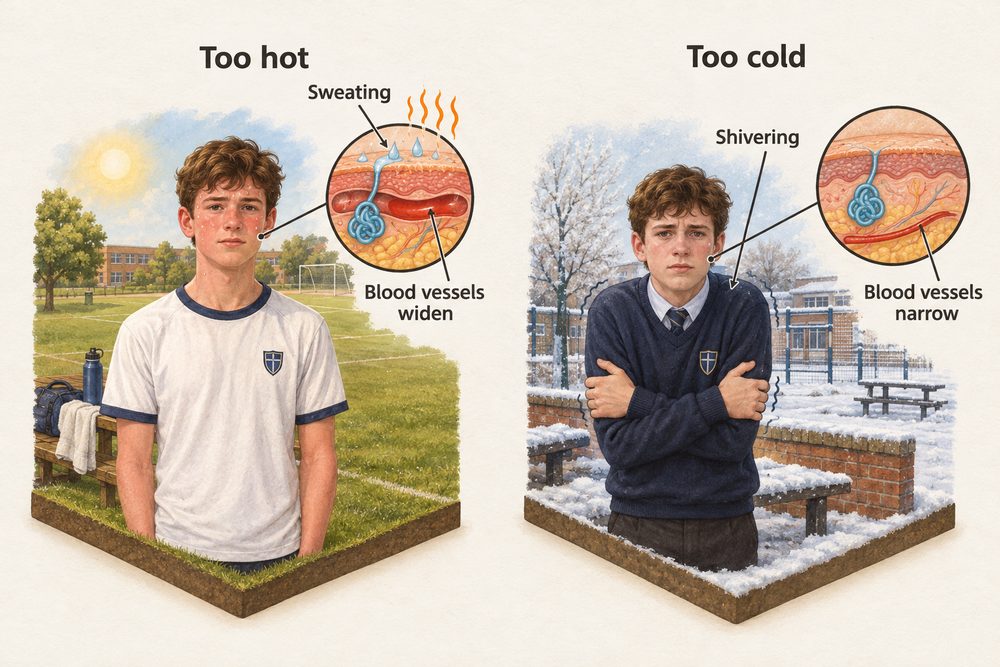
Vasoconstriction: blood vessels near the skin surface narrow, diverting blood away from the skin and reducing heat loss by radiation. Shivering: skeletal muscles contract rapidly and repeatedly; the increased metabolic activity generates heat that warms the body. Body hairs standing on end: erector muscles contract, raising hairs and trapping a thicker insulating layer of air close to the skin (more effective in furry animals than in humans).
Both sets of responses illustrate negative feedback — once body temperature returns to 37 °C, the thermoreceptors detect the change and the effector responses are switched off. This cyclical on-off control is what keeps core temperature within a narrow, safe range.
It is worth noting that the nervous and endocrine systems work together in thermoregulation. The nervous system sends rapid signals to sweat glands and erector muscles (which raise body hairs), while hormones such as adrenaline can also boost metabolic heat production in emergency cold exposure. The skin acts as the primary interface with the environment — its rich blood supply and large surface area make it the key organ for heat exchange. Evaporative cooling via sweat is particularly important during physical exercise, when the body can generate large amounts of metabolic heat through increased muscle respiration.