The Kidneys and Osmoregulation
The Role of the Kidneys
This lesson covers Topic B3 content, so it is examined on Biology Paper 1 (F1 / H3), not Paper 2. The kidneys are a pair of organs responsible for two key homeostatic functions: excretion (removing metabolic waste, especially urea from protein breakdown) and osmoregulation (controlling the water and ion concentration of the blood) (B3.3g). They filter the blood continuously, retaining useful substances and excreting waste products as urine.
Blood is delivered to each kidney via the renal artery (bringing blood to the kidney) and leaves via the renal vein (carrying cleaned blood away from the kidney). Urine drains from the kidney via the ureter to the bladder, and is expelled via the urethra. A common exam error is stating that the artery takes blood away — remember: arteries arrive at the organ.
The renal artery delivers blood to the kidney; the renal vein carries filtered blood away. Urine drains through the ureter to the bladder and out via the urethra.
How the Kidney Filters Blood
The functional unit of the kidney is the nephron. Blood enters the nephron at the glomerulus — a knot of capillaries inside a cup-shaped structure called the Bowman’s capsule. The high blood pressure in the glomerulus forces small molecules out of the blood and into the Bowman’s capsule — this is ultrafiltration. Molecules that pass through include water, glucose, urea and mineral ions. Large molecules (proteins and red blood cells) are too big to pass through and remain in the blood.
The fluid now in the tubule (the filtrate) is not yet urine — it contains useful substances that must be recovered. As the filtrate travels along the tubule, selective reabsorption returns all glucose (via active transport), most water, and the required amount of mineral ions back into the surrounding capillaries. What remains — water, urea and excess ions — passes on to become urine (B3.3g–h).
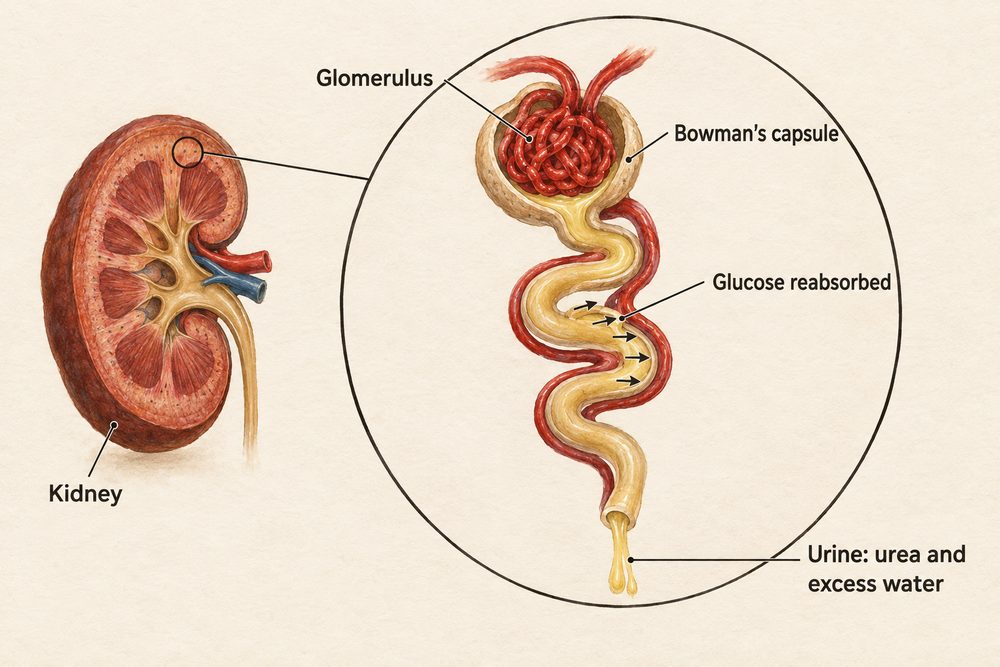
A student analyses the filtrate in the Bowman’s capsule and the urine. They find glucose in the filtrate but not in the urine. Explain why.
Step 1: Glucose is a small molecule, so it passes through the glomerulus into the filtrate during ultrafiltration. Step 2: As the filtrate passes through the tubule, all glucose is selectively reabsorbed via active transport back into the capillaries. Step 3: Therefore, no glucose remains in the fluid that becomes urine. Note: If glucose were found in urine, this would suggest diabetes — blood glucose is so high that the kidneys cannot reabsorb all of it.
Water Balance and ADH
The amount of water reabsorbed in the kidney is regulated by the hormone ADH (antidiuretic hormone). The kidneys keep the body’s water balance by changing the amount and the concentration of the urine they make (B3.3g). ADH is produced in the hypothalamus and released from the pituitary gland. Higher tier only: ADH acts on the collecting ducts and distal tubule of the nephron and makes them more permeable to water, so more water is reabsorbed back into the blood (B3.3i).
When the blood is too concentrated (e.g. after sweating or not drinking enough), osmoreceptors in the hypothalamus detect the increase. More ADH is released → kidney tubules become more permeable → more water is reabsorbed → small volumes of concentrated (dark) urine are produced. Blood water content returns to normal.
When blood is too dilute (e.g. after drinking a lot of water), osmoreceptors detect the decrease in concentration. Less ADH is released → kidney tubules become less permeable → less water is reabsorbed → large volumes of dilute (pale) urine are produced. This is a classic negative feedback loop: the output (water reabsorption and urine concentration) reverses the original change (blood concentration).
ADH controls water reabsorption in the kidney. High blood concentration → more ADH → concentrated urine. Low blood concentration → less ADH → dilute urine. This is negative feedback control of water balance (osmoregulation).
Kidney Failure and Treatments
If the kidneys fail, toxic waste products (especially urea) and excess water build up in the blood. Without treatment, this is fatal. This board has no statement on treating kidney failure, but the treatments show why kidney function matters. Two main treatments exist: dialysis and kidney transplantation.
In haemodialysis, the patient’s blood is passed through a machine containing a partially permeable membrane. On the other side of the membrane is dialysis fluid, which has the same concentration of useful substances (glucose, mineral ions) as normal blood but contains no urea. Urea and excess ions diffuse from the blood through the membrane into the dialysis fluid, which is discarded. The cleaned blood is returned to the patient.
Dialysis must be performed regularly (typically three times per week, each session lasting several hours). It maintains life but does not cure kidney failure. Patients must follow a careful diet to manage urea build-up between sessions. It is a significant commitment and can affect quality of life.
A kidney transplant replaces the failed organ with a healthy one from a compatible donor (living or recently deceased). If successful, the transplanted kidney functions normally and the patient no longer needs dialysis. Donors with closely matched tissue types (determined by surface antigens on cells) are preferable because they reduce the risk of the immune system rejecting the new organ.
To prevent rejection, patients must take immunosuppressant drugs for the rest of their lives. These reduce immune system activity, preventing rejection — but they also make the patient more vulnerable to infection. Despite these disadvantages, a successful transplant typically offers a better quality of life than long-term dialysis. The main limiting factor is the availability of suitable donor kidneys.