Ecosystems, Biotic and Abiotic Factors
Levels of Organisation in an Ecosystem
An ecosystem is a community of organisms interacting with one another and with the abiotic (non-living) environment they share (B4.1e). All ecosystems are built from the same hierarchy of levels: individual organisms of the same species form a population, different populations living together form a community, and a community plus its abiotic environment makes an ecosystem.
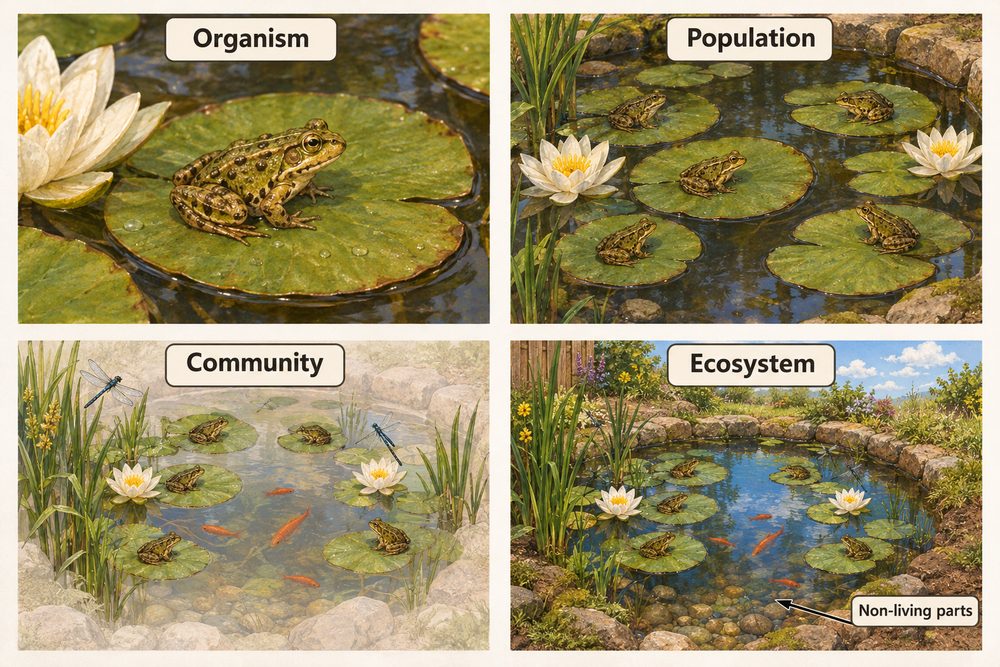
Within communities, organisms are linked by interdependence (B4.1g). Organisms compete for limited resources: animals compete for food, water, territory and mates; plants compete for light, water, mineral ions and space. Relationships also include predation (one organism hunts and eats another), mutualism (both species benefit, as when bees collect nectar while pollinating flowers) and parasitism (one species benefits while harming the other, as in a tapeworm in a host’s gut).
Ecosystems are organised as: organism → population (one species) → community (many species) → ecosystem (community + abiotic environment). Organisms are interdependent through predation, mutualism, parasitism and competition.
Biotic and Abiotic Factors
Abiotic factors are non-living conditions that shape an ecosystem: temperature, light intensity, moisture level, soil pH, wind speed, and dissolved oxygen in aquatic habitats. Biotic factors are living components: predator numbers, disease prevalence, food availability and competition with other species (B4.1f). Changes in either type affect the size and distribution of populations throughout the community.
A classic example of biotic interaction is the predator–prey cycle. In a stable ecosystem, predator and prey populations oscillate: as prey numbers increase (abundant food), predator numbers rise; increased predation reduces prey numbers; with less food, predator numbers fall; prey then recover. This negative feedback keeps both populations within bounds. If an abiotic factor such as drought also reduces prey, the predator population decline is amplified.
Scientists use indicator species to monitor ecosystem health. Lichens are indicators of air quality — they are highly sensitive to sulfur dioxide pollution and disappear from areas with poor air quality. Freshwater invertebrates such as stonefly larvae (intolerant of pollution) or blood worms (tolerant of low oxygen) indicate the degree of water pollution. Monitoring these species provides an early warning of environmental change (B6.1b).
Food Chains, Webs and Trophic Levels
Energy enters most ecosystems as sunlight, captured by producers through photosynthesis. Energy then passes through trophic levels (B4.1h): producer → primary consumer (herbivore) → secondary consumer (carnivore) → tertiary consumer (top predator). A food web shows all the interconnected food chains in a community and illustrates how changes to one population ripple through the whole system.
In a simple terrestrial food chain: grass → rabbit → fox → eagle. Grass is the producer; the rabbit is the primary consumer (herbivore); the fox is the secondary consumer (omnivore/carnivore); the eagle is the tertiary consumer (top predator). Removing the fox from this web allows rabbit numbers to increase, which in turn over-grazes the grass, eventually reducing plant cover.
Food webs are more realistic than single food chains because most consumers eat more than one type of food. This interconnectedness gives ecosystems a degree of resilience — if one prey species declines, a predator may switch to an alternative. However, highly complex food webs can still collapse if a key species at a lower trophic level is lost.
Energy Transfer and Efficiency
At each trophic level, energy is transferred to the next level but a large proportion is lost to the surroundings — through respiration (heat), movement and waste products (faeces, urine). As a result, the biomass available at each successive trophic level is considerably less than at the level below. This is why food chains rarely have more than four or five trophic levels: there is simply not enough energy left to support another level.
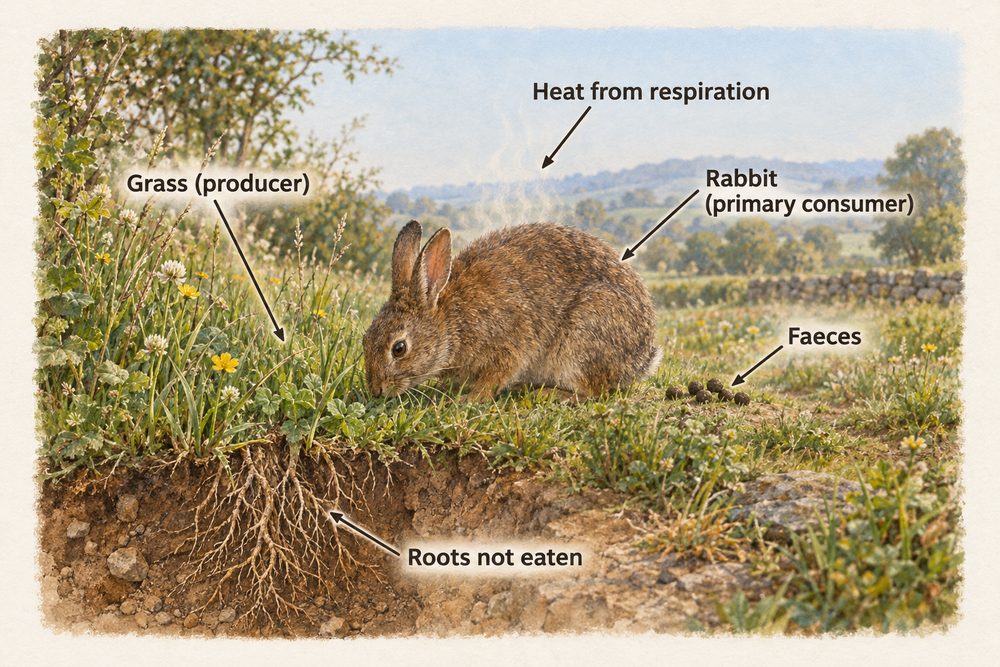
The efficiency of energy transfer between trophic levels is typically around 10% (the “10% rule”), though this varies with species and conditions. If producers capture 10,000 kJ of energy from sunlight, only approximately 1,000 kJ is available to primary consumers, around 100 kJ to secondary consumers, and only about 10 kJ to tertiary consumers. This helps explain why eating lower on the food chain (e.g. eating plant-based foods rather than meat) is more energy-efficient from a global food security perspective (B4.1i–j).
A pyramid of biomass represents the total mass of organisms at each trophic level at a given moment. Unlike pyramids of numbers (which can be inverted — a single oak tree supporting thousands of insects), biomass pyramids are almost always true pyramids: each bar is smaller than the one below because energy and therefore mass decrease at each trophic level.
To construct a biomass pyramid, weigh (or estimate) all organisms at each trophic level in the same area and time period. The bars should be drawn to scale (area or length proportional to biomass). Biomass is usually expressed in grams or kilograms per unit area (g/m2 or kg/m2). A key limitation of a snapshot pyramid is that it does not account for the fact that producers (e.g. algae) reproduce quickly — a small total algal biomass may support a large fish population if turnover is rapid.
Energy (and therefore biomass) decreases at each trophic level because energy is lost through respiration, movement and waste. This is why pyramids of biomass narrow at each level and food chains rarely exceed four or five links.
Adaptations and Biodiversity
Organisms have adaptations — inherited features that improve survival and reproduction in their environment (B4.1). These may be structural (e.g. a polar bear’s thick fur and subcutaneous fat for insulation), behavioural (e.g. nocturnal hunting to avoid daytime predators) or functional (e.g. a camel’s ability to concentrate urine to conserve water). Adaptations arise over many generations through natural selection and shape which organisms live in a given ecosystem.
Biodiversity refers to the variety of species present. High biodiversity makes ecosystems more resilient: if one species declines, others can partially fill its role. Human activities such as deforestation, intensive farming, pollution and over-hunting reduce biodiversity. Conservation programmes — protected habitats, captive breeding, seed banks — aim to preserve biodiversity for ecological stability and future generations.