Reproduction, Meiosis and DNA
Sexual and Asexual Reproduction
There are two fundamentally different ways organisms reproduce. Sexual reproduction involves the fusion of male and female gametes (sperm and egg). Because each gamete carries a different mix of genetic material, the offspring are genetically varied from each other and from both parents. This variation is the raw material for natural selection (B5.1a).
Asexual reproduction involves a single parent. No gametes are formed or fused. Cell division by mitosis produces offspring that are genetically identical to the parent — they are clones. Bacteria, some plants (e.g. strawberry runners) and some animals (e.g. hydra) can reproduce asexually. The advantage is speed and efficiency: no mate is required. The disadvantage is that all offspring are identical, so if the environment changes or disease strikes, all may be equally vulnerable.
Sexual reproduction: two parents, gametes fuse, offspring are genetically varied (benefits natural selection). Asexual reproduction: one parent, mitosis only, offspring are clones (benefits rapid colonisation in stable environments).
Meiosis
Meiosis is the cell division that produces gametes (B5.1h). It occurs in the ovaries and testes. Before meiosis begins, the DNA is replicated. The cell then undergoes two rounds of division:
First division: homologous chromosome pairs line up and then separate into two cells — each cell now has one chromosome from each pair. Second division: each of those cells divides again, producing four cells in total. Each of the four cells is haploid (containing half the normal chromosome number — 23 chromosomes in humans rather than 46). Crucially, genetic material is shuffled during the first division (a process called crossing over), so all four cells are genetically different from each other and from the parent cell.
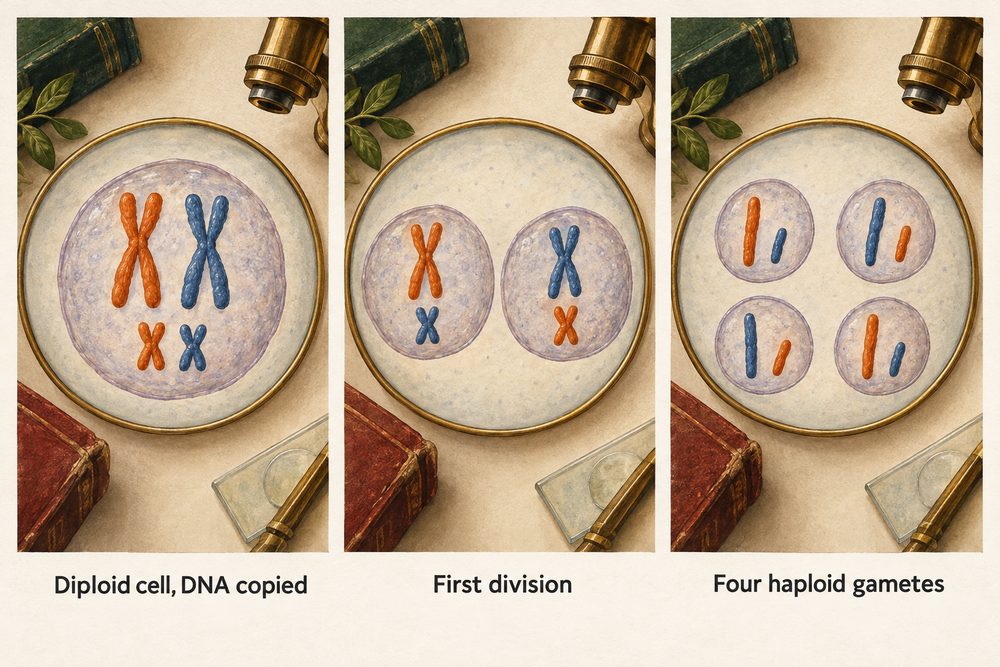
When two haploid gametes fuse at fertilisation, the full chromosome number is restored: the fertilised egg (zygote) contains 46 chromosomes in humans (23 from each gamete). The zygote then divides by mitosis to form the embryo.
Mitosis: one division → 2 cells produced → diploid (full chromosome number) → genetically identical to parent → used for growth, repair and asexual reproduction.
Meiosis: two divisions → 4 cells produced → haploid (half chromosome number) → genetically different from each other and from parent → used to produce gametes for sexual reproduction. Both start with DNA replication, but only meiosis shuffles genetic material to create variation.
DNA Structure
DNA (deoxyribonucleic acid) is a polymer made of two strands wound around each other in a double helix. DNA is found in the nucleus of cells, packaged into structures called chromosomes. Humans have 46 chromosomes arranged as 23 pairs (B1.2a–c, B5.1a).
Each strand of DNA is made of repeating units called nucleotides. Every nucleotide contains a sugar, a phosphate group, and one of four bases: adenine (A), thymine (T), cytosine (C) and guanine (G). The two strands are held together by complementary base pairs: A always pairs with T, and C always pairs with G. This complementary base pairing is fundamental to both DNA replication and protein synthesis.
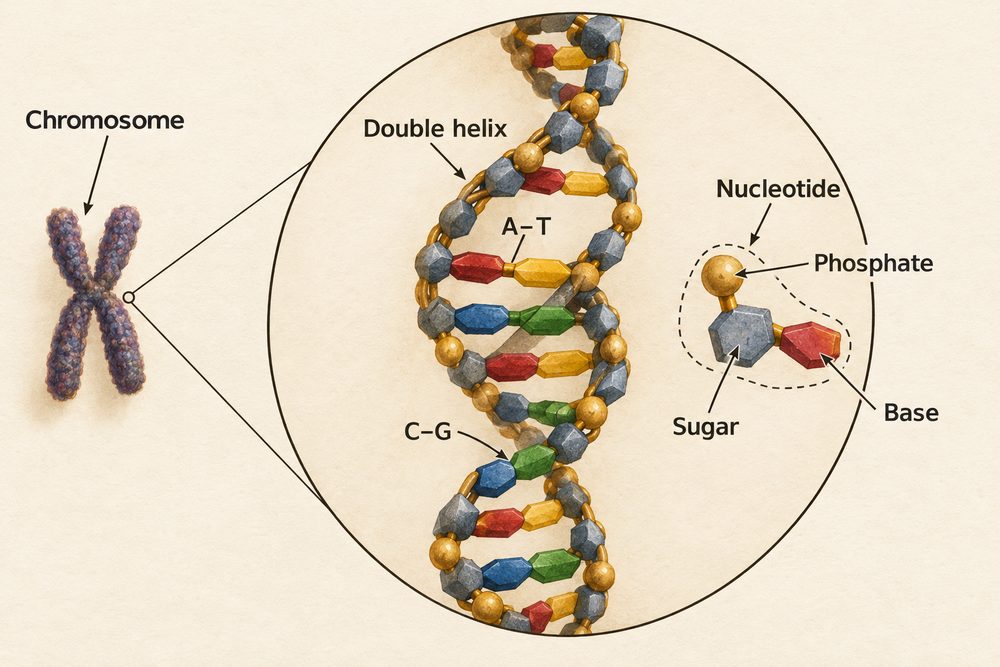
A gene is a specific section of DNA on a chromosome. The sequence of bases along a gene provides a code that determines the order in which amino acids are assembled to build a protein. Different base sequences produce different proteins, and it is proteins — as enzymes, hormones and structural components — that ultimately determine most of the characteristics of an organism.
DNA is a polymer forming a double helix, held together by complementary base pairs (A–T and C–G). A gene is a section of DNA coding for a specific protein. Humans have 23 pairs of chromosomes. The base sequence determines which protein is made.
Protein Synthesis
Protein synthesis involves two linked stages: transcription (in the nucleus) and translation (at the ribosomes in the cytoplasm) (B1.2d–e, Higher tier).
Transcription: The relevant section of DNA is unwound and one strand (the template strand) is used as a template. Free RNA nucleotides align with their complementary bases on the template strand to build a single-stranded molecule of mRNA (messenger RNA). Note that in RNA, uracil (U) replaces thymine (T), so A on DNA pairs with U on mRNA. The mRNA strand then leaves the nucleus through nuclear pores and moves to the cytoplasm.
Translation: At the ribosomes, the mRNA code is read in groups of three bases (codons). Transfer RNA (tRNA) molecules carry specific amino acids to the ribosome, matching their anticodon to the corresponding mRNA codon. The ribosome joins the amino acids together in the correct sequence to form a polypeptide chain. The chain folds into a specific three-dimensional shape to produce a functional protein. Different amino acid sequences produce proteins with different shapes and functions.
The genetic variation produced by meiosis (through chromosome shuffling and crossing over) and by fertilisation (random combination of gametes) means that offspring in sexually reproducing species are never genetically identical (unless they are identical twins). This variation provides the raw material for natural selection: individuals with alleles that better suit a changing environment are more likely to survive and reproduce, passing those alleles to the next generation. Without variation, a species cannot adapt to environmental change.