Inheritance and Genetic Disorders
Genes, Chromosomes and Alleles
The genome is the complete set of genetic material in an organism. In humans, DNA is packaged into 23 pairs of chromosomes inside the nucleus of most cells. Each chromosome carries hundreds of genes — sections of DNA that code for proteins. These proteins control our characteristics, from eye colour to enzyme function.
Most body cells are diploid — they carry two copies of each chromosome, one inherited from each parent. Sex cells (sperm and eggs) are haploid: they carry only one copy of each chromosome (23 in humans). At fertilisation, two haploid gametes fuse to restore the diploid number of 46.
Human body cells are diploid (46 chromosomes in 23 pairs). Gametes are haploid (23 chromosomes). At fertilisation, two gametes fuse to restore the diploid number of 46.
Genotype and Phenotype
Because chromosomes come in pairs, we carry two copies of each gene. Different versions of a gene are called alleles. If both alleles are identical, the individual is homozygous. If the alleles differ, the individual is heterozygous. A dominant allele (written as a capital letter, e.g. A) is expressed in the phenotype even when only one copy is present. A recessive allele (written as a lowercase letter, e.g. a) is only expressed when two copies are present (homozygous recessive).
The combination of alleles an organism carries is its genotype (e.g. Aa). The observable characteristic that results is the phenotype (e.g. brown eyes). The phenotype depends on which alleles are present and how they interact.
Dominant alleles are expressed even in one copy; recessive alleles are only expressed when two copies are present. Genotype = allele combination; phenotype = observable characteristic produced.
Punnett Squares
A Punnett square is used to predict the possible genotypes and phenotypes of offspring from a genetic cross. Place one parent’s alleles along the top and the other parent’s alleles down the side. Fill each box by combining one allele from each parent.
Example: two heterozygous parents (Bb × Bb), where B (brown coat) is dominant over b (white coat). The possible offspring genotypes are BB, Bb, Bb and bb — giving a 3:1 phenotype ratio (three brown : one white). As probabilities: 75% chance of the dominant phenotype, 25% chance of the recessive phenotype. These are expected ratios, not guaranteed outcomes — chance means actual results may differ, especially with small samples.
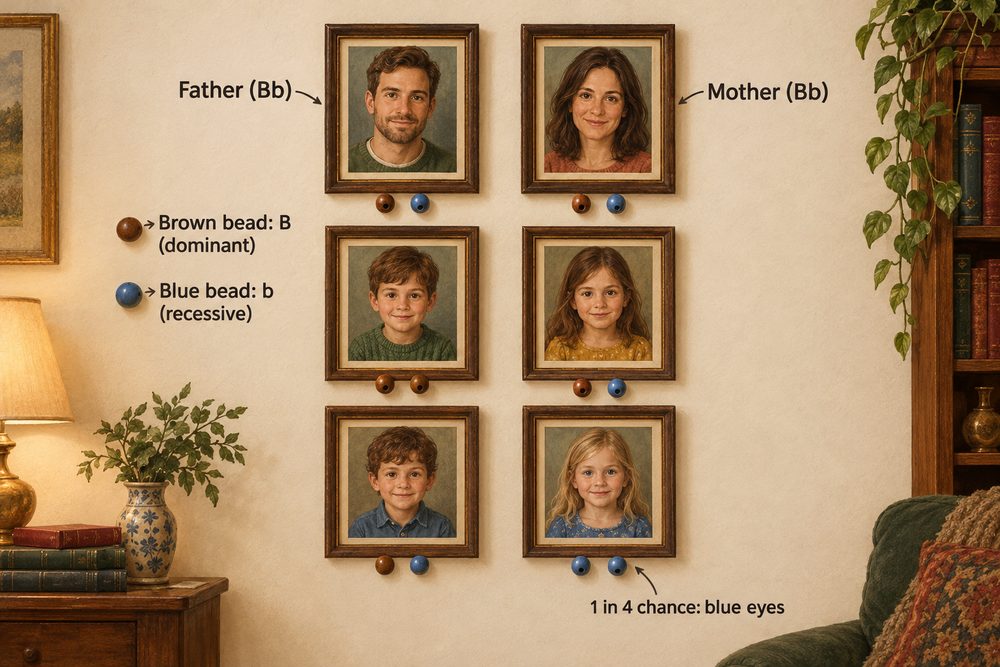
A full genetic diagram includes: (1) parental phenotypes and genotypes; (2) gametes produced by each parent; (3) a 2×2 Punnett square; (4) offspring genotypes with phenotypes stated; (5) probabilities or ratios. Always show gametes as a separate step — this step is required. State the phenotype of each offspring genotype, not just the allele letters. If only one parent is heterozygous (e.g. Bb × bb), the offspring ratio is 1:1 (50% Bb, 50% bb), meaning half show the dominant phenotype and half show the recessive phenotype.
Inherited Disorders
Cystic fibrosis is caused by a recessive allele. A person must inherit two copies of the faulty allele (ff) to have the condition. Individuals with one copy (Ff) are carriers — they carry the allele but show no symptoms. When two carriers have children, there is a 25% chance each child will have cystic fibrosis, a 50% chance each child will be a carrier, and a 25% chance each child will be unaffected and not a carrier. Cystic fibrosis causes thick, sticky mucus to build up in the lungs and digestive system, impairing breathing and digestion.
Huntington’s disease is caused by a dominant allele (H). Only one copy is needed for the condition to appear, so a heterozygous individual (Hh) will develop it. This means an affected parent with genotype Hh has a 50% chance of passing the condition to each child, even if the other parent is unaffected (hh). Huntington’s causes progressive deterioration of the nervous system, with symptoms typically appearing in mid-adulthood.
Sex is determined by the 23rd pair of chromosomes. Females have two X chromosomes (XX); males have one X and one Y (XY). Because fathers can pass either an X or a Y chromosome in their sperm, there is a 50:50 probability that each child will be female (XX) or male (XY). This can be shown with a Punnett square using X and Y instead of allele letters.
Embryo screening can be used to test embryos produced by IVF for specific genetic disorders before implantation. This is called pre-implantation genetic diagnosis (PGD). It raises ethical questions: supporters argue it prevents suffering; critics argue it raises issues about designer babies and the potential for selecting non-medical traits. Genetic testing of adults can also identify carriers before they have children, allowing informed decisions about family planning.
Cystic fibrosis (recessive, ff): both parents must be carriers for a 25% risk per child. Huntington’s disease (dominant, H): one affected parent (Hh × hh) gives a 50% risk per child. Sex: XX = female, XY = male.