Variation, Evolution and Speciation
Variation Within a Species
Individuals within a species are not identical — they show variation. Some variation is genetic (arising from differences in alleles, such as blood type), some is environmental (caused by living conditions, such as a scar or language spoken), and much is a combination of both (height depends on genes but also on diet). Genetic variation arises through three main routes: mutations (random changes in DNA sequence), meiosis (the shuffling and random assortment of chromosomes during gamete formation), and sexual reproduction (combining alleles from two different parents).
Variation within a population is essential for natural selection. Without variation, all individuals would respond identically to environmental pressures — selection would have nothing to act upon. It is variation that makes evolution possible.
Variation can be genetic, environmental or both. Genetic variation comes from mutations, meiosis and sexual reproduction. Without variation, natural selection cannot occur.
Natural Selection and Evolution
Natural selection was proposed by Charles Darwin (1809–1882) and, independently, by Alfred Russel Wallace (1823–1913). Their joint theory was presented to the Linnean Society in 1858. The theory works through four linked steps:
1. Within a population, individuals show variation in their characteristics.
2. More offspring are produced than the environment can support, so individuals compete for limited resources (food, water, mates, space).
3. Those with characteristics best suited to the environment are more likely to survive and reproduce — survival of the fittest.
4. Survivors pass the advantageous alleles to their offspring, so over many generations the proportion of individuals with the beneficial trait increases.
This cumulative change across generations is evolution. It is crucial to remember that individual organisms do not evolve — populations evolve as the frequency of advantageous alleles changes over time. Evolution has no direction or purpose; it simply reflects which traits happen to be best suited to the current environment.
Antibiotic resistance is a modern, observable example of natural selection. When a population of bacteria is exposed to an antibiotic, most individuals die. However, random mutations may have given some bacteria a resistance mechanism. These resistant individuals survive, reproduce rapidly (bacteria can divide every 20 minutes) and pass on the resistance allele. Over time, the resistant strain comes to dominate the population.
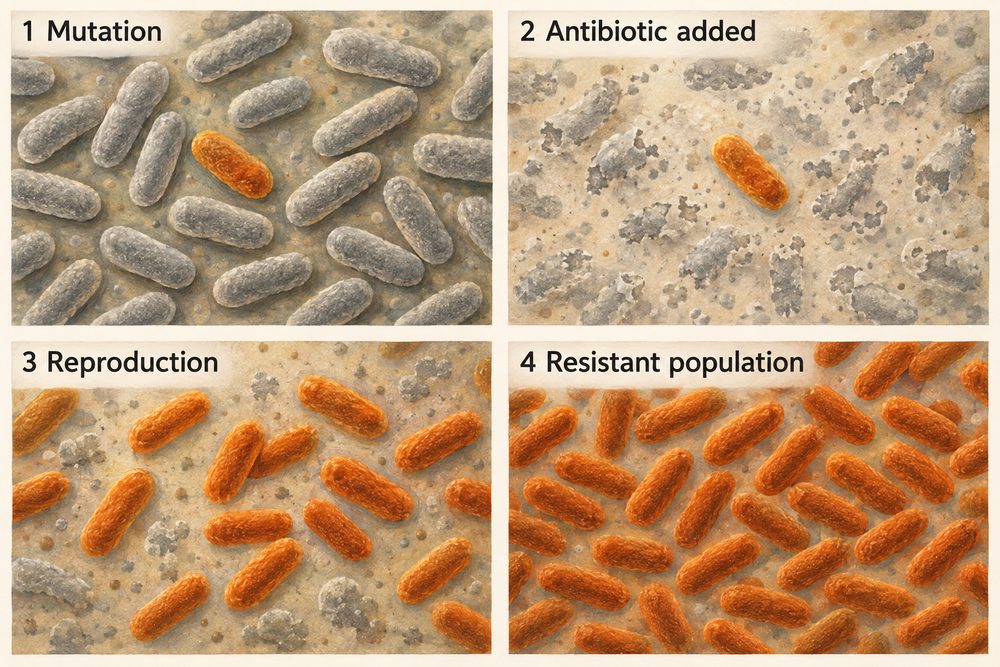
MRSA (methicillin-resistant Staphylococcus aureus) is a well-known example. To slow the spread of resistance, antibiotics should only be prescribed when necessary, patients must complete the full course, and overuse in agriculture should be minimised. New antibiotics are difficult to develop, so preserving the effectiveness of existing ones is critical.
Natural selection: variation → competition → survival and reproduction of the fittest → advantageous alleles inherited by offspring. Repeated over many generations, this drives evolution.
Evidence for Evolution
Evidence for evolution comes from several independent sources:
• The fossil record — fossils show gradual changes in organisms over millions of years, including transitional forms linking ancient and modern species. Fossils can be dated by the rock layers in which they are found (older strata lie deeper), by radiometric dating techniques, and by comparison with other fossils of known age. Gaps in the fossil record exist because fossilisation is rare, but new discoveries continue to fill these gaps.
• Comparative anatomy — different vertebrate species share similar underlying bone structures (the pentadactyl limb: five-digit structure found in human hands, bat wings and whale flippers), suggesting common ancestry despite very different functions.
• DNA analysis — closely related species share more DNA sequences. The more similar the DNA, the more recently the species diverged from a common ancestor. Molecular evidence now allows evolutionary trees to be constructed with great precision.
The peppered moth provides a well-documented example of natural selection within observable timescales. Before industrialisation, pale-coloured moths were better camouflaged on pale, lichen-covered tree bark; dark moths were eaten more often by birds. As industrial pollution darkened tree trunks with soot and killed lichens, dark moths gained a survival advantage. The proportion of dark moths increased substantially in industrial areas. When clean air legislation reduced pollution, the pale form recovered. This demonstrates that natural selection responds rapidly to environmental change.
Speciation occurs when populations of the same species become isolated — most commonly through a geographical barrier such as a mountain range, sea channel or river. Once isolated, the two populations face different environments and different selection pressures. Random mutations and natural selection cause each population to change in different directions over many generations. Eventually, the populations become so genetically different that they can no longer interbreed to produce fertile offspring. At this point, they are classified as separate species.
Extinction occurs when a species cannot adapt fast enough to changing conditions. Causes include climate change, new predators or competitors, new diseases, habitat destruction and catastrophic events. The fossil record shows that the vast majority of species that have ever lived are now extinct. Current extinction rates are elevated compared to the geological average, linked to human activity including habitat destruction, pollution and climate change.
Speciation: geographical isolation → different selection pressures → populations evolve separately → reproductive isolation → two distinct species. Evidence for evolution comes from fossils, comparative anatomy and DNA analysis.