Feeding the Human Race: Selective Breeding and GM
The Challenge of Food Security
Food security means ensuring that all people have reliable access to sufficient, nutritious food. With the global population growing rapidly, achieving food security is one of the most pressing challenges biologists and agricultural scientists face. Key threats include: population growth (more people need more food), climate change (droughts, floods and extreme weather damage crops), rising costs (fuel and fertiliser price increases raise food prices), conflict (war disrupts farming and distribution) and water scarcity (unreliable irrigation).
Food security is threatened by population growth, climate change, rising costs, conflict and water scarcity. Biologists develop scientific solutions to increase food production sustainably.
Selective Breeding
Selective breeding (also called artificial selection) is when humans choose organisms with the most desirable characteristics and breed them together over many generations. Over time, the frequency of the desired alleles increases in the population. Examples include:
• Breeding cattle that produce greater quantities of milk or have faster growth rates.
• Developing wheat varieties resistant to fungal diseases such as wheat rust.
• Selecting dogs with specific temperaments and physical traits for different working roles.
• Breeding crop plants with increased yield per hectare.
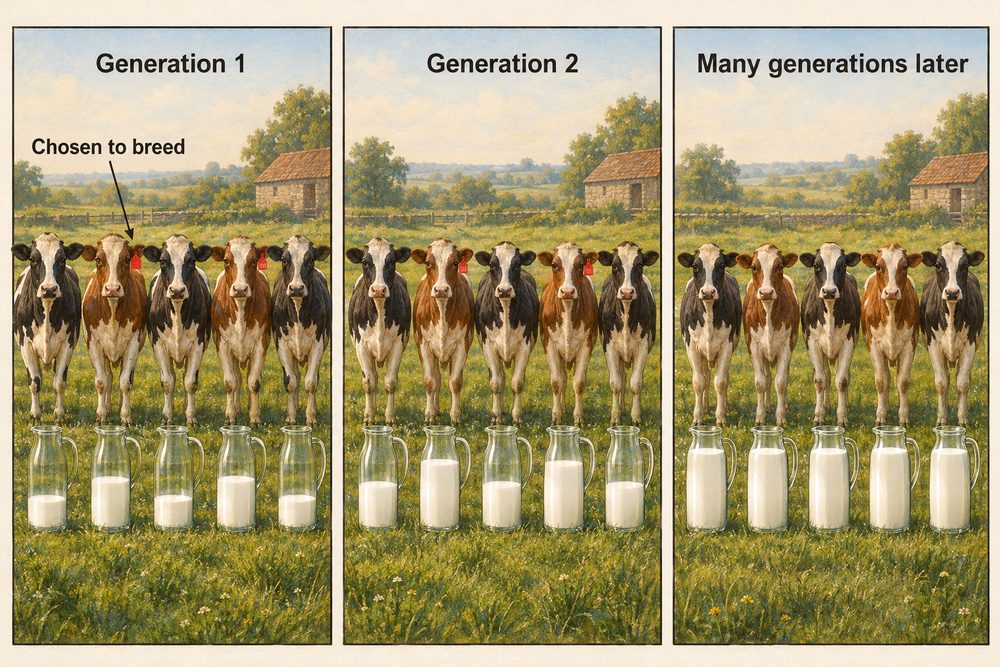
Selective breeding is effective but has a key limitation: it reduces genetic diversity within the population. Repeated breeding from a small gene pool makes populations more uniform. This means a new pathogen or environmental change to which they have no resistance could devastate the entire population. Selective breeding can also cause health issues in animals when extreme traits are selected (e.g. breathing difficulties in flat-faced dog breeds).
Genetic modification (GM) involves inserting a gene from one organism directly into the DNA of another to give it a new characteristic. Unlike selective breeding, GM can introduce entirely new characteristics from a different species in a single generation. Higher tier only: the desired gene is identified in a donor organism, cut out with restriction enzymes that leave sticky ends, joined into a vector such as a bacterial plasmid using the enzyme ligase, and taken up by host bacteria (B6.2e).
GM crops have been engineered to be resistant to insect pests (reducing the need for insecticides), resistant to herbicides (allowing weeds to be killed without harming the crop), tolerant to drought conditions, or capable of producing greater yields. One widely discussed example is golden rice, which has been modified to produce beta-carotene (a precursor to vitamin A) — potentially addressing vitamin A deficiency in populations where rice is a staple food.
Concerns about GM crops include: the possibility that GM genes could spread to wild plant relatives through cross-pollination, creating herbicide-resistant ‘superweeds’; potential unknown long-term effects on human health or ecosystems; ethical objections to interfering with natural genetic sequences; and the concentration of seed ownership in the hands of large corporations, which may disadvantage smallholder farmers.
GM crops can be pest-resistant, drought-tolerant or more nutritious. Concerns include gene transfer to wild plants, unknown long-term effects and ethical objections. Selective breeding reduces genetic diversity over time; GM can introduce new traits in one generation.
Tissue Culture
Tissue culture is a technique used to propagate plants rapidly by taking small samples of plant tissue (called explants), sterilising them and growing them on a nutrient medium containing the correct balance of plant growth hormones. Each explant develops into a complete, whole plant that is genetically identical to the parent plant. This allows large numbers of plants to be produced quickly and reliably from a single parent — useful for preserving rare or endangered plant species, for multiplying commercially high-value varieties such as orchids, and for producing disease-free planting stock. Because all the plants produced are clones, they share the same genetic advantages as the selected parent — but also the same vulnerabilities. If a disease emerges that one plant cannot resist, none of the clones will be resistant either.
Biological control uses living organisms instead of chemical pesticides to manage pests. Examples include introducing ladybirds to feed on aphid colonies on crop plants, or using parasitic wasps that lay eggs inside caterpillars, whose larvae then kill the host. Biological control avoids chemical pollution and is self-sustaining once established, but it can be unpredictable — the introduced organism may become invasive itself, attack non-target species or fail to control the pest effectively.
Integrated pest management (IPM) combines chemical and biological approaches, using pesticides only when pest numbers exceed a threshold and relying on natural predators where possible. This minimises chemical use and environmental impact while protecting crop yields.
Sustainable farming practices that help with food security include crop rotation (alternating crops each season to prevent soil mineral depletion and reduce pest build-up), organic farming (using natural fertilisers and biological control instead of synthetic chemicals) and hydroponics (growing plants in nutrient solutions without soil, allowing year-round production in controlled environments with less water use than traditional farming).
Tissue culture produces many identical plants from a single parent rapidly. Biological control uses natural predators rather than chemicals. Crop rotation and hydroponics are examples of sustainable farming practices that increase food security.