Health, Disease and the Immune System
Health, Disease and Pathogens
Health is a state of complete physical and mental well-being, not merely the absence of disease. Communicable diseases are caused by pathogens — microorganisms including bacteria, viruses, fungi and protists. These are spread by direct contact, airborne droplets, contaminated food or water, or animal vectors such as mosquitoes. Non-communicable diseases cannot be transmitted between people. Examples include cardiovascular disease, type 2 diabetes, cancer and asthma. Risk factors include smoking, poor diet, physical inactivity and obesity — though genetic factors also play a role.

Different pathogens cause disease through different mechanisms. Bacteria reproduce rapidly inside the body and release toxins that damage cells and tissues. Viruses invade host cells, hijack their genetic machinery to replicate, and burst out of the cell (lysis), destroying it. Fungi can cause surface infections (e.g. athlete’s foot) or systemic infections in individuals with weakened immunity. Protists include Plasmodium, which causes malaria and is transmitted by mosquito vectors.
Pathogens (bacteria, viruses, fungi, protists) cause communicable diseases by different mechanisms. Non-communicable diseases (cardiovascular disease, diabetes, cancer) are linked to lifestyle and genetic risk factors and cannot spread between people.
The Body’s Defence Systems
The body has several lines of defence against pathogens. Non-specific defences (first line) prevent pathogens from entering:
• Skin — a physical barrier that prevents most pathogens from entering unless broken.
• Mucus and cilia in the respiratory tract — mucus traps pathogens; cilia sweep the mucus up and out of the airways.
• Stomach acid (approximately pH 2) — kills most pathogens ingested with food or water.
• Tears and saliva — contain the enzyme lysozyme, which breaks down bacterial cell walls.
If pathogens get past these barriers, the inflammatory response is triggered. Damaged cells release chemicals that cause blood vessels to dilate and become more permeable, increasing blood flow to the infected area (causing redness and warmth) and allowing white blood cells to migrate into the tissue more rapidly.
If pathogens breach the non-specific defences, the specific immune response is activated. Each pathogen carries unique proteins on its surface called antigens. B lymphocytes recognise foreign antigens and produce antibodies — Y-shaped proteins that bind specifically to the matching antigen. Antibodies work by clumping pathogens together (agglutination) for easier destruction, neutralising toxins, and marking pathogens for engulfment by phagocytes.
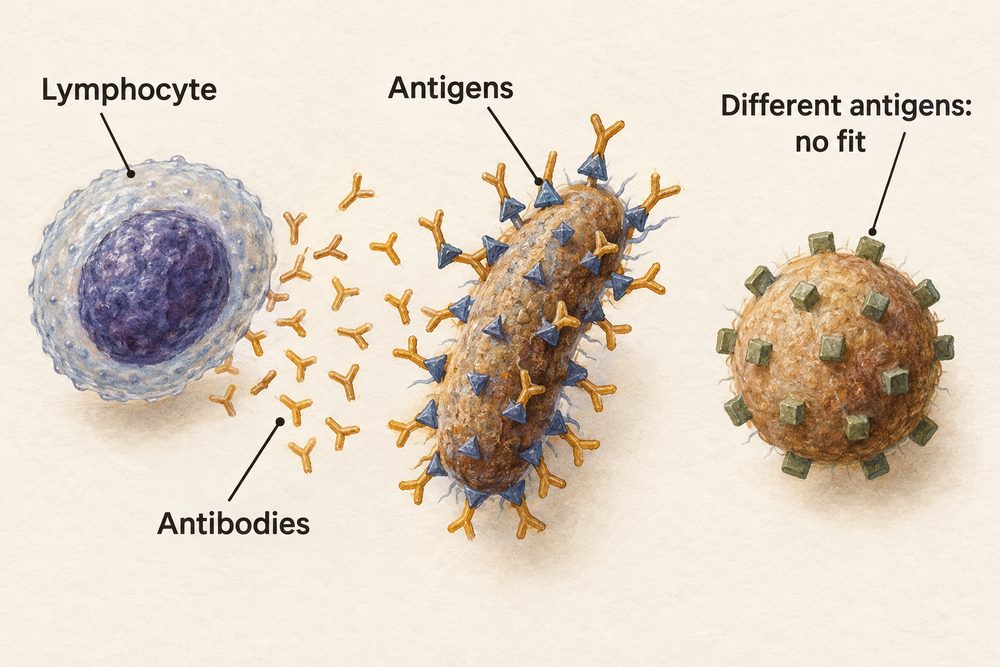
T lymphocytes work alongside B lymphocytes. T lymphocytes recognise and destroy body cells that have been infected by viruses or bacteria, preventing further spread. They also activate B lymphocytes to produce antibodies. After infection, some lymphocytes become memory cells that persist in the body for years. If the same pathogen is encountered again, memory cells trigger a much faster and larger antibody response, usually preventing illness entirely.
Phagocytes engulf and digest pathogens through a process called phagocytosis. This is a non-specific response — phagocytes target any foreign material, not just specific pathogens.
B lymphocytes produce antibodies specific to antigens. T lymphocytes destroy infected cells and activate B lymphocytes. Memory cells enable a faster response to reinfection. Phagocytes engulf pathogens non-specifically.
Vaccination and Antibiotics
Vaccination introduces a harmless form of a pathogen — which may be dead, weakened, or just its antigens — into the body. The immune system responds by producing antibodies and memory cells, without causing the disease. If the real pathogen enters later, memory cells trigger a rapid response. Mass vaccination programmes have dramatically reduced or eliminated diseases such as smallpox, measles, polio and tetanus in many countries.
Antibiotics are medicines that kill bacteria or stop them reproducing. They target structures that bacteria have but human cells lack, such as the bacterial cell wall. This makes them selectively toxic — harmful to bacteria but safe for human cells. Importantly, antibiotics do not work against viruses, because viruses lack the cellular structures that antibiotics target and instead use the host cell’s own machinery to replicate. Overuse and misuse of antibiotics drives antibiotic resistance, producing strains that are very difficult to treat.
Monoclonal antibodies are produced by fusing a specific B lymphocyte (that produces the desired antibody) with a tumour cell to create a hybridoma cell. Hybridoma cells can be grown indefinitely in culture and will continuously produce large quantities of identical antibodies, all specific to the same antigen. Because they are identical and highly specific, monoclonal antibodies can be engineered to target a particular protein or cell type with great precision.
Uses of monoclonal antibodies include:
• Pregnancy tests — detecting the hormone hCG in urine.
• Cancer diagnosis and therapy — antibodies tagged with a radioactive marker or drug are delivered directly to tumour cells carrying the target antigen, destroying the cancer cells while sparing healthy tissue.
• Blood tests — detecting specific proteins or pathogens in blood samples.
• Autoimmune disease treatment — blocking immune signals that cause conditions like rheumatoid arthritis.
Monoclonal antibodies offer greater precision than many conventional drug treatments but side effects remain a concern — the immune system sometimes reacts to the introduced antibody proteins. Research into new applications is ongoing.
Monoclonal antibodies are produced from hybridoma cells (B lymphocyte + tumour cell). They are highly specific and used in pregnancy tests, cancer treatment, blood tests and autoimmune disease therapy.