Cell Division and Transport
The Cell Cycle and Mitosis
Cells in your body divide to grow, repair damaged tissue and replace worn-out cells. This process follows a pattern called the cell cycle. Most of the cell cycle is spent in a growth phase called interphase, during which the cell’s DNA is replicated and the number of sub-cellular structures (organelles) increases.
Once the cell has copied all of its DNA and organelles, it enters mitosis. During mitosis, one set of chromosomes is pulled to each end of the cell. The cytoplasm and cell membrane then divide to produce two genetically identical daughter cells. Each daughter cell has the full set of 46 chromosomes (in humans).
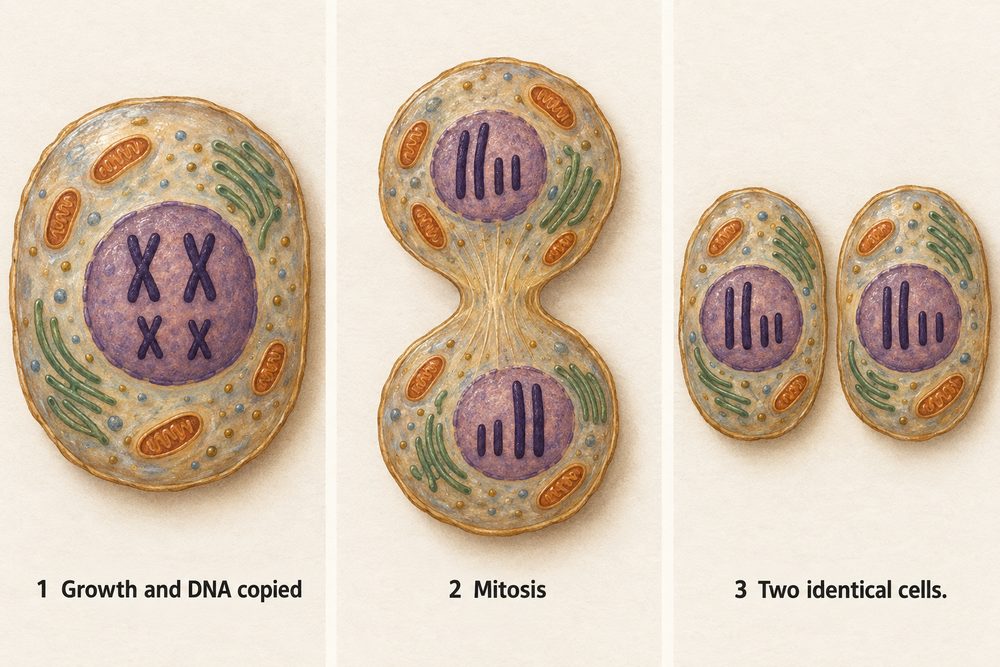
Mitosis produces two genetically identical daughter cells from one parent cell. It is used for growth, repair and asexual reproduction. The cell cycle consists of interphase (growth + DNA replication) followed by mitosis and cell division.
Stem cells are undifferentiated cells that can divide and become specialised. In humans, embryonic stem cells can differentiate into almost any cell type, while adult stem cells (found in bone marrow) are more limited. In plants, meristem tissue retains the ability to differentiate throughout the plant’s life.
Stem cells have therapeutic uses — for example, treating paralysis or diabetes — but raise ethical concerns, particularly around the use of embryonic stem cells. You need to be able to discuss both the potential benefits and the ethical objections.
Diffusion
Diffusion is the spreading out of particles from a region where they are at a higher concentration to a region where they are at a lower concentration. It occurs in both liquids and gases and does not require energy. Oxygen and carbon dioxide move in and out of cells by diffusion.
The rate of diffusion is affected by the concentration gradient (a steeper gradient means faster diffusion), the temperature (higher temperature gives particles more kinetic energy), the surface area of the membrane and the distance the particles must travel.
Diffusion is the net movement of particles from high to low concentration. It is a passive process (no energy required). Factors affecting rate: concentration gradient, temperature, surface area and distance.
Osmosis
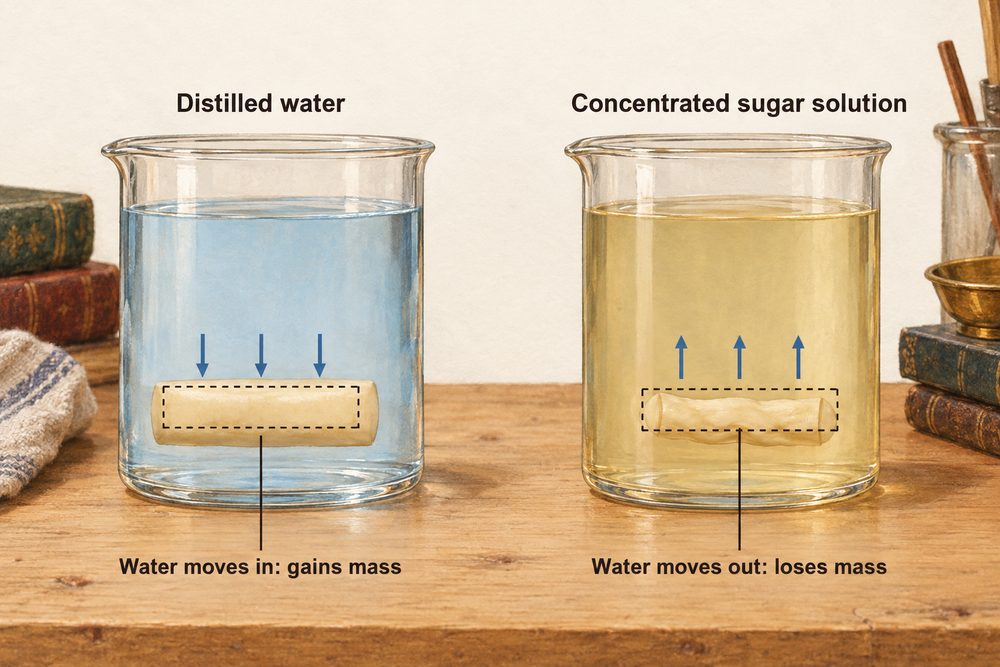
Osmosis is the movement of water molecules across a partially permeable membrane from a dilute solution (high water concentration) to a more concentrated solution (low water concentration). Like diffusion, osmosis is a passive process.
In Required Practical 3, you investigate the effect of a range of sugar solutions on the mass of plant tissue. Potato cylinders placed in distilled water gain mass (water enters cells by osmosis) while those in concentrated sugar solution lose mass (water leaves cells).
Active transport moves substances against the concentration gradient — from a region of lower concentration to a region of higher concentration. This requires energy from cellular respiration. Examples include root hair cells absorbing mineral ions from the soil and the absorption of sugar from the gut into the blood.
Active transport is essential when a cell needs to accumulate substances at a higher concentration than the surrounding environment. The energy for this process comes from the mitochondria.
Comparing Transport Methods
A common exam question asks you to compare diffusion, osmosis and active transport. Diffusion and osmosis are passive (no energy needed) and move substances down the concentration gradient. Active transport requires energy and moves substances against the concentration gradient. Osmosis specifically describes the movement of water through a partially permeable membrane.