Homeostasis and the Nervous System
Homeostasis
Homeostasis is the regulation of the internal conditions of the body to maintain a stable environment. This is essential because cells need the right conditions to function properly — particularly for enzyme action. The conditions controlled include body temperature, blood glucose concentration, water levels and ion levels.
Homeostasis maintains optimal internal conditions for enzyme activity. All control systems involve: receptors (detect stimuli), coordination centres (brain, spinal cord, pancreas) and effectors (muscles or glands that produce a response).
Homeostatic control systems involve three components: receptors that detect changes in the environment (stimuli), coordination centres (the brain, spinal cord and pancreas) that receive and process information, and effectors (muscles and glands) that carry out a response. Many homeostatic systems use negative feedback — a mechanism where the response works to reverse the change and return conditions to the optimum.
The Nervous System
The nervous system enables humans to react to their surroundings and coordinate behaviour. It is made up of the central nervous system (CNS) — the brain and spinal cord — and the peripheral nervous system (sensory and motor neurones that connect receptors and effectors to the CNS).
The pathway of a nervous response is: stimulus → receptor → sensory neurone → relay neurone (in CNS) → motor neurone → effector → response.
Neurones do not directly touch each other. The tiny gap between two neurones is called a synapse. When an electrical impulse reaches the end of a neurone, it triggers the release of chemical neurotransmitters that diffuse across the gap and bind to receptors on the next neurone, triggering a new electrical impulse. This allows signals to pass between neurones.
Reflex Actions
Reflex actions are rapid, automatic responses that do not involve the conscious part of the brain. They protect the body from harm — for example, pulling your hand away from a hot object. The nerve pathway for a reflex is called a reflex arc:
Receptor → sensory neurone → relay neurone (in spinal cord) → motor neurone → effector
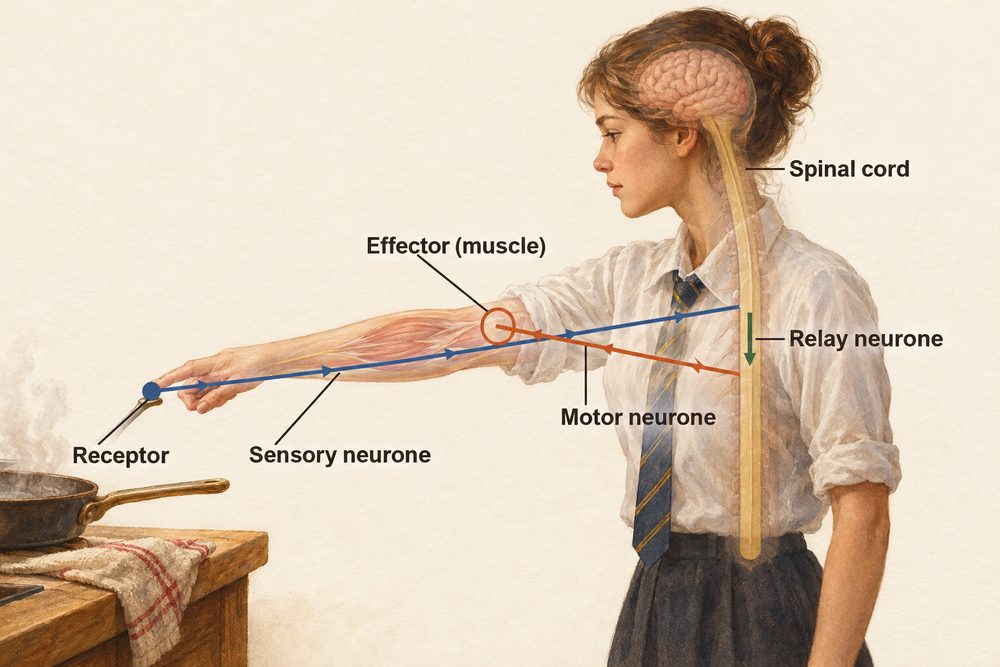
Reflex arcs bypass the brain, making responses faster. The pathway is: receptor → sensory neurone → relay neurone (spinal cord) → motor neurone → effector. This protects the body from danger.
Required Practical 7 involves investigating the effect of a factor on human reaction time. A common method is the ruler drop test: one person holds a ruler vertically, the other person catches it when released. The distance the ruler falls is related to reaction time — a shorter distance means a faster reaction. Variables such as caffeine, practice, or distraction can be investigated as independent variables.
The brain is the main coordination centre. It receives impulses from receptors and sends impulses to effectors. Different regions of the brain have different functions: the cerebral cortex (consciousness, thought, memory), the cerebellum (balance and coordination) and the medulla (unconscious activities like breathing and heart rate).