The Kidney, Water Balance and Plant Hormones
The Kidney and Excretion
The kidneys are vital organs that filter the blood, removing waste products and excess substances while retaining useful molecules. They play a central role in excretion and in maintaining the body’s internal environment through homeostasis.
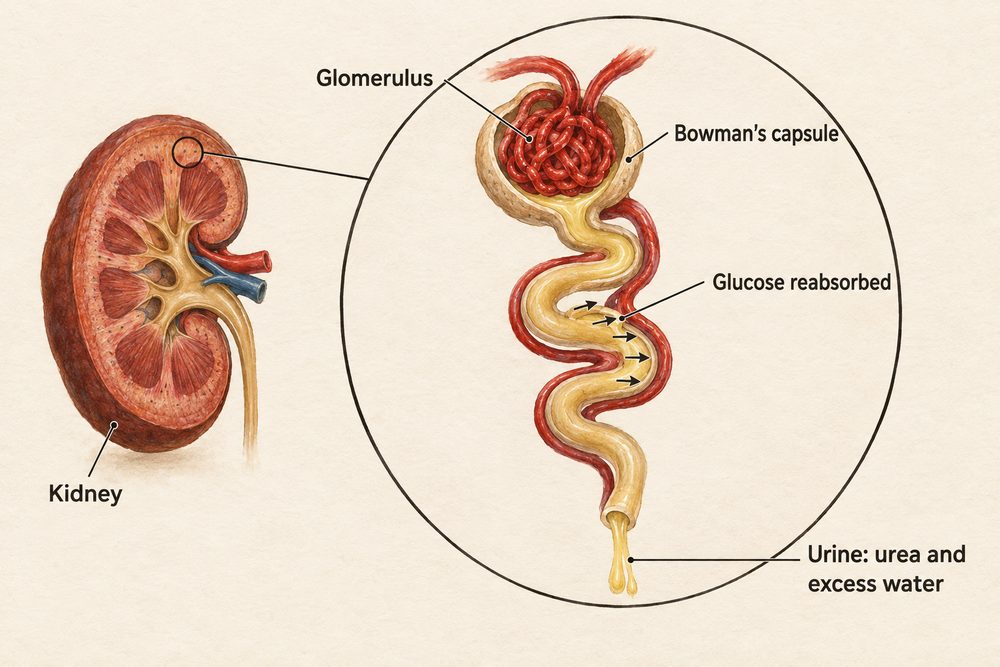
The kidneys produce urine in three stages: filtration (blood is filtered at high pressure in the glomerulus), selective reabsorption (useful substances like glucose, amino acids, and some water are reabsorbed into the blood), and excretion of waste (urea, excess ions, and excess water form urine).
How the Kidney Works
Each kidney contains around one million microscopic filtering units called nephrons. Blood enters each nephron at the glomerulus, a knot of capillaries surrounded by the Bowman’s capsule.
- Filtration: High blood pressure forces small molecules (water, glucose, urea, ions) out of the blood and into the Bowman’s capsule. Large molecules like proteins and blood cells are too big to pass through.
- Selective reabsorption: As the filtrate passes along the tubules, all glucose is reabsorbed by active transport. Sufficient water and dissolved ions are also reabsorbed to maintain the correct blood concentration.
- Formation of urine: The remaining liquid — containing urea, excess ions, and excess water — continues to the collecting duct and is stored in the bladder as urine.
If the kidneys fail, waste products build up in the blood and become toxic. There are two main treatments:
Dialysis: Blood is passed through a machine containing a partially permeable membrane. Urea and excess ions diffuse from the blood into the dialysis fluid, which has the correct concentration of glucose and ions so that these are not lost. Patients typically need dialysis three times per week for several hours.
Kidney transplant: A healthy kidney from a donor replaces the failed kidney. The donor must be a tissue match to reduce the risk of rejection by the recipient’s immune system. Immunosuppressant drugs are taken for life to prevent rejection.
Water Balance and ADH
The concentration of urine is controlled by a hormone called ADH (anti-diuretic hormone), released by the pituitary gland. ADH acts on the kidney tubules to control how much water is reabsorbed back into the blood.
When blood water concentration is too low (e.g. after sweating), more ADH is released. This makes the kidney tubules more permeable to water, so more water is reabsorbed and a small volume of concentrated urine is produced. When blood water concentration is too high (e.g. after drinking lots), less ADH is released, less water is reabsorbed, and a large volume of dilute urine is produced.
This is an example of negative feedback — the response (water reabsorption) counteracts the change (too much or too little water), bringing the system back to normal.
Plant Hormones
Plants produce hormones that coordinate and control growth and responses to the environment. Unlike animal hormones, plant hormones are not produced in glands — they are made in growing regions and move through the plant.
Auxin is the most important plant hormone you need to know. It is produced in the tips of shoots and roots and causes cells to elongate (lengthen).
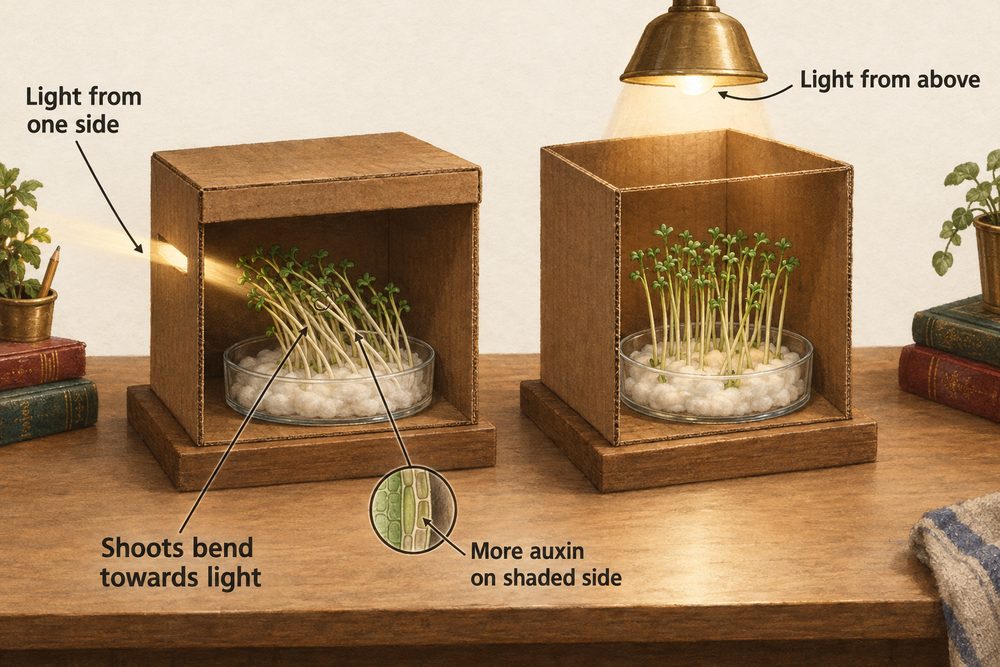
Auxin moves away from light in shoots. This causes the shaded side to have more auxin, so cells on the shaded side elongate more, bending the shoot towards the light (phototropism). In roots, auxin has the opposite effect — it inhibits cell elongation, so more auxin on the lower side causes the root to bend downwards (gravitropism).
Plant hormones have many uses in agriculture and horticulture:
- Auxins as weedkillers: Selective weedkillers contain synthetic auxins that cause broadleaved weeds to grow uncontrollably and die, while narrow-leaved crops (grasses) are unaffected.
- Auxins as rooting powder: Dipping plant cuttings in auxin stimulates root growth, allowing faster propagation.
- Gibberellins: Can end seed dormancy, promote flowering, and increase fruit size.
- Ethene: Controls fruit ripening. Fruit can be picked unripe (for easier transport) and treated with ethene to ripen before sale.