DNA Structure, Cloning and the History of Genetics
DNA Structure
DNA (deoxyribonucleic acid) is a large molecule made of two strands twisted together in a shape called a double helix. Each strand is a polymer made from repeating units called nucleotides.
Each nucleotide consists of a sugar (deoxyribose), a phosphate group, and one of four bases: adenine (A), thymine (T), cytosine (C), or guanine (G). The bases pair in a specific way: A always pairs with T, and C always pairs with G. This is called complementary base pairing.
The sequence of bases along a strand of DNA forms the genetic code. Each group of three bases (a triplet) codes for a particular amino acid. The order of amino acids determines the shape and function of the protein produced.
Protein Synthesis
Proteins are synthesised on ribosomes in the cytoplasm. Since DNA cannot leave the nucleus, a copy of the gene is made as mRNA (messenger RNA) in a process called transcription. The mRNA then travels to a ribosome where it is translated into a chain of amino acids that folds into a protein.
Transcription (in the nucleus): The two strands of DNA unzip. One strand is used as a template to build a complementary mRNA strand. The mRNA then leaves the nucleus through a nuclear pore.
Translation (at the ribosome): The mRNA attaches to a ribosome. Transfer RNA (tRNA) molecules bring the correct amino acids to the ribosome, matching their anticodon to the mRNA codon. The amino acids are joined together in the correct order to form a polypeptide chain.
Genetic Engineering
Genetic engineering involves cutting a gene out of the DNA of one organism and inserting it into the DNA of another. The organism that receives the gene is called a genetically modified (GM) organism or transgenic organism.
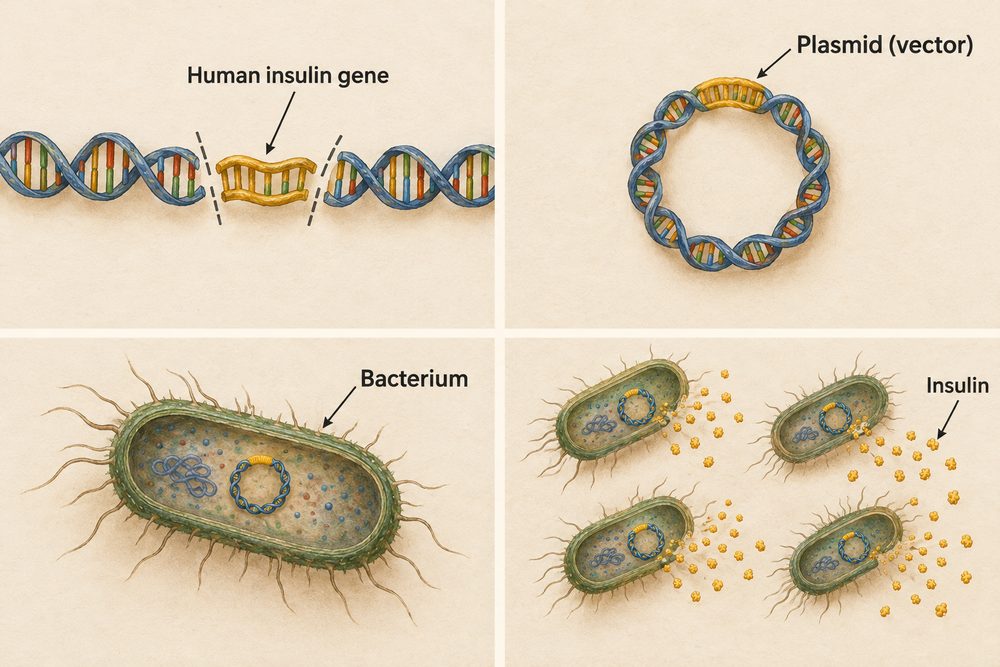
The steps of genetic engineering: (1) The desired gene is identified and cut out using restriction enzymes. (2) The gene is inserted into a vector (e.g. a bacterial plasmid or virus). (3) The vector carries the gene into the target organism's cells. (4) The target organism now expresses the new gene and produces the desired protein.
A key example is the production of human insulin by bacteria. The human insulin gene is inserted into bacterial plasmids, and the bacteria are grown in fermenters to produce large quantities of insulin for treating diabetes.
Cloning
Cloning produces genetically identical copies of an organism. There are different types:
Plant cloning (tissue culture): Small groups of cells are taken from a plant and grown in a sterile growth medium containing nutrients and plant hormones. Each group develops into a genetically identical plant. This is used to produce large numbers of rare or desirable plants quickly.
Animal cloning (adult cell cloning): This was used to create Dolly the sheep in 1996. The nucleus from an adult body cell is inserted into an enucleated (nucleus removed) egg cell. An electric shock stimulates the egg to divide, and the embryo is implanted into a surrogate mother. The offspring is genetically identical to the adult that donated the nucleus.
Gregor Mendel (1860s) discovered the basic laws of inheritance by studying pea plants. He proposed the idea of "hereditary units" (now called genes) that are passed from parents to offspring. His work was not recognised until the early 1900s because the mechanism of inheritance (chromosomes and DNA) had not yet been discovered.
Watson and Crick (1953) worked out the double helix structure of DNA, building on X-ray diffraction data produced by Rosalind Franklin and Maurice Wilkins. Their model showed how DNA could carry the genetic code and replicate itself.
The Human Genome Project (completed 2003) mapped the entire sequence of human DNA. This has enabled scientists to identify genes linked to diseases, develop gene therapies, and understand human evolution.
Dolly the sheep (born 1996) was the first mammal cloned from an adult cell. This proved that a differentiated adult cell still contains all the genetic information needed to produce an entire organism.