Trophic Levels and Transfer of Biomass
Trophic Levels
In an ecosystem, organisms can be classified according to their trophic level — their position in the food chain. Energy enters most ecosystems as sunlight, which producers (plants) convert into chemical energy through photosynthesis. This energy then passes from one trophic level to the next as organisms feed on each other.
Trophic level 1 = producers (plants/algae). Trophic level 2 = primary consumers (herbivores). Trophic level 3 = secondary consumers (carnivores that eat herbivores). Trophic level 4 = tertiary consumers (top predators).
Biomass is the mass of living material at each trophic level. It decreases at each successive level because not all the biomass from one level is transferred to the next. This can be represented using a pyramid of biomass.
Why Biomass Transfer Is Inefficient
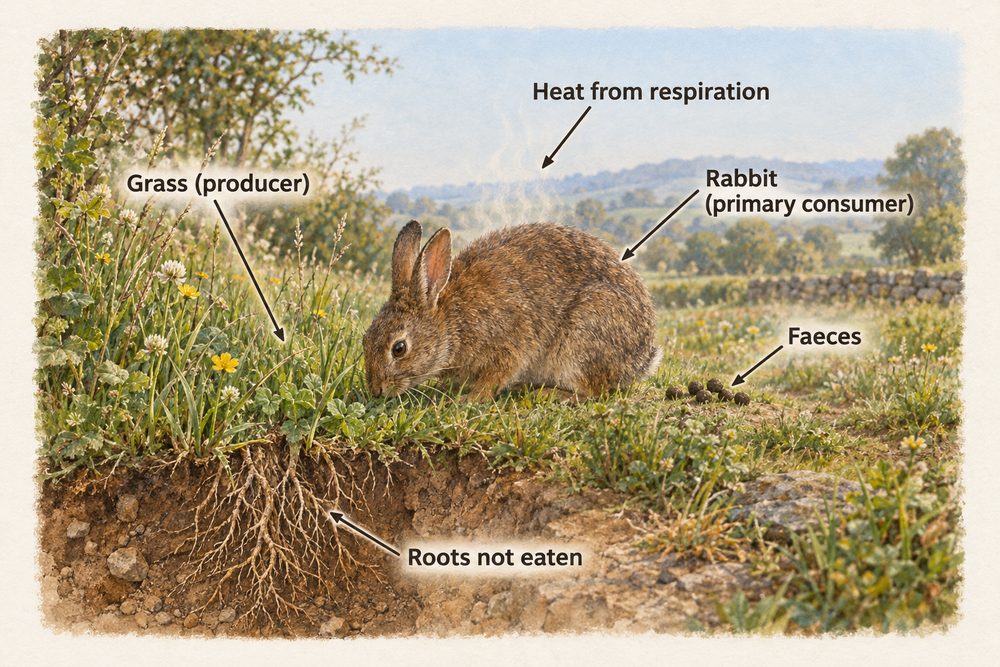
At each trophic level, only a small proportion of the biomass is transferred to the next level. Approximately 10% of the biomass at one level is passed on. The rest is lost because:
- Not all parts of organisms are eaten (e.g. roots, bones, feathers).
- Some material is lost in excretory products such as faeces, urine, and carbon dioxide.
- A large proportion of biomass is used in respiration to release energy for life processes. This energy is ultimately lost as heat to the surroundings.
The efficiency of biomass transfer between trophic levels can be calculated using: $$\text{Efficiency} = \frac{\text{Biomass transferred to next level}}{\text{Biomass at previous level}} \times 100$$
Example: Grass contains 50,000 kJ of energy. Rabbits that eat the grass contain 5,000 kJ. Calculate the efficiency of transfer.
$$\text{Efficiency} = \frac{5000}{50000} \times 100 = 10\%$$
This means 90% of the energy was lost between these trophic levels — through respiration, excretion, and uneaten material.
Implications for Food Production
Because biomass transfer is so inefficient, food chains are usually short (3–5 trophic levels). There simply isn’t enough energy left to support more levels. This has important implications for human food production.
The efficiency of food production can be improved by reducing the number of trophic levels. Eating plants directly (as primary consumers) is more efficient than eating animals that have eaten plants (secondary consumers), because less energy is lost through respiration at fewer trophic levels.
Some farmers use intensive farming methods to increase the efficiency of energy transfer to animals:
- Restricting movement — animals are kept in confined spaces so they use less energy on movement, meaning more energy goes into growth (meat production).
- Controlling temperature — heated or insulated buildings mean animals lose less energy keeping warm.
- High-energy feeds — carefully formulated diets maximise growth rates.
However, these methods raise ethical concerns about animal welfare. Many people argue that animals should be free to exhibit natural behaviours, even if this reduces farming efficiency.
Eating plants directly is more energy-efficient than eating meat because fewer trophic levels means less energy lost through respiration. For every 100 kJ of energy in grain, only about 10 kJ reaches a human who eats an animal that ate the grain. A human who eats the grain directly gets far more of that 100 kJ, because one trophic level is cut out.