Decomposition, Food Security and Biotechnology
Decomposition
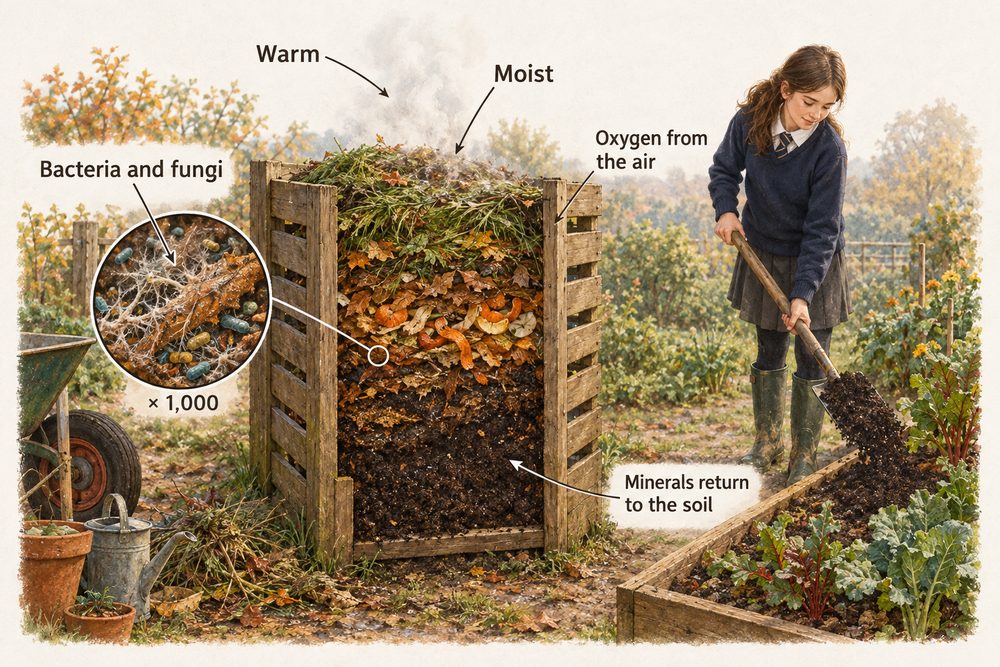
Decomposers are organisms — mainly bacteria and fungi — that break down dead plant and animal matter, returning nutrients and minerals to the soil. This process is essential for recycling materials in ecosystems and keeping nutrient cycles running.
The rate of decomposition is affected by temperature (higher temperatures increase enzyme activity up to the optimum), water availability (decomposers need moisture), oxygen availability (many decomposers respire aerobically), and the number of decomposers present.
Gardeners and farmers use decomposition to their advantage through compost. Garden waste and food scraps are collected in compost bins where decomposers break them down over weeks or months. The resulting compost is rich in minerals and can be added to soil to improve fertility.
In separate GCSE Biology you may be asked to describe an investigation into the effect of temperature on the rate of decay. A common method uses milk and lipase enzyme with a pH indicator:
- Milk mixed with lipase and a pH indicator (such as cresol red) is placed in water baths at different temperatures.
- As lipase breaks down the fat in milk, fatty acids are produced and the pH drops, causing a colour change in the indicator.
- The time taken for the colour change is recorded. A shorter time indicates a faster rate of decomposition.
Food Security
Food security means having enough food to feed a population at all times. The world’s population is growing rapidly, and several factors threaten our ability to produce enough food.
Threats to food security include:
- Increasing birth rate — the global population is expected to reach about 9.7 billion by 2050, requiring significantly more food.
- Changing diets — as countries develop economically, people eat more meat, which is less energy-efficient than eating plants.
- New pests and pathogens — crop diseases and invasive species can destroy harvests.
- Environmental change — climate change alters rainfall patterns and temperatures, reducing yields in some regions.
- Cost of agricultural inputs — rising prices of fuel, fertiliser, and seeds affect farmers’ ability to produce food.
- Conflicts — wars disrupt farming, supply chains, and food distribution.
Sustainable food production means producing enough food for current needs without damaging the environment or reducing the ability of future generations to produce food. This requires balancing yield, environmental protection, and resource management.
Biotechnology
Biotechnology uses living organisms or their products to make useful substances. Modern biotechnology can help address food security challenges.
Mycoprotein is a high-protein food produced from the fungus Fusarium venenatum. The fungus is grown in large fermenters using glucose syrup as a food source. The resulting biomass is processed into a meat substitute (sold as Quorn™). This is more efficient than rearing animals because:
- The fungus grows rapidly and can be harvested continuously.
- It requires less land and water than livestock farming.
- It produces fewer greenhouse gas emissions.
Several approaches can help improve food security sustainably:
- Biological control: Using natural predators to control pests instead of chemical pesticides.
- Genetically modified crops: Engineering crops to resist disease, tolerate drought, or produce higher yields.
- Hydroponics: Growing plants without soil, using mineral nutrient solutions. This can be done indoors, using less water and space.
- Reducing food waste: Improving storage, transportation, and distribution to prevent food being lost before it reaches consumers.
Mycoprotein (Quorn™) is produced by growing Fusarium fungus in aerobic conditions with glucose syrup. It is high in protein and fibre, and lower in fat than meat.