Hormones in Reproduction and Contraception
Hormones and the Menstrual Cycle
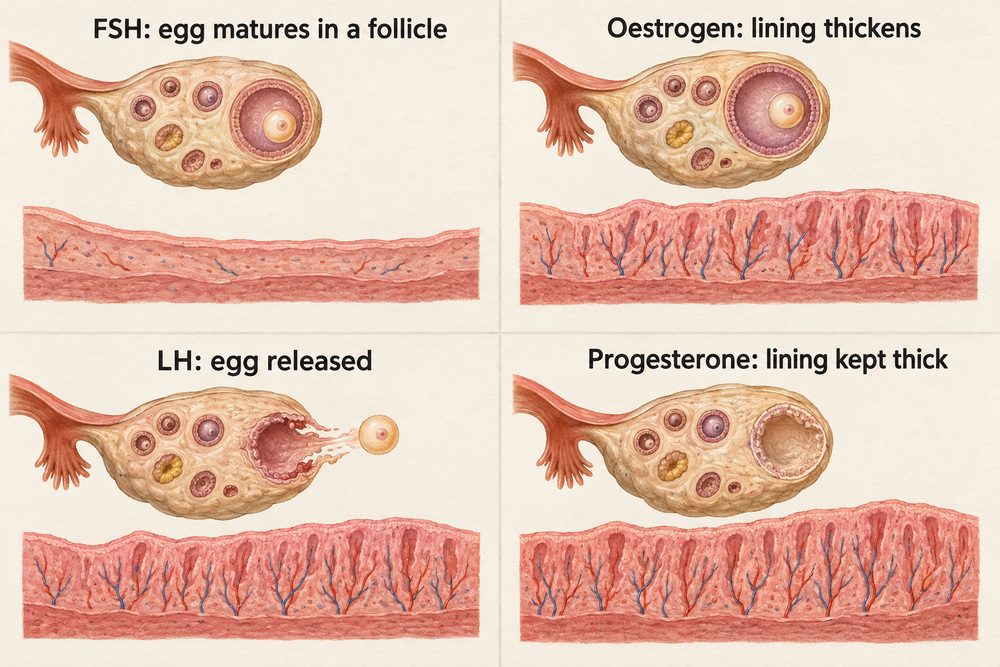
The menstrual cycle is a roughly 28-day cycle controlled by four key hormones that interact through feedback mechanisms:
- FSH (follicle-stimulating hormone) — released by the pituitary gland. It causes an egg to mature in a follicle in the ovary and stimulates the ovaries to produce oestrogen.
- Oestrogen — produced by the ovaries. It causes the uterus lining to thicken and build up with blood vessels. At high levels, it stimulates LH release and inhibits FSH.
- LH (luteinising hormone) — released by the pituitary gland. A surge of LH triggers ovulation around day 14.
- Progesterone — produced by the empty follicle after ovulation. It maintains the uterus lining. If no fertilisation occurs, progesterone levels drop, the lining breaks down, and menstruation begins.
The menstrual cycle: FSH (matures egg + stimulates oestrogen) → Oestrogen (thickens lining + triggers LH surge) → LH (triggers ovulation on day 14) → Progesterone (maintains lining). All four hormones interact via feedback.
Contraception
Contraception can be hormonal or non-hormonal:
Oral contraceptive pill — contains hormones (oestrogen and/or progesterone) that inhibit FSH production, preventing egg maturation and ovulation. The combined pill uses both hormones; the progesterone-only pill has fewer side effects.
Contraceptive injection, implant or skin patch — release progesterone slowly over weeks or months, providing long-term contraception without daily action.
Intrauterine device (IUD) — a device inserted into the uterus. Hormonal IUDs release progesterone; copper IUDs are non-hormonal and prevent implantation.
Barrier methods — condoms (male and female) and diaphragms physically prevent sperm from reaching the egg. Condoms also protect against sexually transmitted infections (STIs).
Spermicidal agents — chemicals that kill or disable sperm, often used with barrier methods.
Surgical methods — sterilisation (cutting or tying the fallopian tubes or vas deferens) is permanent and very effective.
Abstinence or natural family planning — avoiding intercourse during the fertile window. Less reliable than other methods.
Hormonal contraceptives work by inhibiting FSH (preventing egg maturation) and/or preventing ovulation. Only barrier methods (condoms) protect against both pregnancy and STIs.
Fertility Treatments
Some couples have difficulty conceiving. Fertility treatments include:
- FSH and LH injections — given to women who do not produce enough FSH naturally, stimulating egg maturation and ovulation.
- IVF (in vitro fertilisation) — the mother is given FSH and LH to stimulate multiple eggs, which are collected and fertilised with sperm outside the body. One or two embryos are then transferred to the uterus.
IVF raises ethical issues: it is emotionally and physically demanding, expensive, has a low success rate, and can result in multiple pregnancies. Unused embryos may be destroyed, which some people object to on moral or religious grounds.