Genetic Inheritance and Inherited Disorders
Alleles and Inheritance
Most characteristics are controlled by several genes working together (polygenic). Some characteristics are controlled by a single gene with two forms called alleles. You inherit one allele from each parent, giving you two alleles for each gene.
If the two alleles are the same, the individual is homozygous for that gene. If they are different, the individual is heterozygous. A dominant allele is always expressed when present (shown by a capital letter, e.g. B). A recessive allele is only expressed when two copies are present (bb).
Genotype = the combination of alleles (e.g. Bb). Phenotype = the physical characteristic expressed (e.g. brown eyes). Dominant alleles only need one copy to be expressed; recessive alleles need two copies (homozygous recessive).
Punnett Squares and Genetic Diagrams
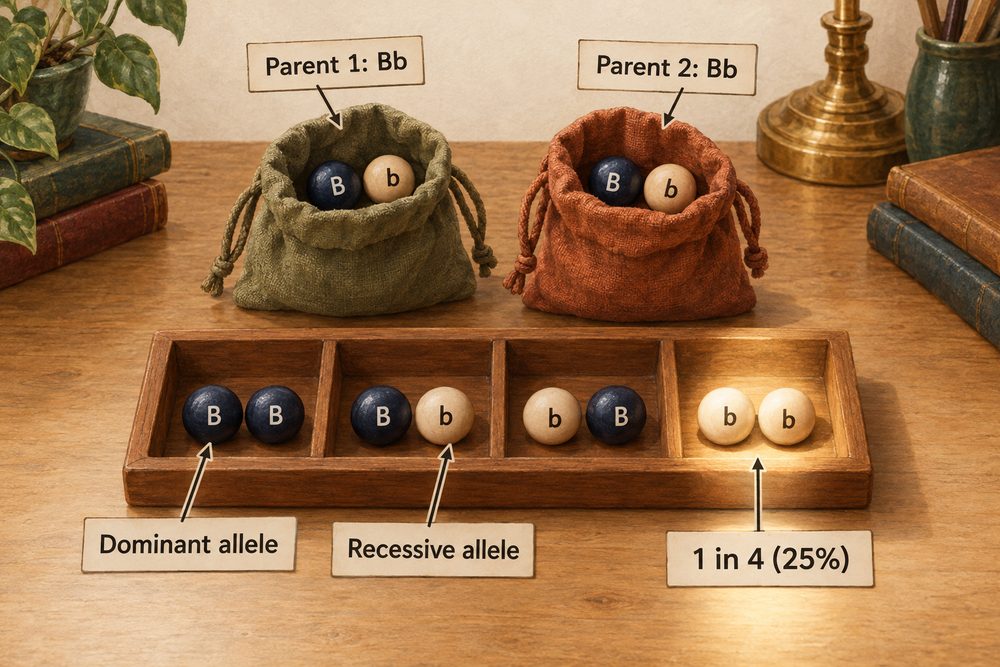
A Punnett square is used to show the possible combinations of alleles in offspring. For example, if both parents are heterozygous (Bb):
The offspring ratios would be: \(\frac{1}{4}\) BB, \(\frac{2}{4}\) Bb, \(\frac{1}{4}\) bb. This gives a 3:1 phenotype ratio (3 dominant : 1 recessive).
A couple are both carriers of cystic fibrosis (genotype Ff). What is the probability of their child having cystic fibrosis?
Parent genotypes: Ff × Ff. The Punnett square gives: FF, Ff, Ff, ff. Only ff has cystic fibrosis. So the probability is \(\frac{1}{4}\) or 25%. Note: each child has the same probability, regardless of previous children.
Inherited Disorders
Some disorders are caused by faulty alleles inherited from parents:
Cystic fibrosis is a disorder of cell membranes caused by a recessive allele (f). A person must inherit two copies (ff) to be affected. A carrier (Ff) has one copy but does not show symptoms. It causes thick, sticky mucus to build up in the lungs and digestive system.
Polydactyly is caused by a dominant allele. It causes extra fingers or toes. Only one copy of the dominant allele is needed to have the condition (Dd or DD).
Cystic fibrosis = recessive disorder (need ff to be affected; Ff = carrier). Polydactyly = dominant disorder (need only one D allele). Use Punnett squares to predict offspring ratios.
During IVF, embryos can be screened for genetic disorders before being implanted. This allows parents to select embryos that do not carry the faulty allele. However, embryo screening is controversial — some people argue it prevents suffering, while others believe it is unethical to select embryos or that it could lead to “designer babies.”
Sex Determination
In humans, sex is determined by the 23rd pair of chromosomes: XX = female, XY = male. A Punnett square shows there is a 50% chance of each sex. The Y chromosome carries the SRY gene, which triggers male development.