The Brain, the Eye and Temperature Control
The Human Brain
The brain is the most complex organ in the body. It is made of billions of interconnected neurones and is responsible for coordinating all of our actions, thoughts, and bodily functions.
The brain has three main regions: the cerebral cortex (conscious thought, memory, language), the cerebellum (balance and coordinated movement), and the medulla oblongata (unconscious functions like breathing and heart rate).
Scientists study brain function using several methods:
- Studying patients with brain damage — if a specific area is damaged and a particular function is lost, this reveals what that region controls.
- Electrical stimulation — stimulating different areas of the brain during surgery can trigger specific responses, mapping functions to locations.
- MRI scanning — magnetic resonance imaging shows which areas of the brain are active during different tasks by detecting changes in blood flow.
Brain surgery and treatment of brain disorders is difficult because the brain is extremely complex, neurones in the brain cannot easily regenerate, and damage to one area may have unpredictable knock-on effects.
The Eye
The eye is a sense organ that detects light. Light enters through the cornea, passes through the pupil, and is focused by the lens onto the retina at the back of the eye.
Cornea: Transparent front layer that refracts (bends) light as it enters the eye.
Iris: Coloured ring of muscle that controls the size of the pupil, regulating how much light enters.
Pupil: The hole in the centre of the iris through which light passes.
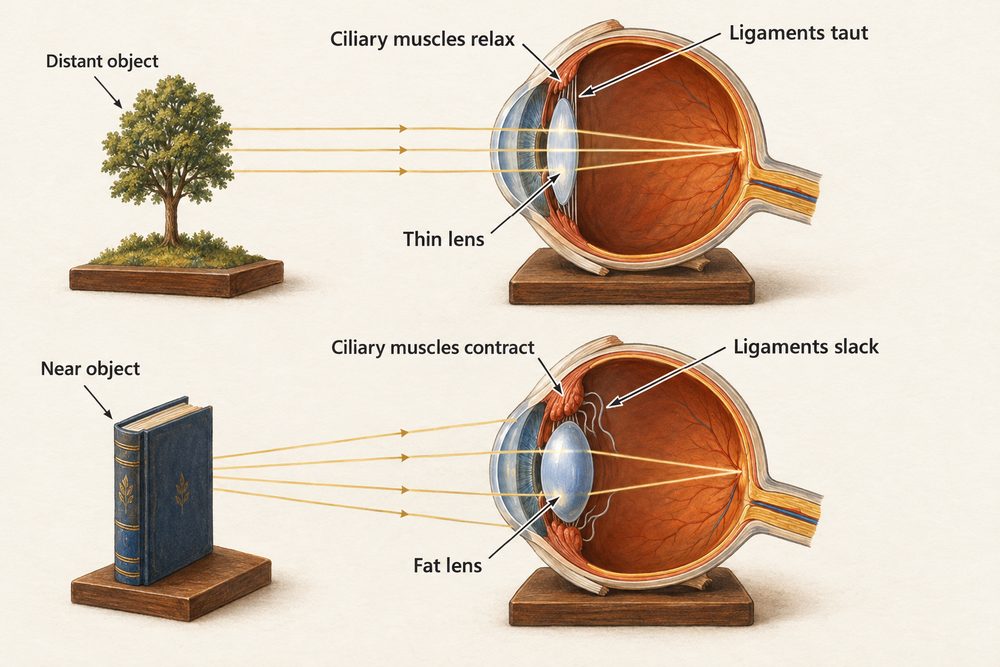
Lens: A transparent, flexible structure that changes shape to focus light on the retina. This is called accommodation.
Retina: The light-sensitive layer at the back containing receptor cells (rods for dim light, cones for colour vision).
Optic nerve: Carries electrical impulses from the retina to the brain.
Accommodation
The eye adjusts to focus on objects at different distances through accommodation:
- Distant objects: The ciliary muscles relax, the suspensory ligaments pull tight, and the lens is pulled thin and flat. This reduces refraction.
- Near objects: The ciliary muscles contract, the suspensory ligaments loosen, and the lens becomes thick and rounded. This increases refraction to focus close objects onto the retina.
Myopia (short-sightedness) is corrected with a concave (diverging) lens. Hyperopia (long-sightedness) is corrected with a convex (converging) lens. Both conditions can also be treated with laser eye surgery or replacement lens surgery.
Myopia (short-sightedness): The eyeball is too long or the lens is too curved, so light focuses in front of the retina. Distant objects appear blurry. Corrected with a concave lens.
Hyperopia (long-sightedness): The eyeball is too short or the lens cannot become curved enough, so light focuses behind the retina. Close objects appear blurry. Corrected with a convex lens.
Both conditions can also be treated with contact lenses, laser eye surgery (reshaping the cornea), or replacement lens surgery.
Temperature Control (Thermoregulation)
The human body maintains a core temperature of approximately 37 °C. This is controlled by the thermoregulatory centre in the hypothalamus, which monitors the temperature of the blood flowing through it and receives impulses from temperature receptors in the skin.
Body temperature is maintained at 37 °C because this is the optimum temperature for enzymes. If the core temperature deviates significantly, enzymes may denature and metabolic reactions slow down or stop.
When the body is too hot:
- Blood vessels near the skin surface vasodilate (widen), increasing blood flow near the surface and heat loss by radiation.
- Sweat glands produce more sweat, which evaporates from the skin surface and transfers heat energy to the environment.
When the body is too cold:
- Blood vessels near the skin surface vasoconstrict (narrow), reducing blood flow near the surface and minimising heat loss.
- Skeletal muscles contract rapidly (shivering), generating heat through increased respiration.